
This Was Never About a Pipeline
I gave the CBC ten minutes. They aired ten seconds.
The ten seconds they chose had me saying that the pipeline announcement “is a means by which the
federal and provincial governments are trying to extinguish the independence movement.” That’s a real
thing I said, and I stand behind it. But stripped of everything around it, it lands as a grievance — a man in a
truck stop grumbling that even good news is a plot. That isn’t the interview I gave. It’s the interview they
built. So let me give you the other nine minutes and fifty seconds.
The reporter asked me whether I thought the pipeline announcement would reduce separation sentiment in
Alberta. It’s a fair question if you believe the movement is a mood — a temperature that rises when Ottawa
slights us and falls when it throws us a bone. But that framing gets the whole thing backwards, and my
answer said so: this is not about separation. It is about self-determination. Why should Alberta have to beg
for projects — beg for the scraps of Confederation? Isn’t Canada supposed to be a country where we work
together to build prosperity?
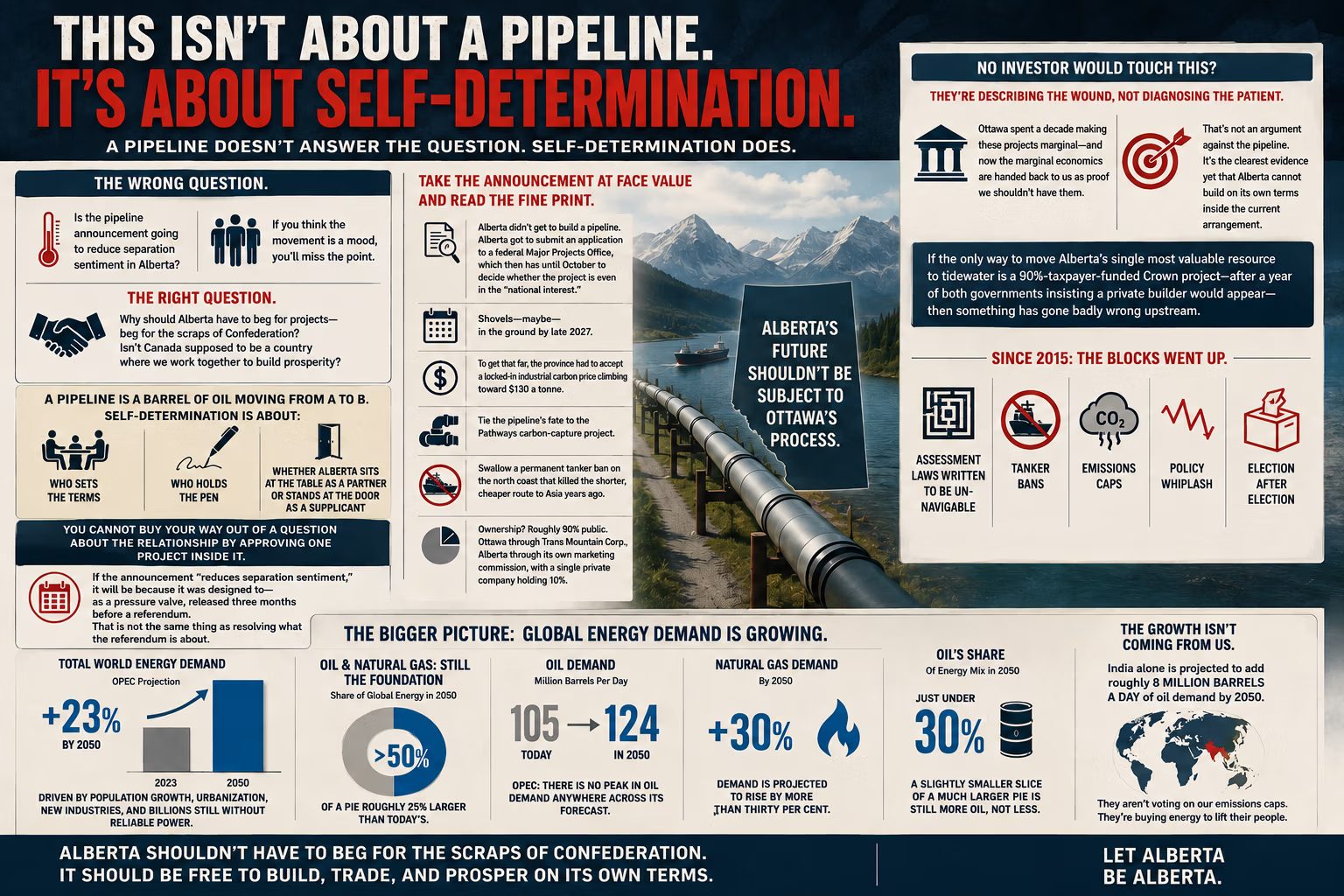
A pipeline doesn’t answer that question. A pipeline is a barrel of oil moving from A to B.
Self-determination is about who sets the terms, who holds the pen, and whether Alberta sits at the table as
a partner or stands at the door as a supplicant. You cannot buy your way out of a question about the
relationship by approving one project inside it. If the announcement “reduces separation sentiment,” it will
be because it was designed to — as a pressure valve, released three months before a referendum. That is
not the same thing as resolving what the referendum is about.
Take the announcement at face value and read the fine print. Alberta didn’t get to build a pipeline. Alberta
got to submit an application to a federal Major Projects Office, which then has until October to decide
whether the project is even in the “national interest.” Shovels — maybe — in the ground by late 2027. To
get that far, the province had to accept a locked-in industrial carbon price climbing toward $130 a tonne,
tie the pipeline’s fate to the Pathways carbon-capture project, and swallow a permanent tanker ban on the
north coast that killed the shorter, cheaper route to Asia years ago. And the ownership? Roughly ninety per
cent public. Ottawa through Trans Mountain Corp., Alberta through its own marketing commission, with a
single private company holding ten.
On the same CBC segment that used my ten seconds, the argument I heard next came from the Pembina
Institute: that global oil demand is going to fall, that no private proponent stepped forward because the
business case is thin, and that taxpayers will be left holding a stranded asset. Here’s the thing. On the
narrow economics, they might even be partly right — and that is exactly my point.
If the only way to move Alberta’s single most valuable resource to tidewater is a ninety-per-cent
taxpayer-funded Crown project — after a year of both governments insisting a private builder would
appear — then something has gone badly wrong upstream. Private capital didn’t vanish because Alberta’s
oil stopped being worth anything. It backed away from a regulatory environment built on purpose, and
built since 2015 — the year Justin Trudeau took Ottawa and Rachel Notley took Edmonton, and the year
the blocks started going up: assessment laws written to be un-navigable, tanker bans, emissions caps, and
the constant policy whiplash that makes any thirty-year investment a coin flip on the next election. So
when critics say “no investor would touch this,” they are describing the wound, not diagnosing the patient.
Ottawa spent a decade making these projects marginal, and now the marginal economics are handed back
to us as proof we shouldn’t have them. That’s not an argument against the pipeline. It’s the clearest
evidence yet that Alberta cannot build on its own terms inside the current arrangement — that even our
strongest hand has to be played through a federal process that can stall it, condition it, or veto it outright.
That still leaves the Pembina Institute’s deeper claim: that even if Alberta builds this pipeline, the world
will stop wanting what flows through it just as the last weld cools. It sounds authoritative. It is also a
choice about which forecast you decide to believe, and the evidence does not break the way they need it to.
Start with the whole picture — because that’s what I was actually getting at in the interview. Global energy
demand is not shrinking. It is growing. OPEC projects total world energy demand rising about 23 per cent
by 2050, driven by expanding populations, urbanization, new energy-hungry industries like AI, and
billions of people who still have no reliable power at all. The honest question was never whether the world
will use less energy. It’s which fuels feed a bigger appetite. And on that, the numbers are stubborn: oil and
natural gas together are still projected to supply more than half of all global energy in 2050 — half of a
pie roughly a quarter larger than today’s.
Translate that into barrels and cubic feet. OPEC’s latest World Oil Outlook has oil demand climbing to
roughly 124 million barrels a day by 2050, up from about 105 million today, and states flatly that there is
no peak in oil demand anywhere across its forecast. Natural gas does even better — demand is projected to
rise by more than thirty per cent. Oil’s share of the energy mix slips a point or two, to just under thirty
per cent, but a slightly smaller slice of a much larger pie is still more oil, not less. And the growth isn’t
coming from us. It comes from India, Southeast Asia, Africa and the Middle East, where billions are
climbing out of energy poverty and buying their first vehicle. India alone is projected to add roughly eight
million barrels a day of new demand — many times what this entire pipeline would ever carry. That is not
a fuel in retreat.
I’ll be honest about the disagreement, because my case is strong enough that I don’t need to hide it. The
International Energy Agency is more conservative: it sees demand plateauing near 105 to 106 million
barrels a day later this decade rather than climbing to 124. But look closely at even that number — it’s a
plateau, not a collapse. The steep decline that the entire “stranded asset” warning depends on shows up in
exactly one place: the IEA’s Net-Zero scenario. And that scenario is not a prediction of what will happen. It
is a model of what would have to happen if every major economy hit its most aggressive climate targets, on
schedule, without fail. That single assumption is doing all the work in Pembina’s argument. Pull it out, and
the stranded asset vanishes.
So how is that assumption holding up? Look around. In August 2025, Germany — the poster child of the
energy transition — put two North Sea sites up for offshore wind development and received not a single
bid. It then shrank its 2026 offshore tenders and opened a review of its own targets; its installed offshore
capacity hadn’t grown at all through the first half of that year. BP has pulled back from renewables to
refocus on oil and gas. TotalEnergies put its German offshore wind business under strategic review. The
United States suspended offshore wind projects under construction off its East Coast. Across the
developed world, the “cheaper, cleaner, inevitable” transition keeps colliding with cost, supply chains, and
physics.
None of this means renewables have no place — they do. Where there’s a genuine economic case, build
them; renewables are well suited to augmenting supply, often at the level of an individual home or
operation. What they are not ready to do — not yet, not without the subsidies propping them up — is carry
mass primary energy supply. And that is the heart of it: the one specific future the Pembina Institute needs
Albertans to believe in — the one where the world abandons oil fast enough to strand a pipeline that
wouldn’t finish until 2034 — is the least likely future on the table, and it’s getting less likely every quarter.
They are asking us to leave transformational wealth in the ground today to hedge against a scenario the
market itself is walking away from.
And that brings me to the part of their argument I find hardest to take seriously. They warn that the
pipeline leans on public money — and it does, roughly ninety per cent of it. But the entire industry they’re
defending doesn’t merely lean on taxpayers. It would not exist without them. Look at what Canadians have
already been asked to fund. The Parliamentary Budget Officer put the public subsidies for just three EV
battery plants — Volkswagen in St. Thomas, Stellantis-LG in Windsor, and Northvolt in Quebec — at
about $43.6 billion, the bulk of it straight production subsidies. Fold in Honda’s project and the rest of the
supply chain and the green-industrial commitments cleared $50 billion in barely two years. Sitting on top
of that is an entire architecture built to make projects pencil that otherwise wouldn’t: federal Clean
Investment Tax Credits for wind, solar, and clean electricity; a Clean Hydrogen credit worth up to forty per
cent; a carbon-capture credit; and the $15-billion Canada Growth Fund. And remember what happened in
Germany the moment the subsidy was stripped out — an offshore wind auction that drew zero bids. That
tells you what’s actually holding the sector up.
Now weigh the two against each other honestly. A pipeline is something the Prime Minister himself calls a
profitable asset — it ships a product the world pays for and collects tolls for decades. A great deal of that
green spending is money out the door with no toll booth at the end. By the PBO’s own math, the
Volkswagen and Stellantis plants will take twenty-plus years just to break even, if they ever do.
Northvolt, carrying billions in Canadian public commitments, went bankrupt. Honda’s
fifteen-billion-dollar plan was put on hold. GM idled its electric-van line in Ingersoll. Those are the
stranded assets that already happened — funded by the very taxpayers Pembina has suddenly discovered a
concern for. So here is the question I’d put back to them. Why do we interrogate every public dollar behind
a pipeline that sells the one thing Alberta makes better than almost anywhere on earth, while waving
through fifty billion for battery plants that are pausing, idling, and going bankrupt? Why is taxpayer risk a
scandal when it backs a barrel of oil and a virtue when it backs the alternative? It was never the risk they
objected to. It’s the product.
And then there is the Premier herself. Danielle Smith named her signature legislation the Alberta
Sovereignty within a United Canada Act. Watch what she actually did this week and ask yourself where
the sovereignty is. She did not build a pipeline — she filed a request with a federal office and now waits on
Ottawa’s verdict. She did not set Alberta’s climate policy — she accepted a federally-blessed carbon price
marching toward $130 a tonne. She did not choose Alberta’s route to tidewater — the northern one was
taken off the table years ago, and she was left with the corridor Ottawa would tolerate and a Crown
structure Ottawa would own. Every time the Premier sets out to demonstrate that Alberta can be sovereign
within a united Canada, she demonstrates the opposite: that on the decisions that matter most, Alberta still
needs permission. “Sovereignty within a united Canada” is not a strategy — it is a contradiction, and this
pipeline is the proof of it. You cannot be sovereign and still be waiting by the phone for a federal
designation on the first of October. What she has shown us, again, is not that a sovereign Alberta is
thriving inside Confederation. It is that a sovereign Alberta, on these terms, is not possible at all.
Whenever self-determination comes up, someone asks: but how would an independent Alberta ever
negotiate to move its oil to a coast it doesn’t control? It’s a serious question and it deserves a serious
answer. But notice what it assumes — that the negotiation only becomes hard after independence. That
right now, inside Confederation, with every federal-provincial lever supposedly available to us, things
basically work. They don’t.
Look at what you just watched. It took a memorandum of understanding, a
carbon-price concession, a dependency on carbon capture, an abandoned northern route, a federal office
with a veto, and years of runway just to propose a pipeline. That is the negotiation happening now, on the
inside, and it is going badly. It has been going badly for the better part of two decades — every major
project dragged through hoops that would be laughable if the stakes weren’t so high. So yes, worry about
how Alberta would negotiate at a table it doesn’t yet sit at. But worry first about the table we’re at today,
where we’ve learned that even a “yes” arrives wrapped in conditions and delay. Self-determination isn’t a
fantasy about escaping negotiation. It’s about changing what we’re negotiating with — and negotiating
from a position of ownership rather than permission.
That’s why the announcement doesn’t touch the question. The independence movement in Alberta — the
self-determination movement, if you’ll let me name it properly — is not a lever that gets pulled when a
pipeline stalls and released when one gets approved. It’s a question about whether a province that generates
this much of the country’s wealth should have to keep asking for permission to prosper. I said Ottawa and
the province are trying to extinguish that question, and I meant it. You extinguish a movement by giving it
just enough that people stop asking the deeper question — a single pipeline, three months before a vote.
But the deeper question outlives the announcement, because it was never about the pipeline. It’s about
whether Canada is a partnership of equals working toward shared prosperity, or an arrangement where one
province is expected to be grateful for the scraps.
On October 19th, Albertans get to answer that themselves. That’s not a threat. That’s what
self-determination looks like — people, deciding, out loud.
— Christopher Scott
Let’s Talk Alberta
Sources & further reading
- Government of Alberta, “West Coast Oil Pipeline” (project page — submission, route, timeline, $18.3M planning spend).
https://www.alberta.ca/west-coast-oil-pipeline - The Canadian Press / Times Colonist, “Alberta submits plans and announces partners for new pipeline to B.C. coast,” Jul 3, 2026
(Bruderheim–Delta route; $35.2–$43.7B; Trans Mountain and Pembina Pipeline partners).
https://www.timescolonist.com/local-news/carney-to-meet-with-eby-in-as-smith-plans-pipeline-announcement-12499581 - Canada’s National Observer, “Government-owned Trans Mountain to lead $35–44 billion oil pipeline to BC Lower Mainland,” Jul 2,
2026 (Pembina Institute’s “alarm bells” critique; Pembina Pipeline 10% stake).
https://www.nationalobserver.com/2026/07/02/news/trans-mountain-new-pipeline-west-coast - The Energy Mix, “‘90% Public Ownership’ Announced For West Coast Pipeline” (roughly 90% public ownership; Pembina Institute
is a think tank distinct from Pembina Pipeline Corp.).
https://www.theenergymix.com/90-public-ownership-as-carney-smith-announce-new-pipeline-into-declining-global-oil-market/ - EnergyNow, “Alberta Set to Reveal Next Move on Proposed West Coast Oil Pipeline” (May 2026 agreement; carbon price rising to
$130/tonne by 2040; Pathways carbon-capture linkage).
https://energynow.ca/2026/07/alberta-set-to-reveal-next-move-on-proposed-west-coast-oil-pipeline/ - Global News, “New pipeline from Alberta to B.C. coast to be built as a private-public partnership” (Carney–Eby MOU; North Coast
tanker ban preserved).
https://globalnews.ca/news/11949863/alberta-oil-pipeline-announcement-danielle-smith/ - CBC News, “Alberta pitches southern route for West Coast pipeline, with a price tag of $35B or more,” Jul 3, 2026 (Severson-Baker
on public funding and electrification; “remains to be negotiated”).
https://www.cbc.ca/news/canada/calgary/alberta-pipeline-proposal-ottawa-major-projects-9.7254251 - The Energy Mix, “West Coast Pipeline to Receive ‘Political Support’ from Carney Deal with Alberta” (IEA and Canada Energy
Regulator decline scenarios underpinning the “stranded asset” argument).
https://www.theenergymix.com/west-coast-pipeline-to-receive-political-support-from-carney-deal-with-alberta/ - CBC News, “Taxpayers could be on hook for West Coast pipeline, but it’s a ‘good investment’: Energy minister” (Carney: “another
very profitable pipeline”; Minister Hodgson).
https://www.cbc.ca/news/politics/taxpayers-could-be-on-hook-for-west-coast-pipeline-but-it-s-a-good-investment-energy-minister-9.72
58006 - The Astana Times, “OPEC Sees Global Oil Demand Rising to 124 Million Barrels Per Day by 2050,” Jul 2026 (World Oil Outlook
2026: oil to ~124 mb/d; no peak; oil+gas ~54% of the mix; primary energy +23%, ~312®383 Mboe/d; India +8.1 mb/d).
https://astanatimes.com/2026/07/opec-sees-global-oil-demand-rising-to-124-million-barrels-per-day-by-2050/ - OPEC, World Oil Outlook 2025 (“no peak in oil demand”; global energy demand +23% to 2050; ~$18.2T oil-sector investment
required); and OPEC press release, Nov 14, 2025 (GECF Global Gas Outlook: gas demand +32% by 2050).
https://publications.opec.org/woo - Forbes, “Will Oil Demand Hit 123 Million Barrels Per Day By 2050 As OPEC Says?” Jul 19, 2025 (IEA sees oil peaking near
105–106 mb/d around 2029, then a marginal decline).
https://www.forbes.com/sites/gauravsharma/2025/07/19/will-oil-demand-hit-123-million-barrels-per-day-by-2050-as-opec-says/ - Clean Energy Wire, “No bids in German offshore wind auction for first time,” Aug 6, 2025 (zero-subsidy North Sea auction drew no
bids).
https://www.cleanenergywire.org/news/no-bids-german-offshore-wind-auction-first-time-industry-association
Let’s Talk Alberta · Christopher Scott 6 - Bloomberg via gCaptain, “Germany Shrinks Wind Auctions After Last Round Attracted No Bids,” Dec 5, 2025 (2026 offshore
tenders cut to 2.5–5 GW; reassessment of targets; U.S. suspends East Coast offshore wind).
https://gcaptain.com/germany-shrinks-wind-auctions-after-last-round-attracted-no-bids/ - Offshore Magazine, “Germany receives no bids in zero-subsidy offshore wind auction,” Aug 8, 2025 (BP pulling back to oil and gas;
TotalEnergies strategic review of German offshore wind).
https://www.offshore-mag.com/renewable-energy/news/55308675/germany-receives-no-bids-in-zero-subsidy-offshore-wind-auction - CBC News, “EV battery deals to cost $5.8B more due to lost corporate tax on subsidies, budget officer says,” Nov 17, 2023 (PBO:
~$43.6B over 10 years for Volkswagen, Stellantis-LGES and Northvolt; ~$32.8B production subsidies; 20+ year break-evens).
https://www.cbc.ca/news/politics/federal-provincial-ev-investments-pbo-1.7031398 - CBC News, “Canada’s multibillion-dollar bets on the EV industry aren’t all working out,” May 13, 2025 (Northvolt bankruptcy;
Honda project on hold; GM idles Ingersoll BrightDrop line; PBO revises VW support to ~$16.3B).
https://www.cbc.ca/news/canada/ev-investments-canada-facts-1.7533719 - The Hub, “$57 billion to EV automakers: good investment or risky gamble?” Apr 2024 (combined federal/provincial
EV-manufacturing subsidy commitments totalling roughly $50–$52 billion).
https://thehub.ca/2024/04/25/40-billion-to-ev-automakers-good-investment-or-risky-gamble/ - Government of Canada, Budget 2023, Chapter 3, and Borden Ladner Gervais, “Canada’s clean economy ITCs” (Clean Technology
ITC 30%; Clean Electricity ITC 15%; Clean Hydrogen ITC up to 40%; CCUS and Clean Tech Manufacturing ITCs).
https://www.budget.canada.ca/2023/report-rapport/chap3-en.html - Natural Resources Canada, “Policy Ecosystem” (Canada Growth Fund: a $15-billion arm’s-length public fund to de-risk private
clean-energy investment).
https://natural-resources.canada.ca/energy-sources/clean-fuels/hydrogen-strategy/policy-ecosystem

Thank you Chris Scott. Excellent article. An Independent Alberta is the only solution to the Federal control of Alberta’s resources.
Love it!!! Absolutely brilliant!!!
Thanks for being such a huge advocate for Alberta Independence.
With people like you leading the charge we will be free & prosperous!!!
Keep up the great work!!
To the point thank you Chris
Andy Hartung
Christopher Scott Your article unintentionally makes the deeper problem clearer than you intended. What you describe as democratic friction is increasingly treated as illegitimate the moment it constrains the political outcome your movement prefers. Consultation becomes paralysis. Judicial review becomes lawfare. Shared jurisdiction becomes permission. Regulation becomes ideological warfare. Negotiation becomes humiliation. Competing sovereignty claims become obstruction. But large modern societies are built on those tensions. Courts, provinces, Indigenous nations, regulators, investors, municipalities, environmental concerns, and competing democratic mandates are not proof that governance has failed. They are proof that no single actor governs alone. That is why the Alberta-as-singular-will framing is such a problem. Alberta is not politically uniform now, and it would not become uniform after separation. The same conflicts would remain, including energy, environment, Indigenous sovereignty, urban-rural tensions, redistribution, constitutional authority, investor pressure, and internal disagreement. They would not disappear. They would simply become Alberta’s responsibility. The world does not become simpler once power moves closer. It simply becomes your responsibility. And that is the contradiction running through the whole piece. This reads less like frustration with Ottawa specifically, and more like frustration with the existence of negotiated constraints on political will itself. Once a movement hardens around that logic, almost any friction can be recast as illegitimate. Then even partial victories stop resolving tension and start serving the movement’s continuation. So the real question is not whether Alberta can escape negotiation. It cannot. The real question is whether the movement can tolerate a political reality in which no one gets to govern without compromise and be completely transparent about what they are and have become.
Very well written and explained Chris.
I hope you keep up the fight, Alberta needs you and more like you. Thank you🙏
Great article Chris. Those of us that are aware of the government’s true motives behind this “pipeline” know it’s just that … a motive to quell the independence movement. It’s not working because they simply won’t, or don’t, understand what this movement is really about. We are done. Done with Ottawa. Simply … done. Throwing us a bone with a bunch of conditions attached, ain’t gonna cut it. I can’t wait to be free of the leash that Ottawa has on all Albertans.
Well done Chris Scott.
Great article. Independence all the way. Thank you
Now that’s a ten second response, we’ll played…
Excellent article Chris!