Every Reason to Stay Is a Reason to Leave: The Comprehensive Case for Alberta Independence
An honest answer to every argument Forever Canadian, federalists, academics, and establishment voices are making — for anyone who wants to make an informed decision in October
.
Compiled from essays at whistlestoptruckstop.ca/blog — including “What Business Have Ye With Me, Your Majesty?”, “Alberta Independence: Necessary and Inevitable,” “Alberta Independence: Rebuttal to a Failed Green Party Candidate’s Claims,” “Treaties Were Meant to Free People,” “Why First Nations Stand to Benefit the Most in an Independent Alberta,” and “Alberta and Ontario: GDP, Fiscal Balance, and Structural Risk in the Canadian Federation.”
If you’ve signed the Forever Canadian petition — or you’re thinking about it — this is for you. If you’ve read a Globe and Mail op-ed, watched a CBC panel, or scrolled past a friend’s Facebook post about why Alberta independence is “impossible,” “illegal,” or “economic suicide,” this is for you too.
An honest, comprehensive look at every major argument being made against Alberta independence — and why, once you trace each one back to its source, every single one strengthens the case for independence rather than weakens it.
Hopefully you’ll hear it out. Because what’s being defended isn’t what you’ve been told is being defended.
I. The Frame Almost Nobody Talks About
Canada was not founded. It was drafted in London.
The British North America Act, 1867 was written, debated, and enacted by the British Parliament under the supervision of the Colonial Office — not by Canadians, not by any democratic vote. Colonial delegates sent to London negotiated debt assumptions, customs duties, and senate allocations like shareholders settling the equity structure of a new company. Queen Victoria gave Royal Assent. The Dominion was born as a Crown franchise — a semi-autonomous colony whose preamble bound it “under the Crown of the United Kingdom of Great Britain and Ireland” forever, by design.
That’s not patriotic folklore. That’s the paperwork. I’ve traced it in detail in “What Business Have Ye With Me, Your Majesty?”
This frame matters because every single argument for staying in Canada assumes the existing framework is the ground floor of political reality. It isn’t. It’s the operating system of a 158-year-old imperial franchise. Every “benefit” Forever Canadian lists is a benefit of that franchise running smoothly. Every “risk” they claim Alberta faces by leaving is a description of what we don’t currently have — because we’re a subsidiary, not a nation.
Once you see that, the entire debate changes.
II. The Emotional Arguments — Reframed
These are the arguments you’ll hear at the coffee shop, at family gatherings, in the polling numbers. They’re not really economic or constitutional. They’re emotional appeals to continuity. Every one of them, on examination, defends the franchise.
Stability. The stability of a franchise is not the stability of a nation. What’s being defended is continuity of the operating system that has already cost Alberta decades of cancelled pipelines, rigged equalization formulas, and legislative attacks on our core industries. Since 2015, Canada has cancelled or obstructed over $150 billion in private investment in oil and gas projects. That isn’t stability. That’s the franchise extracting from one node to subsidize the others.
Certainty. The only thing certain under the current arrangement is that the terms get rewritten against Alberta whenever Ottawa feels like it. Independence means certainty we negotiate — for ourselves.
Accessibility / Portability. These only sound like arguments if you assume an independent Alberta would seal its borders. No serious independence advocate proposes that. Sovereign nations move people, goods, and capital across borders every day. Switzerland does it. Ireland does it. Norway does it.
Turn Key. “Turn key” is the language branch managers use about a corporate operating system. It’s reassurance, not analysis. Ask Albertans whose industries have been legislated against whether the current turn-key operation is working.
Reputation. Canada’s reputation is increasingly the Crown’s brand in decline. Alberta’s reputation as a productive, export-generating economy is ours — and we carry it with us.
Longevity. The franchise has been renewed many times. That’s not the same as the franchise being good. Empires have lasted centuries.
Camaraderie — sharing culture and values. This is Forever Canadian’s most emotionally resonant point, and it’s worth taking seriously. Right up until you remember that what’s being called “shared values” was engineered in 1867 as “French in law, British in allegiance.” Cartier brokered cultural pluralism as a strategy of control, not an expression of unity. Independence doesn’t end real camaraderie with Canadians. It ends the fiction that we need the Crown to mediate it.
Canadian Identity. Polling shows 92% of “definite stay” voters find their Canadian identity convincing as a reason to remain. That’s real — and it deserves respect. But identity is distinct from governance. Irish people didn’t stop being culturally connected to Britain when they became independent in 1922. Norwegians still share deep cultural ties with Swedes and Danes after leaving both unions. You don’t have to surrender who you are to change who governs you. In fact, writing our own constitution is how Alberta’s identity gets protected rather than slowly diluted by policies designed in Ottawa for Ottawa’s priorities.
Opportunity — future. Opportunity within the hierarchy is what’s being described. Cabinet portfolios, diplomatic posts, corporate directorships, Senate appointments — all flow to those who reinforce the franchise. The rewards pipeline hasn’t changed since Macdonald, Cartier, and Tupper received their KCMGs. Only the vocabulary has.
Equality — incomes and people. Alberta has the highest GDP per capita in Canada — roughly $96,600 compared to Ontario’s $71,700. We’re the largest net contributor to Confederation. We don’t receive equalization. In 2022 alone, Alberta sent roughly $22 billion more to Ottawa than it received back. The cumulative net transfer from 2007 to 2022 was approximately $244.6 billion. Extending that back to 1957 and adjusting for inflation yields roughly $1.3 trillion in 2025 dollars. Calling this arrangement “equality” is a semantic trick. Equality means symmetry. This is asymmetry that has run in one direction for generations.
Freedom / Rights. Rights granted by the Crown can be limited by the Crown. Charter Section 1 allows the government to suspend any right if the courts call the limit “reasonable.” The Oakes Test (1986) turned that into a legal framework for overriding Charter rights whenever a “pressing and substantial objective” is claimed. During COVID, the limits got exercised in real time — Ingram v Alberta (2023 ABKB 360) later confirmed many public health orders were never properly enacted in law. People were fined, arrested, and prosecuted under illegal orders. I was one of them. An independent Alberta would write its own constitution with rights that aren’t “subject to reasonable limits” — rights that are absolute, grounded in the people, not delegated from a sovereign in London.
Diversity — differences are strengths. Agreed — and an independent Alberta remains diverse. Indigenous, francophone, multi-generational settler, newcomer from every continent. What Forever Canadian is actually defending is a system of managed diversity, where the Crown sits above everyone as arbiter. Real diversity doesn’t need a referee seated in Ottawa.
Democracy — independent pillars. The Senate is unelected. The Supreme Court was a colonial appellate tribunal to the Judicial Committee of the Privy Council in London until 1949. The Governor General retains reserve powers. Provinces operate with delegated, not inherent, authority. What’s being called “democracy” is a hybrid system with monarchical bones. Independence would let Alberta build pillars that are actually answerable to Albertans.
III. The Practical “Alberta Will Fail” List — Reframed
Here’s what most of these points actually prove: Alberta currently doesn’t have the institutions of a nation because we’re a subsidiary, not a nation. The list isn’t a warning against independence. It’s the punch list for sovereignty.
“Landlocked and dependent on Canada for trade.” Switzerland. Austria. Kazakhstan. Paraguay. Botswana. Every one landlocked. Every one trading. Under the UN Convention on Transit Trade of Land-Locked States (1965), reaffirmed in Article 125 of the UN Convention on the Law of the Sea (1982), landlocked countries are legally guaranteed free access to international waters through neighbouring states. Canada is a signatory. That means an independent Alberta would have legal right to tidewater access through British Columbia or the United States. And BC gets roughly 90% of its refined fuel from Alberta pipelines. Vancouver International Airport’s jet-fuel supply would dry up in four days if BC tried to block us. We have the leverage, not them.
“No travel permitted without Canada/USA permission.” Flatly false. Sovereign nations run their own borders. Tourists fly into dozens of countries every day that aren’t Canada.
“Lose access to generations of Canadian diplomatic work.” We’d build our own. Quebec has international offices as a province right now. An independent Alberta would have real embassies, trade missions, and consulates — instead of whatever Ottawa decides we deserve.
“No free trade agreements, WTO, NATO, UN, USMCA.” New states join international organizations routinely. South Sudan was in the UN within days. The USMCA concern is real but temporary — a resource-rich, democratic, peaceful North American nation sharing the world’s most integrated energy market with the US would be fast-tracked. The US Treasury Secretary has already described Albertans as “a very independent people” and Alberta as “a natural American partner.” Delegates from the Alberta Prosperity Project have met three times between April 2025 and January 2026 with the US State Department about post-independence trade relationships. A half-trillion credit facility was reportedly on the February 2026 agenda. This isn’t hypothetical — it’s already being worked out.
“If Canada is divisible, so is Alberta — Edmonton or First Nations might stay.” International law criteria for statehood — permanent population, defined territory, functioning government, capacity to engage internationally — apply to Alberta. They don’t apply to “Edmonton minus the surrounding province.” As for First Nations — I’ll address that at length in Section V.
“On the hook for First Nations obligations.” Yes. Treaty obligations are obligations. We accept them. That’s the deal.
“Federal land stays federally owned — parks, bases, rail.” Negotiated in every independence process in history. Not a barrier. An agenda item. And Alberta’s $1.3 trillion net contribution to Confederation provides more than enough offset to claim full ownership of CFB Cold Lake, CFB Suffield, CFB Edmonton, and Wainwright Garrison — 2,700 square kilometres of military infrastructure we already paid for many times over.
“Need our own armed forces, embassies, courts, health care, prisons, immigration, etc.” Yes. Every one of those is what sovereignty consists of. What’s being described as a burden is the actual infrastructure of being a country. Canada’s defense budget for 2024 is $39 billion; Alberta contributes roughly $8 billion through federal taxation. That alone could fund a modern Alberta Defense Force at NATO’s 2% of GDP benchmark. Norway ($9.5B USD), Finland ($7.1B USD), and Singapore ($12.3B USD) all maintain advanced militaries on comparable populations.
“Lose skilled workers from outside Alberta.” Workers follow opportunity. Ireland, Estonia, Singapore — all magnetize talent as small, successful, independent nations. Prosperity attracts professionals. It always has.
“$100 billion federal debt share.” Alberta has been a massive net contributor to Confederation for decades. Any honest debt negotiation nets those figures against each other. The Crown franchise doesn’t get to pocket a century of Alberta’s contributions and then hand us the bill for debt it ran up while doing it.
“Debt servicing of $1 billion.” We currently fund far more than that annually in transfers that leave the province. Cut the middleman.
“Difficulty financing disaster relief like COVID.” COVID was financed with Alberta tax dollars funnelled through Ottawa first. Cut the middleman and we have more capacity, not less.
“Credit rating takes a huge blow.” Alberta’s fundamentals — resource base, per-capita GDP, export orientation, low debt-to-GDP — are stronger than most new nations establishing their credit. Norway did it. Its sovereign wealth fund is now worth over $1.5 trillion USD. Had Alberta followed the same model since 1976, our fund today would exceed $500 billion CAD. Instead, Ottawa drained our surplus.
“Transportation / utilities truncated at the border.” Borders are logistics, not walls. Canada-US grids interconnect. European power grids span borders. Trade continues. Terms just change.
“Pipelines beyond Alberta taken over by Canada.” Ottawa bought a pipeline specifically to cancel another one. The current arrangement is already hostile to our energy infrastructure. Independence means we control what crosses our territory.
“Overly reliant on oil and gas.” Both Alberta and Ontario have sectoral concentration. Alberta’s is energy — export-oriented, globally priced, revenue-generating, carrying the world’s third-largest proven oil reserves, producing 80% of Canada’s crude oil, 65% of its natural gas, and one-third of its agricultural exports. Ontario’s is housing and finance — domestically leveraged, policy-dependent, 30% of GDP tied to housing activity. Both carry risk. Only one consistently generates external trade surpluses and foreign exchange.
“Water for oil depends on desalination.” Factually incorrect. Alberta has substantial freshwater resources. Industrial water usage is a small fraction of the total.
“Currency would be flakey.” Currencies track fundamentals. Strong resource base, fiscal discipline, export economy, rule of law — the foundations of a stable currency. The real currency risk right now is for the Canadian dollar after Alberta leaves, not for the Alberta dollar. The Canadian dollar has depreciated roughly 45% against gold since 2015. Markets know where the fiscal muscle lives. Alberta could back its currency with gold at just 10% reserve — about 385 metric tonnes, equivalent to one month of annual energy royalties dedicated for a decade. That alone would make the Alberta Dollar one of the most trusted currencies in the world.
“Clarity Act and constitutional unwinding.” The Clarity Act applies within Canada, not internationally. It cannot bind foreign governments, override international law, or stop independence once political reality has moved beyond it. It’s a delaying mechanism, not a veto. The Quebec Secession Reference — the case federalists love to cite — did not declare secession illegal under international law. It acknowledged that the will of the people creates democratic legitimacy and imposes an obligation to negotiate. Full argument in my Green Party rebuttal.
“Not easily recognized by world governments.” A resource-rich, democratic, peaceful North American nation with the third-largest proven oil reserves on earth? Recognized quickly. Already in active, documented discussions with the US Treasury and State Department.
IV. The Economic Fear Campaign
This is where establishment voices get specific with numbers. University of Calgary economist Trevor Tombe calculates that Alberta would lose roughly $20 billion in economic activity — $3,900 per Albertan — and end up $30 billion smaller. The Calgary Chamber of Commerce released polling in March 2026 where 83% believe Alberta Independence discourse increases recession risk, 74% believe businesses are considering relocation, and 71% believe it increases difficulty attracting investment.
Here’s what these numbers actually prove.
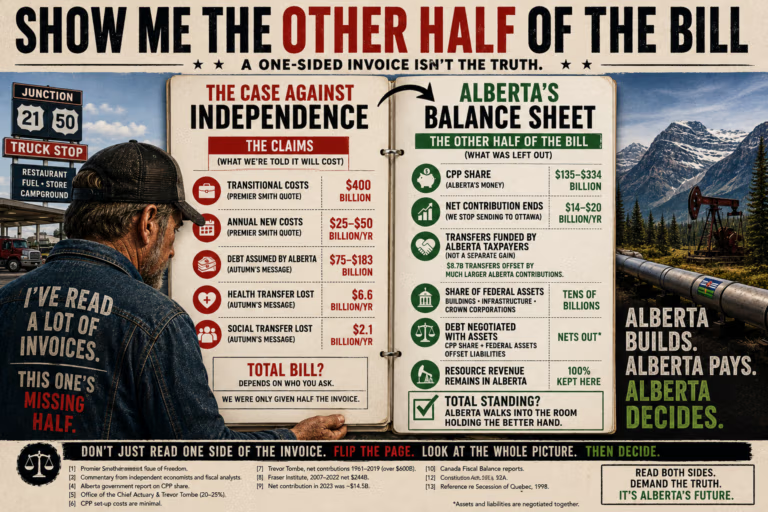
Tombe’s $20 billion figure assumes friction during transition — tariffs, trade disruption, investment uncertainty. But those costs run against Alberta’s current outflows. Alberta sends roughly $30 billion per year more to Ottawa than it gets back. Tombe’s worst-case transitional loss is less than one year of net contributions we’d stop sending. Extended over a decade, independence saves Albertans roughly $300 billion in avoided fiscal transfers alone — fifteen times Tombe’s number. That’s before accounting for the $334 billion Alberta would immediately gain from the Canada Pension Plan based on historical contributions (Lifeworks Actuarial Report, 2023). Before the $700 million annually we’d stop paying for RCMP services we could provide more efficiently through an Alberta Provincial Police. Before the resource royalties that currently disappear into federal calculations and never fully return.
The Calgary Chamber poll measures anxiety about uncertainty, not the economics of independence itself. It’s a self-fulfilling prophecy argument: “things are uncertain right now, so don’t change anything.” By that logic, Estonia shouldn’t have left the Soviet Union. Ireland shouldn’t have left Britain. Norway shouldn’t have left Sweden. Every independence transition carries short-term uncertainty. Every one of those nations is wealthier today than they would have been had they stayed.
The deeper problem with the economic fear campaign is that it treats the status quo as free. It isn’t. Canada’s GDP per capita, adjusted for purchasing power, has declined 7.5% since 2019 (OECD Economic Outlook, 2024). Real wages are stagnant. Productivity growth is at its lowest since the 1980s. Foreign direct investment outflows average $90 billion annually while inflows fall below $60 billion. Capital is already fleeing. The question isn’t “will independence cost us?” — it’s “will independence cost us more than managed decline?”
The arithmetic says no. Alberta’s independent fiscal position would project a $15-20 billion annual surplus even after standing up full national services (Fraser Institute, 2023). That surplus could fund a sovereign wealth fund, eliminate provincial income tax, or both.
Full analysis in “Alberta and Ontario: GDP, Fiscal Balance, and Structural Risk” and “Alberta Independence: Necessary and Inevitable.”
V. The First Nations Question — Taken Seriously
This is the most important section in this piece. Because the argument is that Alberta independence would violate treaties, that First Nations have unanimously opposed it, that 16 First Nations of Treaty 6 called Bill 54 a “direct violation,” that Chief Billy-Joe Tuccaro called separation a “fantasy” that’s “impossible with the treaty,” that Chief Troy Knowlton said “there is no pathway to separation,” that the Sturgeon Lake Cree Nation has sought court injunctions, that Justice Feasby’s December 2025 ruling found transformation of provincial borders into international borders would “significantly impair the exercise of treaty rights.” That Justice Leonard granted a one-month stay in April 2026.
These are serious arguments from serious people. They deserve serious engagement. Here it is.
First, what treaties actually say. The Numbered Treaties (1-11) are with the Crown. Not with the Dominion of Canada specifically. Not with any particular political configuration. The text is explicit: Indigenous signatories ceded, released, surrendered, and yielded up their rights, title, and privileges to the land to the Crown in exchange for specific enumerated rights — reserve lands, annuities, education provisions, and continued hunting, fishing, and gathering rights within treaty territory.
Second, treaties have already survived multiple jurisdictional transfers. From Indigenous stewardship → Hudson’s Bay Company → British Crown → Dominion of Canada → provincial control (via the Natural Resources Transfer Agreements of 1930-31). Courts upheld the treaties every time. When Alberta itself was legislated into existence in 1905, there was zero Indigenous consultation. No consent was sought. Yet the treaties remained intact. This isn’t speculation. It’s 150+ years of documented legal precedent. Alberta Independence would be no different.
Third, the “Honour of the Crown” doctrine that Emmett Macfarlane and others invoke. This doctrine requires the Crown to act honourably in its dealings with Indigenous Peoples. It doesn’t create a veto. In Haida Nation v. BC (2004) and Tsilhqot’in v. BC (2014), the Supreme Court affirmed the Crown’s “duty to consult” but retained final decision-making authority with the Crown. The honour of the Crown survives in an independent Alberta because the treaty obligations transfer with jurisdiction, as they always have. Alberta becomes the Crown in right of Alberta — with the honour attached.
Fourth, what the current system has actually delivered. Under Ottawa’s exclusive Section 91(24) jurisdiction:
- First Nations life expectancy 8-12 years shorter than non-Indigenous Canadians
- Suicide rates 2-4 times higher, 5-6 times higher for Indigenous youth
- Mood, anxiety, and substance-use disorders roughly twice the national rate
- On-reserve child poverty rate four times the non-Indigenous rate
- Overcrowded housing several times the national average
- 98% of Prairie territory transferred from Indigenous stewardship to Crown ownership between 1871 and 1930
Defending the status quo means defending those outcomes. For generations. With no improvement. Full documentation in “Why First Nations Stand to Benefit the Most in an Independent Alberta.”
Fifth, who is speaking for whom. There’s a gap between Indigenous leadership and lived Indigenous reality. Chiefs, councils, and national organizations operate in a federally funded bubble — secure salaries, covered legal costs, relevance through Ottawa alignment. Funding flows through them. Authority flows through them. Bureaucracy sustains them. Meanwhile ordinary Indigenous people endure the outcomes above. When Chief Allan Adam of ACFN joined Neil Young’s “Honour the Treaties” tour in 2014, the Tides Foundation’s 2013 IRS Form 990 listed a $55,000 grant to 850450 Alberta Ltd., a company tied to ACFN’s business arm with Adam as director. The timing aligned with his activism. Yes, the SAME Allan Adam who claimed I get paid $20,000 per month to advocate for Alberta Sovereignty! (I don’t)
Sixth, what Indigenous economic partnership actually looks like when governance gets out of the way. Oil sands operators spent $7.3 billion on procurement from Indigenous businesses from 2013–2016 alone. Fort McKay First Nation has netted hundreds of millions through Impact Benefit Agreements and equity stakes — funding housing, education, health, and infrastructure. The split isn’t Indigenous values versus development. It’s governance choices.
Seventh, what Feasby actually wrote. In the same December 2025 decision that critics cite, Justice Feasby also stated: “This case has not decided that First Nations have a veto over Alberta independence.” That line gets left out of media coverage. It shouldn’t. He also was specific in that a referendum is NOT unconstitutional and would be allowed, only that the question was not allowed under the old wording of the Elections Act- a provincial law not a Constitutional issue.
Eighth, what Alberta Independence actually offers. Nothing in law prevents an independent Alberta from honouring the treaties exactly as written — transparently, directly, without Ottawa as eternal middleman. Or — if First Nations choose — from renegotiating treaty arrangements in a new political context, potentially securing outcomes far better than 150 years of federal management have delivered. Renegotiation is not betrayal. It is self-determination. I do not see many people asking the indigenous people what THEY want, only Chiefs chirping.
Full argument in “Treaties Were Meant to Free People.”
Treaties were meant to free people. Ottawa turned them into chains. Defending those chains isn’t protecting Indigenous nations. It’s protecting the system that has failed them.
VI. The “Trump Will Annex Us” Fear
This argument comes in two flavours. The fear version: if Alberta leaves, Trump will absorb us as the 51st state. The accusatory version: BC Premier David Eby’s claim that meeting with US officials is “an act of treason.”
Both fall apart under examination.
On the fear version. Nobody serious in this movement is campaigning for Alberta to become a US state. The Alberta Prosperity Project has repeatedly and publicly stated independence is the goal, not annexation. Lawyer Jeff Rath has stated on the record that annexation was discussed and rejected as “not viable or possible” in meetings with the US Treasury and State Departments. The US position itself, per Treasury Secretary Scott Bessent, treats Alberta as “a natural American partner” — which is the language of bilateral relations, not absorption.
Independence is the alternative to absorption. A province with no leverage inside Confederation is far more vulnerable to US pressure than a sovereign Alberta negotiating a bilateral defense and trade relationship. Iceland, Norway, and Ireland all maintain their sovereignty next to vastly larger powers. So can we.
On the “treason” accusation. Premier Eby is free to his opinion, but it’s a legal nullity. Treason under Canadian law requires overt acts against the sovereign, not meeting with foreign officials. Provincial premiers and political groups meet with US officials constantly. Quebec maintains formal international offices. Ontario, BC, and Alberta have all engaged directly with US counterparts over energy, trade, and defense. Calling that “treason” is political theatre, not legal analysis.
The deeper point: if discussing Alberta’s future with international partners is treasonous, then Canada has no First Amendment equivalent, no right of free political association, and no meaningful sovereignty of thought. Which is precisely the problem independence is trying to solve.
The documented US position is this: if Alberta becomes independent democratically and peacefully, the US would support continental defense cooperation through NORAD and pursue zero-tariff bilateral trade. Senior US national security advisors have noted that strengthening the continental interior between Alaska and the lower 48 improves American security. That’s not annexation. That’s partnership — which Canada currently enjoys and which Alberta would continue to enjoy as a sovereign nation.
Full context in “Alberta Independence: Necessary and Inevitable,” Section VII.
VII. The Constitutional “Impossibility” Argument
This one is made by constitutional law academics and sympathetic columnists — Emmett Macfarlane’s pieces in Policy Options, the Alberta Independence from Canada would be illegal arguments, the invocation of the Secession Reference and the “Honour of the Crown” as absolute barriers.
The argument, in summary: a successful independence referendum would have “almost no” legal effect; Canadian constitutional law, the Secession Reference, First Nations treaty rights, and the Honour of the Crown doctrine make Alberta independence “virtually impossible.”
Here’s why that argument is not just wrong but structurally backwards.
It confuses domestic law with international law. Canadian constitutional law governs what happens inside Canada. It has no force outside Canada’s borders. Statehood under international law requires four things: a permanent population, a defined territory, a functioning government, and the capacity to engage in relations with other states. Nothing in international law requires constitutional amendments, unanimous consent from neighbouring jurisdictions, or permission from the existing regime. Those are domestic political preferences, not legal prerequisites.
It misreads the Secession Reference. The 1998 Supreme Court opinion did not declare secession illegal. It acknowledged that a clear expression of the will of the people creates democratic legitimacy and imposes an obligation to negotiate. The ruling was a political balancing act, not a veto. It attempted to preserve federal authority while conceding that sovereignty ultimately flows from the people, not from statutes or judges.
It reverses how political change actually works. The claim that constitutional amendment must precede independence inverts every successful independence movement in history. Constitutions do not create nations. Nations create constitutions. Every successful independence movement establishes legitimacy and control first, then cleans up legal frameworks afterward. Expecting a people to secure constitutional approval from the very structure they’re trying to leave is logically incoherent. It amounts to arguing that freedom requires prior permission from the authority being rejected. That’s not law. It’s circular dependency dressed up as sophistication.
It ignores Section 38’s impossibility. The Constitution Act, 1982 requires seven provinces representing 50% of Canada’s population plus majorities in both the House of Commons and Senate for constitutional amendment. In practice, Ontario and Quebec hold a permanent veto. Alberta’s voice — no matter how unified — cannot alter the system from within. So when academics say “work within the system,” they’re prescribing a remedy that doesn’t exist.
It treats the Clarity Act as international law. The Clarity Act applies only within Canada and only so long as a province remains part of Canada. It cannot bind foreign governments. It cannot override international law. It cannot stop independence once political reality has moved beyond it. At most, it’s a delaying mechanism.
It assumes the honour of the Crown prevents secession. The honour of the Crown is a legal doctrine governing the Crown’s dealings with Indigenous Peoples. It requires good-faith conduct, consultation, and respect for treaty obligations. An independent Alberta inheriting Crown obligations in its territory — as every new state has done in history — satisfies the honour doctrine. What the doctrine doesn’t do is freeze political structures forever.
At its core, the “impossibility” argument reduces to this: a people may only leave a political arrangement if those who benefit most from that arrangement agree to the departure. That premise isn’t democratic, legal, or moral. It’s control logic. Independence movements don’t succeed by satisfying every procedural demand of the existing order. They succeed because the people insist on self-government and make that insistence unavoidable.
VIII. The “Sending a Message” Warning
Pollster Dan Arnold has flagged a concern: among three-in-four Albertans who would vote against Alberta Independence or are unsure, 21% say they’d “consider voting for Alberta Independence in a referendum as a way to send a message to Ottawa.” If they all did, support jumps from 27% to 42%.
The establishment frames this as a warning against protest voting. The Brexit comparison gets deployed. David Cameron’s regret. Don’t let symbolic frustration produce real separation.
But here’s the thing: the referendum isn’t symbolic to the rest of us.
For a growing number of Albertans, independence isn’t a pressure-release valve. It’s not a protest vote. It’s the recognition that 158 years of managed extraction have produced a system that cannot be reformed, only exited. When you understand that — when you’ve read the BNA Act, traced the honours pipeline, watched your industries cancelled, seen your rights “balanced” away during COVID, and calculated the $1.3 trillion transfer — you stop caring whether the outcome “sends a message.”
The only message worth sending is the result.
The Brexit comparison is also misleading. Brexit was about leaving a supranational body (the EU) and reclaiming an already-sovereign parliament’s authority. Alberta independence is the opposite direction — becoming sovereign for the first time. The better historical parallel is Ireland’s independence from Britain, or Norway’s from Sweden, or Slovakia’s peaceful split from the Czech Republic in 1993. In every case, the economic fearmongering proved overblown and the independent nation ended up wealthier, freer, and more prosperous than its former ruler predicted.
So yes — some voters may mark yes to send a message. Others will mark yes because they mean it. Either way, the result is the same: a legitimate democratic mandate to restructure our relationship with Canada. That’s not a mistake. That’s the point.
IX. The “Alberta’s Problems Are Self-Inflicted” Argument
This one comes from the left — Tamara Krawchenko in the Tyee, academic economists, commentators who argue Alberta’s own conservative governments failed to save oil revenues properly, resisted higher royalties, underinvested in stabilization funds, and now blame Ottawa for decisions Edmonton made.
There’s a kernel of truth here worth acknowledging: Alberta’s Heritage Fund, established in 1976, was badly managed compared to Norway’s sovereign fund. Norway started at the same time and now holds $1.5 trillion USD. Alberta’s Heritage Fund holds roughly $24 billion. That’s a legitimate policy critique.
But it doesn’t change the independence case. It strengthens it.
First, the reason Alberta couldn’t build a Norway-style fund is precisely the federal structure. Ottawa skims roughly half of Alberta’s resource-generated corporate and personal income tax revenue before it ever reaches the provincial treasury. Every dollar Alberta could have invested in a sovereign fund was already partly claimed by Ottawa through equalization, federal taxation, and regulatory friction. Norway never had that problem. Its resource wealth stayed home.
Second, the critique assumes Alberta has had the constitutional authority to manage its own fiscal affairs the way Norway did. It hasn’t. Section 91(3) of the Constitution places exclusive taxing power over income and corporations with Ottawa. Alberta is constitutionally handcuffed to the same bureaucracy that bleeds it.
Third, even if every PC and UCP government had been perfect stewards, the $1.3 trillion net transfer out of Alberta over 68 years would still have happened. That’s not a policy failure. That’s the design.
Fourth, the critique often comes from the same voices demanding Alberta stay in a system they acknowledge is dysfunctional — while opposing every tool Alberta would need to fix it independently. You can’t simultaneously say “Alberta mismanaged its fiscal position” and “Alberta shouldn’t have full fiscal authority.” The critique undermines itself.
The past matters. The future matters more. And the future under Confederation is more of the same — with compound interest.
X. The “Credible Conservatives Oppose This” Argument
Jason Kenney and Monte Solberg have publicly argued against Alberta Independence. Kenney will be involved in public debates with independence lawyer Keith Wilson. The framing is: if respected Conservative voices oppose this, shouldn’t that give you pause?
I wrote about this exact pattern extensively in “What Business Have Ye With Me, Your Majesty?” — months before the current debate. Let me quote myself directly:
“Consider my friend Jason Kenney — a member of His Majesty’s Privy Council, decorated with Royal Ribbons, or Thomas Lukaszuk — former MLA, head of a Shariah compliant bank, already richly rewarded for participating in the Crown system, both men find prosperity in the reward structure of the Crown, but at what expense? At the expense of who?”
From the knighthoods and governorships of the 19th century to the cabinet portfolios, diplomatic posts, and Senate appointments of today, the Crown franchise has always rewarded loyalty to the centre. Confederation’s architects received their KCMGs — Macdonald, Cartier, Tupper, Tilley. Loyalty to the sovereign equaled personal prestige, social elevation, and access to capital. The pipeline continues under different names.
Jason Kenney is a member of His Majesty’s Privy Council. Thomas Lukaszuk — former Deputy Premier, now running Forever Canadian, summoned to Prime Minister Carney’s PMO, briefing federal caucus, hosted as an honoured guest in the Senate, rumours of a Senate appointment circulating — is the template operating as designed.
When Forever Canadian’s most prominent voices attack Alberta independence, they are not defending your family, your farm, your business, or your community. They are defending the reward structure that has served them and will continue to serve them. The fact that their leader can get a meeting with the PMO while regular Albertans can’t get a callback is the system working exactly the way it was engineered to in 1867.
Their opposition to Alberta Independence is not mysterious. It’s rational within the existing system. Political careers, party funding, and post-office appointments all flow from remaining aligned with the national centre. That’s the real reason the arguments sound so polished. They’ve been sharpened by 158 years of practice defending the franchise.
XI. The “Hotel Canada” Argument
The viral meme, deployed in the CBC court coverage: “Welcome to Hotel Canada — you can check out, but you can never leave.” The implication: independence is legally impossible no matter how the democratic process unfolds. A state-funded attack on Alberta Independence.
This is the honest distillation of every argument in this post. And it’s why independence matters.
If the answer to “can Alberta lawfully leave Canada?” is “no, and no referendum can change that,” then Canada is not a free federation. It’s a cage with a vote-shaped window.
But international law doesn’t work that way. The 1960 UN Declaration on the Granting of Independence to Colonial Countries and Peoples, the 1970 Declaration on Principles of International Law Concerning Friendly Relations, and the entire post-WWII corpus of self-determination doctrine all recognize that peoples have the right to determine their political status. The Quebec Secession Reference acknowledged this. Every successful independence movement has demonstrated it.
“You can never leave” is not a legal principle. It’s a threat. And the fact that it’s being deployed against Albertans — peacefully gathering signatures, running petitions, organizing referendum questions — should tell you everything you need to know about who’s actually afraid of democracy here.
XII. The “Angry White Men” Smear
Thomas Lukaszuk, in a National Post article, briefed the PMO under Prime Minister Carney, federal caucus, and the Senate that the independence movement is “angry white men armed to the teeth” and a “national security threat.”
I’ll say plainly what this is: a smear designed to justify federal intervention in a democratic process.
The independence movement includes:
- Indigenous people from across Treaty 6, 7, and 8 territories who support sovereignty openly
- Francophone Albertans who value their community without federal supervision
- Newcomers from every continent who chose Alberta specifically
- Women who make up roughly half the volunteer base of every major independence organization
- Farmers, ranchers, patch workers, nurses, teachers, small business owners
- Young people watching their future get legislated away
- Elders who’ve watched Confederation fail Alberta for generations
Constitutional lawyer Jeffrey Rath — 34 years championing Indigenous rights — responded directly on X: “This will come as a shock to all of the indigenous men and women who support our movement!” That post sparked replies from Treaty 6 families, immigrants, women declaring unyielding support. A respondent from a First Nations family wrote simply: “we all support independence! Letssss go!!”
Lukaszuk’s smear doesn’t just misrepresent the movement. It erases the Albertans who make it up. And he does it from inside the PMO, while his counter-petition campaign partners with a group — ACFA — that has received over $19 million in federal funding (Western Standard, March 2026). Canadian Heritage has refused to comment.
This isn’t debate. This is establishment machinery smearing Albertans to keep the reward structure intact.
XIII. The “74% of Stay Voters Would Leave Alberta” Statistic
Angus Reid’s February 2026 polling found that 74% of “stay” voters say they would leave Alberta and move elsewhere in Canada if Alberta Independence is achieved. Only 23% say they’d stay in a newly independent Alberta. The establishment treats this as devastating — we’d lose three-quarters of our federalist population to emigration.
Two responses.
First, the same polling found that 29% of Albertans already lean or definitely vote yes — and the lean-stay group (64% of the “stay” majority) find the key leave arguments persuasive: 88% find “Alberta gives more than it gets” convincing, 79% find “Alberta controlling its own resources” convincing. The soft middle is moveable, and moving.
Second, even if every “definite stay” voter (57% of the population, per Angus Reid) followed through on leaving, Alberta would still have roughly 2 million people — a population larger than Iceland, Malta, Luxembourg, and Bahrain combined. All four are prosperous, sovereign, internationally respected nations. AND- There would be no elbows up.
But the much more likely reality is that people say they’ll leave in polls and then don’t when the time comes. Quebec polls showed similar sentiment before its 1995 referendum. Quebec’s population didn’t collapse. Neither did Ireland’s after independence. Neither did Estonia’s. Neither did Slovakia’s. People overwhelmingly stay where their lives are — where they own homes, raise children, run businesses. The threat of mass exodus is a pollster’s artifact, not an economic reality.
And finally: if someone is truly unwilling to be a citizen of a democratic, prosperous, self-governing Alberta because they preferred the Crown franchise model, that’s their choice — and it’s one they’re entitled to make. Independence doesn’t require unanimity. It requires democratic legitimacy, which is precisely what the petition and referendum deliver.
XIV. Why This List Sounds So Practiced
Because it’s been practiced. For 158 years.
From the knighthoods and governorships of the 19th century to the cabinet portfolios, diplomatic posts, and Senate appointments of today, the Crown franchise has always rewarded loyalty to the centre. Every argument against Alberta independence has been polished by generations of loyal operators defending their place in the hierarchy.
Every technical fear — currency, trade, debt, military, embassies — has been solved dozens of times by successful independence movements. Every constitutional obstacle has been navigated. Every economic concern has been overcome.
The reason the arguments against Alberta Independence sound unanswerable isn’t because they are. It’s because they’ve been rehearsed for a century and a half by people whose careers, pensions, and prestige depend on Albertans never actually demanding sovereignty.
Once you see that pattern, you cannot unsee it.
XV. The Real Question
“Can a federation born as a business deal under monarchy become a true partnership of equals?”
That’s the question I’ve been asking for two years on whistlestoptruckstop.ca. The answer, so far, is no. Every reform has been bounded by the original imperial premise. Every grievance has been answered with delay. Every demand has been met with more smears from the Crown’s loyal operators.
Which is why, for the first time in 158 years, Albertans — Indigenous, francophone, newcomer, rancher, welder, nurse, teacher, small business owner, young, old, for, against, undecided — are actually talking to each other. Not as subjects. Not as tenants. Not as customers of a Crown franchise. As citizens of a place we choose. Only manifested through Alberta Independence.
XVI. The Difference Between Being Governed and Governing
Here’s the distinction that almost no Canadian is ever taught in school, and it’s the one that matters most.
The British North America Act was imposed on us. It was drafted in London, passed by a foreign parliament, and handed down to the colonies as the terms of our existence. It tells us how we will be governed. It establishes the authority of the Crown over our land, our resources, our laws, and our lives. It defines what Ottawa may do to us, what the provinces are permitted to do, and what rights we are allowed to exercise — always within limits set by a sovereign we did not choose.
That is a fundamentally different kind of document than a constitution written by a free people.
A genuine constitution flows in the opposite direction. It isn’t imposed on the people by a government. It is written by the people, adopted by the people, and it tells the government what it may and may not do. The government is the creation. The people are the creator. Authority flows up from the citizens to the institutions they design — not down from a Crown to the subjects it administers.
This is the foundational distinction between a subject and a citizen.
A subject lives under authority granted from above. Their rights are privileges the sovereign has chosen not to revoke yet. Their property is held at the Crown’s pleasure. Their laws are made for them by institutions that predate them and will outlast them, regardless of their consent.
A citizen lives under authority they themselves constituted. Their rights are recognized, not granted — because they were never the sovereign’s to give. Their property is theirs because they own it, not because the Crown has declined to take it back. Their government operates within limits the people wrote, and can be altered, replaced, or abolished by the same people who created it.
Canada, at its constitutional root, still treats us as subjects. The preamble of 1867 binds us “under the Crown.” Every land title says we hold our property “of the Crown in right of” whichever province. Every mineral beneath us belongs “to the Crown.” Every oath of citizenship, every judicial appointment, every parliamentary session opens in the name of a monarch who rarely sets foot in this province and will never live the effects of it’s governance.
That isn’t an accident of history. That’s the architecture.
And it’s why an independent Alberta matters in a way that goes deeper than pipelines, equalization, or any policy fight. Because an independent Alberta wouldn’t just be a new country. It would be — for the first time on this land — a constitution written by Albertans, for Albertans, that tells government what it may do, rather than the other way around.
A document that recognizes rights as inherent, not granted.
A document where land is owned by the people who live on it, not held in trust by a foreign sovereign.
A document where resources belong to the citizens whose ancestors built the industries that extracted them — not to a Crown that treats them as royal dividends.
A document that flows up from the people, not down from the palace.
This is the piece Forever Canadian doesn’t want you to think about. Because once you do, the whole thing collapses. Every stability argument. Every continuity argument. Every “but what will happen to…” argument. They all assume the existing framework is the ground floor of political reality.
It isn’t. It’s just the deal we were handed in 1867.
We can write a better one.
Alberta Independence.
XVII. The Call
LetsTalkAlberta.com is where that conversation is happening. Run by Albertans. No politicians. No parties. No federal paycheck. No smears. Just the honest conversation Forever Canadian doesn’t want us to have.
People like me have everything to lose doing this. Reputation. Business. No pension. No safety net. No soft landing at a federally-adjacent bank, no Senate seat being warmed, no Privy Council ribbons waiting. Just my family, my café in Mirror, my community, and the belief that Albertans deserve better than a franchise agreement drafted in London in 1867.
Alberta Independence- We’re doing it anyway.
On October 25th, join us at the Alberta Legislature Grounds in Edmonton for the rally for Alberta Independence. Engage with the Alberta Prosperity Project at albertaprosperityproject.com. Support the referendum question proposed by constitutional lawyer Jeff Rath: “Do you agree that Alberta should become an independent nation and cease to be a province within Canada?”
And if you’re still working things through — read. Everything I’ve written is at whistlestoptruckstop.ca/blog. I’m not hiding who I am, what I’ve lost, or what I’m willing to risk.
👉 LetsTalkAlberta.com
Sign up. Get the real story. Find events near you. Your name stays with us — always.
Christopher Scott The Whistle Stop Café, Mirror, Alberta
References:
Core Legal & Constitutional Sources
- Constitution Act, 1867
https://laws-lois.justice.gc.ca/eng/const/page-1.html - Constitution Act, 1982
https://laws-lois.justice.gc.ca/eng/const/page-12.html - Clarity Act
https://laws-lois.justice.gc.ca/eng/acts/c-31.8/ - Reference re Secession of Quebec
https://scc-csc.lexum.com/scc-csc/scc-csc/en/item/1643/index.do - R v Oakes
https://scc-csc.lexum.com/scc-csc/scc-csc/en/item/117/index.do
International Law / Self-Determination
- United Nations Convention on the Law of the Sea
https://www.un.org/depts/los/convention_agreements/texts/unclos/unclos_e.pdf - UN Convention on Transit Trade of Land-Locked States
https://legal.un.org/ilc/texts/instruments/english/conventions/8_1_1965.pdf - UN Declaration on the Granting of Independence to Colonial Countries and Peoples
https://www.un.org/en/decolonization/declaration.shtml - UN Declaration on Friendly Relations
https://www.un.org/ruleoflaw/files/3dda1f104.pdf
Indigenous Law & Key Cases
- Haida Nation v British Columbia
https://scc-csc.lexum.com/scc-csc/scc-csc/en/item/2189/index.do - Tsilhqot’in Nation v British Columbia
https://scc-csc.lexum.com/scc-csc/scc-csc/en/item/14246/index.do - Numbered Treaties
https://www.rcaanc-cirnac.gc.ca/eng/1360948213124/1544620003549
Economic & Fiscal Data
- Statistics Canada
https://www.statcan.gc.ca - Fraser Institute
https://www.fraserinstitute.org - OECD
https://www.oecd.org - OECD Economic Outlook
https://www.oecd.org/economic-outlook/ - LifeWorks
(CPP report referenced – not always publicly hosted cleanly, but summary source)
https://www.osfi-bsif.gc.ca
Polling & Public Opinion
- Angus Reid Institute
https://angusreid.org - Calgary Chamber of Commerce
https://www.calgarychamber.com
Energy & Industry Data
- Canadian Energy Regulator
https://www.cer-rec.gc.ca - Natural Resources Canada
https://natural-resources.canada.ca
Referenced Figures & People
- Trevor Tombe
https://econ.ucalgary.ca/profiles/trevor-tombe - Emmett Macfarlane
https://emmettmacfarlane.com - Neil Young
(Referenced in activism context)
Organizations
Alberta Prosperity Project
https://albertaprosperityproject.com
Whistle Stop Truck Stop Blog
https://www.whistlestoptruckstop.ca/blog
Lets Talk Alberta
https://letstalkalberta.com