Show Me the Other Half of the Invoice!
I run a truck stop. Restaurant, fuel, the store, the campground, all of it, out at the junction of 21 and 50. I have spent thirty years reading invoices. And I can tell you the fastest way to spot a man who’s trying to put one over on you: he hands you a bill that lists everything you owe him and nothing you’ve already paid.
That is exactly what Premier Smith handed Albertans this week.
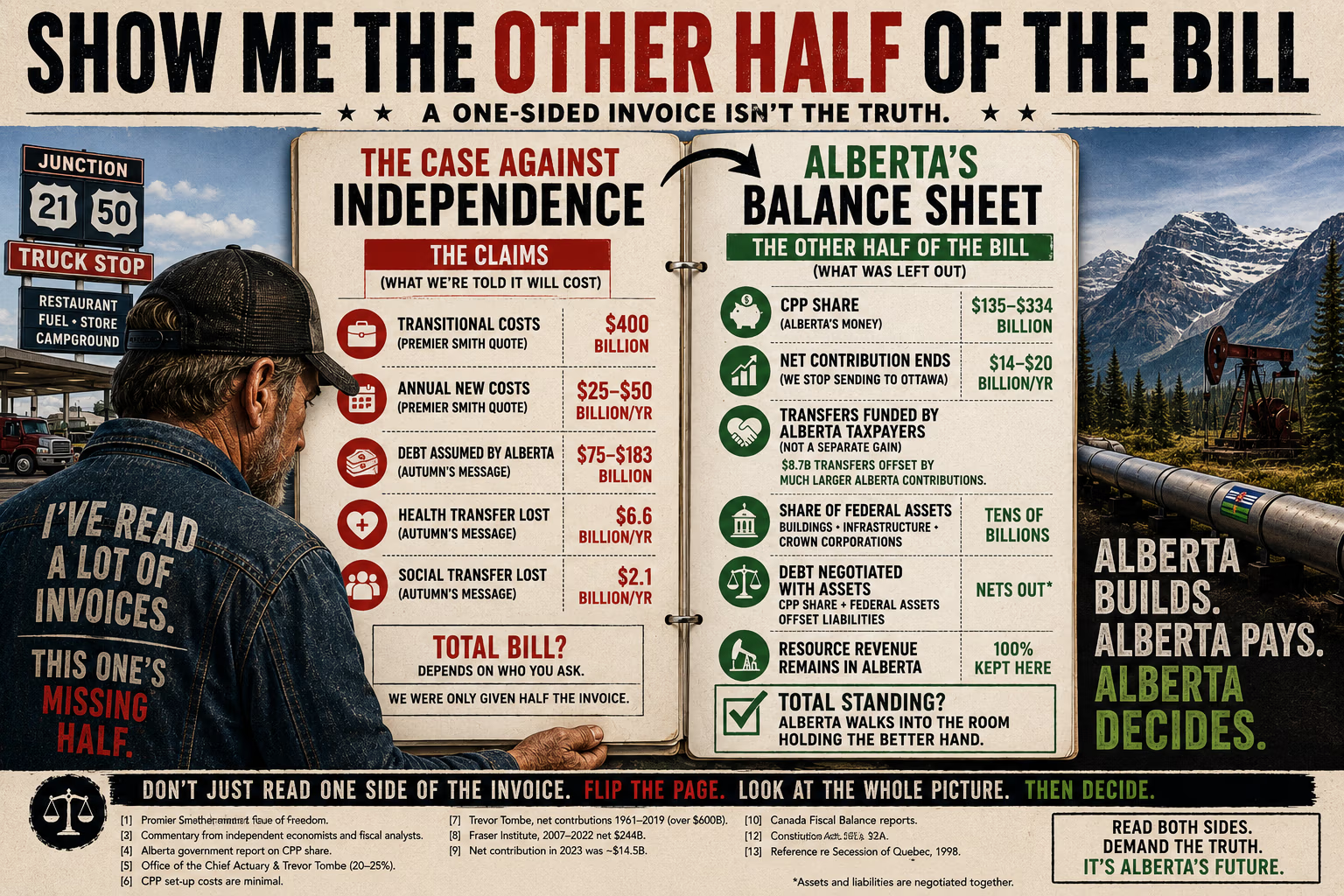
Asked what independence would cost, she said “almost $400 billion in transitional costs” and another “$25 to $50 billion a year.” [1] Somebody took that, divided it by the population, and got eighty grand a head, and now it’s bouncing around every comment section in the province. Autumn sent it to us. I don’t blame Autumn. She’s repeating what the Premier of Alberta said into a microphone.
But I’ve signed enough cheques to know a one-sided invoice when I see one. So let’s do what the Premier won’t. Let’s turn the page over and look at the other column.
Where did $400 billion even come from?
Here’s the first thing nobody’s asking. Where are the receipts?
There’s no costed model behind that number. No spreadsheet, no line items, no report you can download and check. It got said at a podium and that was that. Compare that to the one group that actually sat down and did the arithmetic — the Alberta Prosperity Project’s Value of Freedom plan puts the whole start-up cost at around $98 to $107 billion, with about $23 to $32 billion of that to stand up every federal service we’d take over, defence included. [2] You can argue their plan’s too sunny. Fine. At least they showed their work.
The Premier showed a number. That’s not analysis. That’s a scare.
The column she deleted
Our pension money. The note says we’d be left with some small standalone pension “likely smaller than the CPP.” It does not mention that we’d walk out the door with a share of the CPP itself. Alberta’s own report pegged that share at $334 billion, because Albertans are younger, work more, earn more, and have been overpaying into that fund for sixty years. [4]
Now I’ll be straight with you, because I’d rather you hear it from me than from a heckler. That $334 billion is fought over. Ottawa’s own actuary and a U of C economist named Trevor Tombe say it’s more like 20 to 25 percent — call it $135 billion. [5] Doesn’t matter for my point. Even the low number is a hundred and thirty-five billion dollars that the Premier’s “$400 billion bill” writes down as zero. And setting up the plan to run it costs pocket change by comparison. [6]
What we’ve already paid in. This is the one that should make your blood pressure jump, and it doesn’t come from me or from any independence group. It comes from Tombe — the same guy who opposes leaving. His own work says Albertans put $622 billion more into Confederation than we got back, just between 1961 and 2019. He calls the “over $600 billion” figure true. [7] The Fraser Institute counts $244 billion net just from 2007 to 2022. [8]
Run the years out and that’s somewhere around $20 billion a year, every year, going out the door. In a normal recent year, 2023, the net was about $14.5 billion. [9] I’ll use the smaller number. I don’t need the big one and I won’t quote anything I can’t defend on the radio.
So when she warns about “$25 to $50 billion in new yearly costs,” set it next to the $14 to $20 billion we’d stop shipping to Ottawa every single year, plus the federal taxes raised right here that we’d finally keep. You can’t talk about one side of that and pretend the other doesn’t exist.
The transfers she calls “lost.” Health Transfer, $6.6 billion. Social Transfer, $2.1 billion. The note lists those as money we’d be giving up. [1] Think about that for a second. That money is paid out of federal revenue — out of the sixty-plus billion we send to Ottawa in the first place. [10] You don’t lose money by no longer getting an $8.7 billion rebate on the $60 billion you overpaid. You stop overpaying and you fund your own hospitals with the difference.
This is the whole Crown-franchise problem in one line. We do the volume. They take the cut, hand a little back, and then tell us we can’t afford to run our own store. That’s not partnership. That’s a franchise agreement we never got to sign — the kind where you’re a subject, not an owner.
The stuff we already own. Our resources aren’t something we’d have to “claim.” Under the Constitution they’re already the province’s — section 92A, look it up. [11] A sovereign Alberta just keeps a hundred percent of the resource revenue instead of feeding part of it east. And the federal buildings, the bases, the infrastructure sitting on Alberta soil, plus our share of the Crown corporations and the embassies abroad — that’s all on the negotiating table, and a lot of it lands in our column, not Ottawa’s. [12]
The debt gets negotiated, and it nets out
The note says we’d “absorb” $75 to $183 billion of the national debt. Two things.
One, nobody hands us a debt. It’s negotiated. The Supreme Court already said so back in 1998 — a clear vote triggers a duty to negotiate, and the assets and the liabilities get split together. [13] You don’t get to assign Alberta a share of the debt while pretending it gets no share of what’s owed to it.
Two, put it side by side. A debt share of, say, $75 to $183 billion sits across from a pension share of $135 to $334 billion, plus our cut of federal assets, plus the strongest net-contributor record in the country. That’s not a province that owes $183 billion. That’s a province that walks into that room holding the better hand.
The “$50 billion a year” is the soft spot in her whole pitch
She says a new country has to build a military, regulators, all of it. True. But the people who costed it put replacing every federal service at $23 to $32 billion, not fifty. [2] And against that you set the $14 to $20 billion we stop sending away, and the $68 billion in federal taxes raised here that we’d keep. [10] The costed plan, even playing it conservative, lands on a surplus in year one. [2]
Now the part where I tell you the truth about the risks
I’m not going to stand behind my own counter and sell you a fairy tale, because it’s my name on this and my business on the line if I’m wrong. So here’s the honest side.
The real cost of leaving is trade friction. Tombe figures a 5 percent jump in the cost of moving goods in and out shrinks our economy about 4 percent — roughly $20 billion a year, $130 billion over a decade. [14] That’s the strongest thing the other side’s got, and I’m not going to wave it away. My answer: that 5 percent is an assumption, not fate. What it actually costs depends on the deal we negotiate, and a place sitting on energy that both the U.S. and central Canada need is not negotiating from its knees. A sovereign Alberta moves us to an adult negotiating position rather than negotiating for crumbs at the kids table.
There’s an uncertainty cost too. Money gets nervous before the lawyers finish, and I’m not going to pretend it doesn’t. The cure for that is a credible, fully-costed, transparent plan and a steady hand — the exact opposite of scaring people with a number you won’t explain. For evidence on how business leaves uncertain scenarios look no further than the exit of Encana- the flagship company of Canadian energy production, to the United States. The Feds made the economic and business landscape of Alberta so uncertain that many businesses like Encana left. Alberta could not do anything about this at the time, which is exactly the problem Alberta Sovereignty could solve.
But while we’re on the subject, let me correct the record, because the other side’s favourite warning is Quebec, and they tell it wrong. Yes, the head offices left Montreal for Toronto. Sun Life was the first one out the door, January 1978. So go read why. The PQ had just passed Bill 101 — the Charter of the French Language — and made French the mandatory language of business. For a company like Sun Life it was cheaper to pack up for Toronto than to convert its whole operation into French and try to recruit and keep people under those rules. The company said as much at the time. [15] The English business community read it as a hostile act, and they answered in kind. That’s the part that gets left out when people wave Quebec at us.
And that language law has never even been good law. The Supreme Court has knocked down pieces of it again and again — in 1984, in 1988, and again in 2009 — and every time, Quebec reaches for the notwithstanding clause to keep it on the books anyway. [16] The newest version, Bill 96, is being fought in court right now. [17] And here’s the part that should land for us: Quebec can defy Ottawa like this because it already took control of the things that matter — its own pension, its own immigration stream, its own tax collection. It built the very levers Alberta is only now debating. Control is the whole game. Without it any province that tries to assert their sovereignty will face reduced Federal transfers as a stick.
So here’s why Quebec is a lousy warning for Alberta. We are not proposing to force a single business to switch languages. We’re not telling anybody they can’t operate in English. The thing that actually pushed those head offices out of Montreal isn’t on our table at all. Montreal had also been slipping behind Toronto since the 1950s for plain economic reasons — so even there it was never just “they talked about leaving.” The honest lesson from Quebec isn’t “don’t seek sovereignty.” It’s “don’t pass a hostile law that makes it expensive to do business in your own province.” We can learn that lesson and skip the mistake.
And yes, there are real cleanup bills in here. I won’t pretend otherwise. But this is another number that gets told dishonestly, and this one I know from the inside.
When they throw around “$200 billion in liabilities,” they’re stuffing oilsands mine reclamation in with conventional wells to make the number scary. The actual bill to clean up the wells themselves runs more like $40 to $70 billion by the independent estimates, and the regulator’s own 2024 figure for total well-site liability was about $37 billion. [18] Real money. But a long way from $200 billion — and not all of it a loss in the first place.
Here’s what I know that the people writing these reports don’t. Not every “orphan” well is a dead well. I have watched perfectly workable, producing wells get swept into a bankruptcy and dumped on the Orphan Well Association — not because they were finished, but because it was cheaper for a receiver to keep the good assets and walk away from the obligations. The Supreme Court had to step in on exactly this in 2019, the Redwater case, and rule that a bankrupt company has to meet its cleanup duties before it pays its creditors. [19] That’s how bad the cherry-picking had gotten — the highest court in the land had to make it stop.
So a chunk of that “liability” inventory isn’t a liability at all. It’s stranded production. And here’s what a sovereign Alberta should do with it: stand up a Crown corporation whose whole job is to go through the orphan and inactive inventory well by well, restart the ones that are actually viable, and run them. The revenue comes off the top to fund the cleanup of the dead ones — polluter-pays, except the leftover oil does the paying instead of you — and once the cleanup’s covered, the rest flows straight into Alberta’s coffers for services.
And here’s the part the old studies miss completely. When the experts say only six to ten percent of these wells will ever reactivate, [20] they’re freezing the picture in time — measuring yesterday’s wells against yesterday’s technology and yesterday’s markets. That number isn’t fixed. It’s moving, and it’s moving right now.
Take lithium. The salt water these old wells produce — the stuff we used to pay to dispose of — turns out to be worth something. I suspended a well myself near Clive, and before I did, I sent the produced water off to a lab. It came back at 300 parts per million lithium — from 1,800 metres down, in the Nisku D-2 zone. That’s my own well and my own sample, and it’s worth being precise about why the number’s high: the Nisku is a different, shallower formation than the Leduc brines you’ll usually see quoted at around 75 parts per million, so different chemistry is exactly what you’d expect. The bigger picture backs the opportunity either way — Alberta is now sitting on what the province pegs as a near-trillion-dollar lithium resource in these brines, and a Calgary outfit, E3 Lithium, has already produced battery-grade lithium out of Alberta brine using the existing oilfield plumbing. [21] A well that’s “dead” as an oil well can be very much alive as a lithium well.
Then there’s the geology. A lot of the old vertical wells in this province sit in formations that horizontal drilling and modern fracking have completely reopened — ground that was marginal on a vertical well thirty years ago can be a serious producer today. So when somebody hands you a study that says these wells are ninety percent dead, the fair question back is: dead by which decade’s technology?
The cost she never mentions: staying
So here’s my answer to the Premier
The $400 billion isn’t a lie. It’s worse. It’s half the truth, used to frighten people who don’t have time to check the other half.
Put the whole ledger on the table. The pension share. The six hundred billion we’ve already paid. The twenty billion a year we’d quit sending. The taxes raised here that we’d finally keep. The resources we already own and the assets we’re owed. Do that honestly and the scary number falls apart in your hands.
So I’ll finish with the only fair demand there is. Premier — show me the model. Show me the costed page that adds up to $400 billion. Until you do, you haven’t shown Albertans a bill. You’ve shown them one column of one and asked them to be afraid of it.
I’ve been reading invoices for thirty years. I know the difference.
Source
- CBC News, “Separatism and energy: Alberta’s Danielle Smith to meet with counterpart in Quebec this week,” June 2, 2026. https://www.cbc.ca/news/canada/calgary/separatism-energy-alberta-quebec-meeting-9.7220104
- Alberta Prosperity Project, The Value of Freedom: A Draft Fully Costed Fiscal Plan for an Independent Alberta, July 10, 2025. https://albertaprosperityproject.com/wp-content/uploads/2025/11/Value_of_Freedom-DraftFiscal-Plan-10July2025.pdf
- Trevor Tombe, “Alberta separation could cost $130 billion over the next decade,” Calgary’s Business, Nov. 7, 2025. https://calgarysbusiness.ca/viewpoint/alberta-separation-could-cost-130-billion-over-the-next-decade/
- Government of Alberta / LifeWorks report (2023); $334B / 53% estimate. https://www.albertapensionplan.ca/the-report
- Canada’s National Observer, “Federal chief actuary at odds with Alberta over CPP assets,” Dec. 24, 2024 (Tombe: ~20–25%, ~$135B). https://www.nationalobserver.com/2024/12/24/news/federal-chief-actuary-alberta-cpp-assets
- Global News, “Alberta releases CPP exit report,” Sept. 21, 2023 (setup $100M–$1B; investment arm $75M–$1.2B). https://globalnews.ca/news/9976633/alberta-canada-pension-plan-exits-report/
- Trevor Tombe, “Hub Explainer: Alberta’s $600-billion federal contribution,” The Hub, July 26, 2021 ($622B net, 1961–2019). https://thehub.ca/2021/07/26/hub-explainer-albertas-600-billion-federal-contribution-leaves-fairness-in-the-eye-of-the-beholder/
- Fraser Institute, “Understanding Alberta’s Outsized Contribution to Confederation,” Aug. 13, 2024 ($244.6B, 2007–2022). https://www.fraserinstitute.org/studies/understanding-albertas-outsized-contribution-to-confederation
- Trevor Tombe via Macdonald-Laurier Institute, July 24, 2025 (2023 net ~$14.5B). https://macdonaldlaurier.ca/a-separate-alberta-would-be-a-poorer-alberta-trevor-tombe-in-the-hub/
- Lennie Kaplan, Troy Media, Aug. 29, 2025 (~$68.8B federal revenue from Alberta projected, 2025). https://troymedia.com/politicslaw/is-alberta-getting-ripped-off-by-ottawa-the-numbers-say-yes/
- Constitution Act, 1867, s. 92A (provincial ownership of non-renewable resources); Constitution Act, 1982, s. 36 (equalization). https://laws-lois.justice.gc.ca/eng/const/
- On pipeline interdependence/leverage and asset division: Global News, May 2026. https://globalnews.ca/news/11867633/alberta-separatism-referendum-business-investment-uncertainty/
- Supreme Court of Canada, Reference re Secession of Quebec, [1998] — duty to negotiate, division of assets and liabilities. Summary: https://www.policyalternatives.ca/news-research/reality-check-if-alberta-left-canada/
- Trevor Tombe via Calgary’s Business, Nov. 7, 2025 (5% trade-cost rise ≈ 4% GDP ≈ ~$20B/yr; ~$130B/decade). https://calgarysbusiness.ca/viewpoint/alberta-separation-could-cost-130-billion-over-the-next-decade/
- Sun Life’s 1978 head-office move and Bill 101: Montreal Gazette, “Jan. 12, 1978: Sun Life moves head office” (the company said the new language law would make it hard to operate, including recruitment/retention). https://www.pressreader.com/canada/montreal-gazette/20190112/281560881951728 • Background on Bill 101 making French the official language of business (1977): Global News, Aug. 26, 2017. https://globalnews.ca/news/3696745/40-years-ago-today-the-pq-introduced-bill-101-in-quebec/amp/
- Courts repeatedly striking down provisions of the Charter of the French Language — incl. the Supreme Court of Canada in 1984 (English-schooling access), Ford v. Quebec (1988, French-only signs), and 2009 (Quebec given one year to redraft). The Canadian Encyclopedia, “Bill 101 (Charter of the French Language).” https://thecanadianencyclopedia.ca/en/article/bill-101
- Bill 96 (2022 overhaul of the Charter) currently being challenged in court; Quebec Superior Court suspended two provisions in 2022. Norton Rose Fulbright. https://www.nortonrosefulbright.com/en-ca/knowledge/publications/beaa88ca/court-temporarily-suspends-two-provisions-of-quebecs-bill-96-french-language-reform • TALQ, “Standing up to Bill 96” (Oct. 2025). https://talq.ca/resources-item/standing-up-to-bill-96/
- Alberta well-cleanup liability figures: AER 2024 estimate of ~$36.6B total well-site liability, via CP24, May 19, 2026 (https://www.cp24.com/news/canada/2026/05/19/fears-grow-in-alberta-as-orphan-well-crisis-could-leave-taxpayers-on-hook-for-cleanup/); ALDP “The Big Clean” estimate of $40–70B to clean ~300,000 unreclaimed wells, summarized at https://en.wikipedia.org/wiki/Orphan_wells_in_Alberta,_Canada . (Note: the larger $200B+ figures fold in oilsands mine reclamation, not just wells.)
- Orphan Well Association v. Grant Thornton Ltd. (the Redwater decision), Supreme Court of Canada, Jan. 2019 — bankrupt companies must meet environmental cleanup obligations before paying creditors; reversed a lower-court ruling that had let receivers sell viable assets and orphan the rest. Canadian Energy Centre. https://www.canadianenergycentre.ca/understanding-inactive-and-orphan-wells-in-alberta/
- Lucija Muehlenbachs, “80,000 Inactive Oil Wells: A Blessing or a Curse?”, University of Calgary School of Public Policy, 2017 — most inactive wells are unlikely to be reactivated and are often suspended to avoid cleanup obligations. https://www.policyschool.ca/wp-content/uploads/2017/03/Inactive-Oil-Wells-Muehlenbachs-1.pdf
- Alberta lithium-from-brine industry: E3 Lithium produced battery-grade lithium carbonate from Alberta oilfield brine at its central-Alberta demonstration facility in 2025 using direct lithium extraction (DLE) and existing oilfield infrastructure — CBC, Oct. 6, 2025 (https://www.cbc.ca/news/canada/edmonton/alberta-lithium-pilot-project-1.7650791); province’s ~US$1-trillion lithium resource assessment — BNN Bloomberg, Apr. 2026 (https://www.bnnbloomberg.ca/business/2026/04/02/alberta-confirms-a-potential-us1-trillion-lithium-resource-what-happens-now/); regional Leduc brine grades (~75 mg/L; ~50 mg/L economic cutoff) and resource estimates — Alberta Energy Regulator (https://www.aer.ca/data-and-performance-reports/statistical-reports/alberta-energy-outlook-st98/emerging-resources/emerging-resources-lithium). Commercial-scale DLE remains unproven industry-wide as of 2026.
- Industry/advocacy estimate of $500B+ in lost energy investment over ~a decade (advocacy figure, label it as such). Global News, May 2026. https://globalnews.ca/news/11867633/alberta-separatism-referendum-business-investment-uncertainty/