What Business Have Ye With Me, Your Majesty?
Author’s Note
It is only through advanced technology that I was able to prepare this blog. If you consider the amount of information I would have had to go through just to start, it is mind boggling. I started with a theory-Canada was not founded for the people, rather, it was created for the Crowns interest. ChatGPT was able to pull up all sorts of information to support my theory, much of which I did not know. As I continued to ask questions and build out the paper I found solid alignment with a statement I make frequently- ALL paths lead to Alberta Independence. My choice of topic for this blog is largely a response to a claim I’ve heard many times — that the people of what became Canada built this country organically, through unity and free will. That version of history sounds noble, but it isn’t true. Canada was not born from the collective will of its people; it was assembled through imperial design, drafted in London, and signed into existence under the Crown’s authority. When people sign a “Forever Canadian” petition, they believe they’re defending unity, stability, and shared identity. But what they’re actually defending—whether they know it or not—is the continuation of a colonial, Crown-based hierarchy that was never built by or for ordinary Canadians in the first place.
Throughout Canadian history, advancement has tended to reward those who reinforce federal unity and Crown continuity. From the knighthoods and governorships of the 19th century to the cabinet portfolios, diplomatic posts, and corporate directorships of today, the pattern remains: loyalty to the central system brings opportunity. The structure of Confederation still channels prestige and power through Ottawa and through institutions operating in the name of the Crown. It’s within that context that some modern politicians oppose movements like Alberta sovereignty. Their opposition isn’t mysterious—it’s rational within the existing system. Political careers, party funding, and post-office appointments all flow from remaining aligned with the national centre. Defending Confederation preserves their place within the hierarchy that has rewarded loyalty since 1867. Consider my friend Jason Kenney– a member of His Majesty’s Privy Council, decorated with Royal Ribbons or Thomas Lukaszak-former MLA, head of a Shariah compliant bank, already richly rewarded for participating in the Crown system, both men find prosperity in the reward structure of the Crown, but at what expense? At the expense of who?
It’s important to remember this when we talk about Alberta Independence or Alberta Sovereignty. Do we truly wish to remain subjects — tenants of a monarchy we never chose — never owning our land outright, forever bound to the fiscal and political control of central Canada- that favours the east, as the system was designed to ensure?
And what of our First Nations brothers and sisters? They were promised sovereignty but were handed a colonial structure meant to manage and contain them. Today, they say they are sovereign nations — but sovereign over what, if the Crown still owns every acre beneath their feet? How can a people be sovereign when the very structure of their own governance was decided by another who benefits for it? The uncomfortable truth is that none of us, Indigenous or non, truly own the land we stand on. We hold it at the Crown’s pleasure.
It’s time we grow up as a people — all of us — and stand on our own two feet. Real sovereignty begins with understanding the system that binds us, and having the courage to step beyond it.
Part I – Confederation as a Crown Enterprise
A Country Born by Contract
Every Canadian schoolchild is told that Canada was born in 1867, the product of high-minded statesmen who joined four colonies in peaceful union. The image is neat, patriotic, and harmless. But when you open the paperwork behind that myth—the British North America Actitself—the story looks far less like the birth of a nation and far more like the closing of a business deal.
The BNA Act, 1867 was not written, debated, or enacted in Canada. It was drafted in London, England, under the supervision of Britain’s Colonial Office and passed by the British Parliament as “An Act for the Union of Canada, Nova Scotia, and New Brunswick, and the Government thereof” (UK 30 & 31 Vict., c. 3). The text nowhere claims to create an independent country; it creates a “Dominion,” a legal term for a semi-autonomous colony still bound to the Crown.
The preamble states the colonies “have expressed their Desire to be federally united under the Crown of the United Kingdom of Great Britain and Ireland.” Those twelve words are the hinge on which the whole structure turns. They make the Dominion’s independence impossible by design. The Act was less a declaration of sovereignty than a franchise agreement: the Crown supplied legitimacy and global credit, while the colonial partners supplied administration and revenue.
The London Conference: Negotiating the Franchise
The decisive negotiations took place not in Charlottetown or Quebec but in London during the winter of 1866-67. John A. Macdonald, George-Étienne Cartier, and Alexander Galt led the Canadian delegation; the other colonies sent smaller teams. The chair was Lord Carnarvon, Secretary of State for the Colonies, representing the shareholder whose consent mattered most: the Crown.
Macdonald’s letters from that period read less like revolutionary manifestos than like corporate minutes. He reported to colleagues that Carnarvon had “most kindly undertaken to pilot the Bill through the House of Lords” (Macdonald Correspondence, Dec 1866). The delegates haggled over debt assumptions, customs duties, and the number of senators each province would receive—the equity shares of the new Dominion.
Even the terminology was corporate. Provinces were to retain “local works and undertakings” while ceding “trade and commerce” and “public debt and property” to the federal level. The Dominion would collect the revenue and distribute it back to provincial administrations as “allowances”—essentially dividends from a parent company to its subsidiaries.
When the delegates returned to Canada, there was no popular referendum, no ratification by colonial legislatures beyond simple enabling resolutions. London’s assent was the only signature required. On March 29 1867 Queen Victoria gave Royal Assent, and The British North America Act became law on July 1. The “birth of a nation” was, in fact, a transaction recorded in the British Statute Book.
Macdonald’s Design: A Governor, Not a Liberator
John A. Macdonald often receives credit as the architect of Canada’s independence. His own writings suggest otherwise. He told the House of Commons in 1865:
“I am strongly of the opinion that the Central Government should possess the sovereign power.” (Parliamentary Debates on the Confederation of the British North American Provinces, 1865.)
But the “sovereign power” he described was not the people; it was the Crown acting through a colonial cabinet. He explicitly rejected the American model of popular sovereignty, citing the U.S. Civil War as proof that too much democracy led to chaos. Macdonald wanted a federation strong enough to suppress dissent yet loyal enough to maintain imperial order—a company state run by appointed managers.
At the London conference he pushed for an unelected Senate, lifetime appointments, and a Governor General empowered to withhold assent from colonial laws. Lord Carnarvon agreed. The resulting system mirrored Britain’s colonial constitutions elsewhere—strong executive, dependent legislature, and built-in safeguards for imperial interests.
The Balance Sheet of Confederation
The economic clauses of the BNA Act reveal the financial logic behind the union.
- Debts and Assets: Section 111 transferred each colony’s public debt to the new federal government, consolidating them under London’s guaranteed bonds. Britain thus secured repayment through a larger, tax-collecting entity.
- Trade and Customs: Sections 91(2) and 122 gave Ottawa exclusive control over “Trade and Commerce” and “Customs and Excise,” ensuring that the profits of imperial trade could be managed from one treasury.
- Public Property: Section 108 listed federal assets—canals, harbours, railways—mirroring the capital assets of a joint-stock company.
The Crown’s representative, the Governor General, retained the power to reserve or disallow provincial legislation (ss. 55–57), a mechanism identical to the vetoes used in other colonies to protect imperial revenue streams.
The Dominion, in short, was a commercial consolidation—a means to stabilize Britain’s North American holdings and secure debt service, not to unleash self-rule.
Sidebar – The Crown’s Corporate Language
Dominion – a term first used in the Bible (“He shall have dominion also from sea to sea,” Psalm 72:8) but adopted by the Colonial Office to denote a self-governing colony still “under the Crown.” Governor General – literally the Crown’s chief executive officer. Royal Assent – the final signature required to validate legislation, equivalent to board approval. Disallowance – the right of head office (London) to cancel colonial legislation within two years. Lieutenant Governor – branch manager of a provincial subsidiary.
A Constitution Written to Prevent Independence
It’s tempting to think Confederation merely postponed independence until Canada “matured.” But internal correspondence from Britain’s Colonial Office shows that preventing separation was the design, not the delay. In 1866 Carnarvon wrote to the Governor of New Brunswick:
Carnarvon’s despatches reveal the objective of securing a ‘permanent union under the Crown’ that would preclude future secession without imperial consent. (Paraphrase based on Carnarvon’s correspondence in CO 42/666 and related Colonial Office files, which do not contain this exact wording but reflect this policy objective.)
The BNA Act achieved that by embedding the Crown at every constitutional level: the Governor General federally, the Lieutenant Governors provincially, the Privy Council as the executive core, and the monarch as the final legal authority. Canada did not inherit Britain’s parliamentary sovereignty; it inherited Britain’s imperial hierarchy.
Who Benefited
The Fathers of Confederation were not revolutionaries but entrepreneurs. The union solved their immediate political and financial problems:
- Macdonald gained control of customs revenue to service railway debts.
- Cartier secured French Catholic autonomy within Quebec.
- Maritime elites received federal guarantees for ports and pensions.
- British bondholders obtained a larger, safer debtor.
Ordinary settlers received continuity, not liberty. The same imperial bureaucracy remained in place; it simply reported to Ottawa instead of London.
The Queen’s Stake
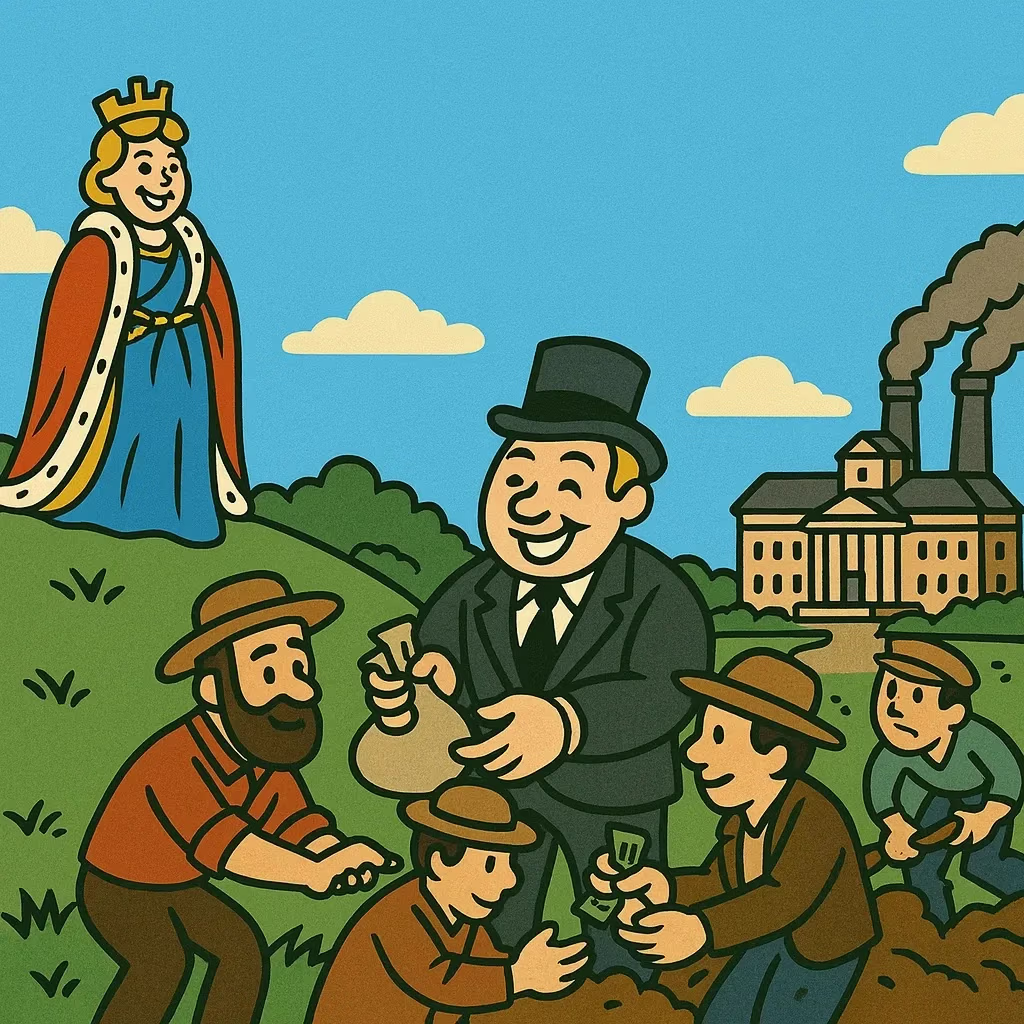
Queen Victoria’s government viewed the arrangement as an accounting victory. The Dominion would finance its own defence and infrastructure yet remain loyal to British markets. Britain retained naval bases, shipping contracts, and access to raw materials without the cost of direct administration. The Crown’s name—its brand, essentially—gave the new Dominion international credit.
The deal paid dividends immediately. Canadian bonds issued in London after 1867 carried lower interest rates because they were backed by the Crown’s guarantee (The Times, London, 3 Aug 1867). Investors treated the Dominion as a Crown corporation.
A Nation by Proxy
Canada’s founding document thus created a proxy state—a local management company operating under royal charter. Its directors were the Cabinet; its shareholders were the imperial government and its financial partners. Its workers were the colonial public.
When the Statute of Westminster finally granted legislative autonomy in 1931, Canada still retained the same operating system. The Crown remained the legal owner of land and the sovereign source of law. The Dominion had learned to speak with a Canadian accent but continued to think in imperial terms.
The structure Macdonald and Carnarvon built required loyalty, and loyalty had to be rewarded. In the years following Confederation, the Crown converted political obedience into personal wealth and social prestige through knighthoods, governorships, and lucrative appointments. The Dominion’s early elite were paid not only in currency but in titles—proof that the Queen’s business deal was profitable for those who signed it.
Part II – Imperial Rewards: Knighthoods, Titles, and Patronage
The Price of Loyalty
Confederation did not rest on abstract patriotism; it rested on loyalty that could be purchased. The British Empire had long perfected the art of rewarding compliance through titles, decorations, and appointments. In the years surrounding 1867, that machinery reached Canada. Those who had mid-wifed the British North America Actquickly found themselves compensated in the coin of empire—honour, office, and access.
The honours were not symbolic. They conferred social elevation, insider status in London’s political and financial circles, and direct material gain through government patronage and contracts. Every Dominion politician understood that proximity to the Crown translated into profit.
Britain’s colonial bureaucracy had long used honours to hold far-flung governors in line. From India to New Zealand, the same pattern appeared: loyal administrators received a ribbon and a title, which in turn validated their rule at home (Colley 1992). The Canadian Confederation was simply another node in that imperial network.
When the Order of St. Michael and St. George was extended to “colonial and foreign service” in 1868 (London Gazette, June 28 1868), the ink on the BNA Act was scarcely dry. The first investitures went to Confederation’s architects. The Crown’s message was unmistakable: serve well, and you become one of us.
In July 1867, barely days after Dominion Day, John A. Macdonald was knighted KCMG by Queen Victoria (London Gazette, July 1 1867). The honour was not spontaneous gratitude; it was an investment in continuity. Macdonald became the Crown’s most reliable colonial governor without the uniform. The knighthood placed him within the imperial order and made his authority visible to Canadians who might still confuse “responsible government” with popular rule.
The rewards continued. When Macdonald faced scandal over the Pacific Railway contracts in 1873, the Crown did not rescind his title; London’s financiers still considered him “safe hands.” His later elevation to GCB (Grand Cross of the Order of the Bath, 1884) re-affirmed that status. In the imperial logic of the age, mismanaging public money was a venial sin; threatening the Crown’s hierarchy was mortal.
George-Étienne Cartier, Macdonald’s Quebec partner, received his knighthood the following year (1868). His role had been delicate: to convince French-Catholic elites that they could remain French in law and British in allegiance. For the Colonial Office this was the masterstroke that made Confederation safe. The KCMG pinned to Cartier’s chest was more than ornament—it was a badge of successful containment.
The decoration belonged to the Order of St. Michael and St. George, an order originally created to honour British officials governing the Mediterranean colonies. In other words, Cartier was admitted to the same order as colonial administrators in Malta and the Ionian Islands. The symbolism was precise: Quebec was another territory to be managed through cultural accommodation under royal oversight.
Charles Tupper of Nova Scotia and Samuel Leonard Tilley of New Brunswick both received the KCMG in 1879. By that time Tupper had proven his loyalty by suppressing Nova Scotian resistance to Confederation; Tilley had kept the Maritimes fiscally obedient. Their knighthoods publicly legitimized them as the Crown’s men in the Maritimes.
Alexander Galt took a different path. He left Parliament to become the Dominion’s first High Commissioner to London—essentially a permanent lobbyist to the British government and bond market (Government of Canada Archives, RG 25). The position came with diplomatic rank, a salary drawn from Canadian taxes, and a social circle inside the empire’s financial capital. Galt’s career illustrated the transactional nature of Confederation: those who built the Dominion became its colonial ambassadors.
Titles were only the visible rewards. Beneath them lay a web of contracts, commissions, and sinecures that tied provincial elites to Ottawa and Ottawa to London.
- Railway charters worth millions went to firms connected to Conservative donors.
- Legal and banking appointments rotated through the same families that supplied Cabinet ministers.
- Governorships of new provinces and territories were awarded to party loyalists (Creighton 1952).
Each appointment reinforced the imperial hierarchy: authority flowed from the monarch to the governor general, then to the prime minister, and finally down to provincial lieutenants and local officers. The pay packets may have been issued in Canadian dollars, but the hierarchy remained denominated in British prestige.
Sidebar – The Honours Pipeline
Order of the Bath (OB/CB/GCB): Primarily for military and senior civil service distinction. Colonial premiers who kept the empire solvent could be advanced to Grand Cross.
Order of St. Michael and St. George (CMG/KCMG/GCMG): Created 1818; extended 1868 to colonial administrators and diplomats. Almost every major Dominion politician between 1867 and 1914 entered this order.
Privy Council of the United Kingdom: Membership conferred the style “Right Honourable.” Admission signified that the holder was trusted to advise the Crown directly—a privilege granted to very few outside Britain.
Governor General’s Appointments: The monarch’s vice-regal representatives in Canada were drawn almost exclusively from British nobility until 1952. Each Canadian knighthood or governorship reaffirmed that the imperial chain of command remained intact.
The strategy worked. Knighthood provided the colonial elite with social parity to their British patrons. It also created a psychological dependency: once titled, a man’s status and sense of legitimacy derived from the Crown’s recognition. The same mechanism operated across the empire. As historian David Cannadine observed, Britain governed its possessions “through the art of symbolic inequality” (Cannadine 2001). Canada’s new aristocracy was no exception.
Even opponents of Macdonald’s party competed for honours. Liberal leader Alexander Mackenzie, despite railing against patronage, accepted membership in the Privy Council in 1874. To refuse a royal favour was to admit irrelevance.
By the 1890s the honours system had matured into an economy of its own. Lieutenant governors, judges, and senior civil servants routinely received British decorations upon retirement. The London Gazette listed Canadian recipients beside colonial governors from Jamaica and Ceylon.
The federal Cabinet even budgeted for the travel costs of new knights to receive investiture in London (Public Accounts of Canada, 1892). The empire rewarded its local partners the same way a corporation rewards executives with stock options.
The practice continued after Macdonald’s death in 1891.
Prime Minister John Thompson died at Windsor Castle in 1894 just after being sworn into Queen Victoria’s Privy Council—a death literally in service to the Crown. Wilfrid Laurier, the first French-Canadian prime minister, accepted the GCMG in 1897 during the Diamond Jubilee. His knighthood was meant to show that French Canada’s loyalty had not wavered.
Laurier’s acceptance provoked republican grumbling in the press, but the criticism faded; colonial society still equated imperial favour with respectability.
The material advantage of a title was real. “Sir” on a calling card opened doors in London banks and shipping houses. Dominion politicians could float loans or negotiate trade concessions precisely because their honours signalled credibility within the imperial hierarchy.
In that sense, the Crown’s honours were a form of convertible currency—one that traded political obedience for access to capital. Canada’s early infrastructure, from the Intercolonial Railway to the transcontinental telegraph, depended on those London loans. Knighthood was collateral for empire-backed credit.
The honours economy also bred corruption. The Pacific Scandal of 1873 revealed that Macdonald’s government had accepted election funds from railway financiers seeking the transcontinental contract (Parliamentary Debates, 1873). The scandal temporarily toppled his government but did not end the practice. Titles and contracts continued to circulate together. The Crown’s concern was not ethics but stability; as long as Ottawa remained loyal, London ignored domestic irregularities.
By 1914, knighthood had become almost automatic for prime ministers, governors, and judges. Even the judicial hierarchy embodied imperial subordination: the final court of appeal for Canadians remained the Judicial Committee of the Privy Council in Londonuntil 1949 (UK Judicial Committee Act 1833). That meant British peers could overturn Canadian Supreme Court decisions. The same men who conferred knighthoods also handed down verdicts—a closed circuit of colonial validation.
The honours pipeline persisted long after the Dominion acquired legislative autonomy. Between 1867 and 1935, more than 400 Canadians received British knighthoods or comparable titles (Canada Gazette Honours List, 1935). Only in 1919 did Parliament pass a resolution discouraging the acceptance of hereditary titles—the Nickle Resolution—and even that was advisory, not binding.
The symbolic chain of loyalty survived because it served both sides. Britain retained influence; Canadian politicians retained prestige. The corporate culture of empire had become part of the Dominion’s political DNA.
The Crown had purchased loyalty with decorations, but it also bought peace through division. The same year the first Canadian knighthoods were minted, George-Étienne Cartier sold Quebec’s elite on the promise that they could remain “French in law and British in allegiance.” That compromise created a permanent dualism that would define Confederation from that day to this.
Part III – French in Law, British in Allegiance: The Quebec Compromise
The architects of Confederation faced a puzzle that could have undone the entire project: how to bind a conquered French-Catholic population to an Anglo-Protestant empire without bloodshed. Britain’s answer was not equality but containment through privilege—granting Quebec legal and cultural autonomy while securing its political allegiance. George-Étienne Cartier became the broker of that trade. Macdonald, the consummate imperial pragmatist, called him “the very keystone of the arch.”
The price of Cartier’s loyalty—and of Quebec’s acquiescence—was a constitutional duality that still divides Canada: French in law, British in allegiance.
At the Quebec Conference of 1864, Cartier promised his compatriots that Confederation would protect la nation canadienne-française. His assurance was explicit:
“By Confederation we will be French in our laws, religion, and customs, but British in allegiance and in the liberty which that allegiance gives us.” (Cartier, Speech to the Electors of Montreal East, 1865; Debates on Confederation, 1865.)
The phrase was no flourish—it became a constitutional blueprint. The BNA Act entrenched Quebec’s separate system of civil law (s. 92(13)) and education (s. 93), granting cultural sovereignty in exchange for political loyalty. The British Parliament could thus present the new Dominion as tolerant, while ensuring that final authority—the Crown—remained untouched.
To the Colonial Office, cultural pluralism was not a concession—it was a strategy of control. Empires thrive on manageable difference: keep communities distinct enough to prevent unified opposition, yet dependent on imperial arbitration (Porter 1999). By granting Quebec autonomy over culture and law, London ensured that no common colonial identity could emerge. Cartier’s compromise created a bilingual, bi-legal Dominion that required the Crown’s authority as referee.
The result was ingenious and poisonous: a structure where unity depended on division.
Macdonald, an Orangeman with little love for French institutions, accepted the arrangement because it neutralized both Quebec nationalism and republican contagion from the south. As he told Parliament in 1865:
“In legislating for ourselves we must remember that we legislate under the Crown of England, and for subjects of Her Majesty of different races and creeds.” (Debates on Confederation, 1865.)
That single sentence captures the logic of Confederation: multiple peoples, one sovereign. The Crown became not merely the head of state but the mechanism that made coexistence possible. Without it, Macdonald warned, Canada would dissolve into “a second United States.”
The Roman Catholic Church in Quebec was another key stakeholder. Bishop Ignace Bourget and his ultramontane allies viewed the British Crown as a lesser evil compared with secular republicanism. Confederation promised constitutional protection for denominational schools—an ecclesiastical stronghold against liberal reform. In return, the clergy used their pulpit network to rally support for the union (Cook 1969).
The Church thus became an auxiliary of imperial order: teaching loyalty to “God and the Queen” as compatible duties.
The autonomy granted to Quebec’s elites did not extend to the masses. Francophone farmers and workers gained little political power; they were represented by a clerical-nationalist class invested in the very system that limited them. The rest of the Dominion saw Quebec’s privileges as favoritism, fuelling resentment that Ottawa would later exploit to justify central control.
Confederation’s dual structure hardened into two solitudes, each bound to the Crown yet alienated from the other. The imperial centre remained the only common authority.
In England, from Whitehall’s perspective, the Quebec arrangement was a triumph of imperial engineering. Governor General Lord Monck wrote to the Colonial Office in 1867:
“The French Canadians, whose attachment to their laws and religion made them difficult subjects to govern, will now find their security in the maintenance of the connection with the Crown.” (CO 42/661.)
Translation: keeping Quebec Catholic and French ensured that it would never join an American-style republic. Cultural autonomy was the leash, not the liberation.
The pattern repeated in later imperial settlements: South Africa (1909) preserved Dutch legal forms under British sovereignty; India (1935) maintained religious electorates under the Raj. The formula—local custom plus imperial allegiance—was the British Empire’s most reliable technology of rule. Canada was its prototype in the north.
While Quebec enjoyed legal autonomy, economic power remained centred in Ontario and the Maritimes, where British capital financed railways, shipping, and manufacturing. By insulating Quebec’s culture, Confederation also insulated its economy from dominance. Francophone business developed within a protected provincial sphere, dependent on federal transfers and London markets. Unity was achieved through complementary dependence: the English owned, the French administered, and both deferred to the Crown.
Cartier’s “French in law, British in allegiance” formula outlived him by generations. It defined the negotiations of 1926 (King–Byng Affair), 1960 (Quiet Revolution), and 1982 (patriation debates). Each crisis revolved around the same question: who actually owns the constitution—the people or the Crown? Every attempt to redefine the relationship collapsed into the inherited fiction that the monarch is the final arbiter of Canadian unity.
“We are British subjects because we enjoy the liberties of Englishmen; we remain French because we have preserved our religion, our institutions, and our laws.” — George-Étienne Cartier, 1865
Cartier believed these liberties would shield his nation within the empire. In practice, they bound it more tightly to the very system that defined it as subordinate.
Why It Matters Now
The Quebec Compromise did more than shape cultural policy; it established the template for Ottawa’s later relationships—with the West, with Indigenous peoples, and with every region that demanded autonomy. The lesson was simple: grant limited self-management, retain sovereign control. That doctrine explains why Alberta today controls its schools and hospitals but not the constitutional framework that governs them. Confederation’s DNA still carries Cartier’s logic.
By 1867, the Crown had divided the Dominion into manageable identities: a loyal French province, a compliant Anglo core, and a frontier yet to be subdued. The next step was to apply the same imperial logic to the peoples who had never been consulted at all—the First Nations. In 1876, Ottawa codified their subordination through a single piece of legislation that turned sovereign nations into wards of the Crown.
Part IV – The Internal Empire: The Indian Act and the Crown’s Dominion Over Indigenous Peoples, A Colony Within a Colony
When Parliament passed the Indian Actin 1876 (S.C. 1876, c. 18), it created not merely a statute but a parallel government—an internal empire nested inside the Dominion. The Act consolidated dozens of earlier colonial ordinances into one code that defined who was an “Indian,” how reserves would be governed, and how Ottawa would control every aspect of life on them. Its guiding premise was explicit: Indigenous nations were wards of the Crown, not partners in Confederation.
The new Dominion had inherited both the land and the legal habits of empire. British administrators from India and the Caribbean already knew how to manage dependent populations through trusteeship and appointed intermediaries. The Indian Act was Canada’s local application of that global formula.
Each section treated Indigenous peoples not as treaty partners but as a category of the public service to be administered. Parliament thus assumed a power the imperial Parliament had never explicitly granted: to legislate unilaterally over sovereign nations that had signed treaties with the Crown.
Between 1871 and 1921 Canada negotiated the Numbered Treaties (1-11) across the Prairies and North. While Indigenous signatories understood them as nation-to-nation agreements guaranteeing coexistence, Ottawa interpreted them as land-surrender documents enabling agricultural settlement and resource extraction (Miller 2009; TRC 2015). Clause 3 of most treaties transferred land “to the Crown and its successors forever,” echoing the language of a real-estate deed rather than a political compact.
Once the ink was dry, federal surveyors moved in, reserves were plotted, and the Indian Act supplied the administrative framework for control. The treaties became the acquisition paperwork for the Dominion’s expansion—the internal equivalent of Britain’s colonial charters overseas.
Sidebar – How the Indian Act Centralized Power
- Departmental Control: All “Indian affairs” assigned to a federal department (now Indigenous Services Canada).
- Discretionary Authority: The minister could override band decisions, lease reserve lands, or distribute funds.
- Judicial Immunity: Crown agents operated with near-total immunity; grievances required petition to the same authority causing them.
- Cultural Suppression: Later amendments banned the potlatch (1884) and Sun Dance (1895).
- Enfranchisement: “Civilized” Indians could be forcibly enfranchised—losing status and land rights.
Officials justified these powers as “benevolent guardianship.” Deputy Superintendent D.C. Scott wrote in 1920:
“Our object is to continue until there is not a single Indian in Canada that has not been absorbed into the body politic.” (Department of Indian Affairs Annual Report, 1920.)
Such language cast assimilation as a moral duty. In practice it produced chronic poverty and dependency. Ottawa controlled band revenues, approved or rejected economic projects, and restricted mobility through the pass system (an administrative order in effect 1885-1940). A population once self-governing became, by law, a client of the state.
The policy also secured land for settlement and resources for the Crown. Between 1871 and 1930, more than 98 percent of Prairie territory passed from Indigenous stewardship to Crown ownership (Statistics Canada Historical Atlas Series, 1936). The mineral wealth beneath those lands—coal, oil, gas, and later potash—became the economic foundation of the Dominion. The Indian Act thus served the same function domestically that imperial charters served abroad: it converted inhabited territory into taxable, leasable Crown property.
Residential and industrial schools—operated by churches under federal contract—functioned as the assimilation arm of this internal empire. Roughly 150 000 Indigenous children attended these institutions between 1883 and 1996 (TRC Final Report, 2015). Many never returned home. The system’s intent was identical to the statute’s wording: “Our object is to continue until there is not a single Indian in Canada that has not been absorbed into the body politic.” The Truth and Reconciliation Commission later concluded that these policies constituted cultural genocide (TRC Summary Report 2015, p. 1).
Seen through the lens of imperial governance, the Indian Act was the Crown’s colonial reflex applied at home. Where Britain ruled India through the Viceroy, Canada ruled Indigenous peoples through the Superintendent-General of Indian Affairs. Both systems relied on intermediaries—chiefs, clerks, missionaries—who derived their authority from the sovereign rather than their communities.
Even the language of the Act mirrored overseas ordinances: “bands,” “reserves,” “wards,” “guardianship.” The difference was geography, not principle.
Parliament amended the Indian Actdozens of times—in 1951 (to remove bans on ceremonies) and 1985 (to end gender discrimination)—but the core premise remained: Indigenous affairs are a federal jurisdiction under section 91(24) of the Constitution Act, 1867. That constitutional anchor ensures that true sovereignty for Indigenous nations would require constitutional, not statutory, change.
In this sense, Indigenous peoples and provinces share a structural predicament: both hold delegated authority beneath a sovereign Crown. The “two systems” that Cartier designed for French and English Canada became three once Indigenous nations were added to the hierarchy—all operating under a single imperial root.
Sidebar – Legal Echoes Today
- Constitution Act 1982, s. 35: recognizes “existing Aboriginal and treaty rights,” but courts interpret those rights subject to Crown sovereignty (R v. Sparrow, 1990).
- Haida Nation v. B.C., 2004 SCC 73: the Crown has a “duty to consult,” yet retains final decision-making power.
- Tsilhqot’in Nation v. B.C., 2014 SCC 44: recognized Aboriginal title but confirmed that “Crown title underlies all land in Canada.”
Each ruling affirms the same legal fiction established in 1876: ultimate ownership resides with the Crown.
The Indian Act reveals that Confederation was never a compact among equals; it was a tiered empire disguised as federation. At the top, the Crown; beneath it, federal and provincial governments; below them, Indigenous nations and ordinary citizens. That pyramid still defines Canadian constitutional order.
Understanding this hierarchy is crucial to any discussion of Alberta’s place within Confederation. The province’s fight for jurisdiction over its resources and laws is a mirror image of the struggle Indigenous nations have waged for sovereignty: both challenge the same imperial premise—that the Crown owns the land and the people govern only by permission.
By 1876, Canada had extended the Crown’s authority from the Atlantic to the Rockies, binding settlers and Indigenous peoples alike through legal dependence. The next layer of control concerned property itself—the soil under everyone’s feet. The same feudal logic that defined reserve lands also defined private ownership across the Dominion.
Part V – The Crown’s Real-Estate Empire: Fee Simple and the Illusion of Ownership, A Feudal Foundation Hidden in Modern Paperwork
Canadians speak of “owning” their homes, farms, and businesses as if ownership were absolute. Yet every land title in the country carries a quiet confession: the land is held of His Majesty the King—not from the people, not from Parliament, but from the Crown itself.
The term used in the Land Titles Act is fee simple, the most complete estate a subject can possess. It sounds modern, but it is the direct descendant of feudal tenure. In the eyes of the law, the monarch still owns the soil; the public merely holds hereditary tenancies.
That legal fiction is the invisible architecture of Canada’s property system. It defines how governments tax, expropriate, and regulate land, and why the state can seize a parcel for unpaid taxes or infrastructure without violating “ownership.”
When Britain claimed sovereignty over North America, the Crown declared itself the root of title to all land. Settlement proceeded through royal grants—Crown patents—which transferred possession but never sovereignty. The colonist became a tenant, owing loyalty instead of rent.
After Confederation, section 109 of the British North America Act (1867) vested “all Lands, Mines, Minerals, and Royalties belonging to the several Provinces” in “the Crown in right of each Province.” Ownership of the country’s entire surface and subsurface remained with the same legal person: the monarch.
In Alberta, section 61 (1) of the Land Titles Act still spells it out:
“The owner of land shall hold the land of the Crown in right of Alberta in fee simple.”
The phrase is not decorative; it is operative law.
Sidebar – What Is a Legal Fiction?
A legal fiction is something the law treats as true for convenience, even when it is not literally true. The idea allows courts to keep order where reality would be messy. Classic examples include:
- “The Crown owns all land.” No monarch could personally own 10 million square kilometres, yet the fiction makes property law coherent.
- “Corporations are persons.” A legal stand-in so companies can sign contracts or be sued.
- “The King can do no wrong.” An old immunity rule to protect the sovereign from his own courts.
Fictions simplify law—but they also preserve power structures. Accepting that the Crown owns the land keeps sovereignty anchored in the monarchy rather than in the citizen.
From Allodial to Feudal: The Lost Right of Absolute Ownership
In medieval England, only the king held allodial title—land owned outright, owing service to no lord. Everyone else held an estate of the Crown.
The same principle travelled to Canada. The Royal Proclamation of 1763 declared all North-American lands “belonging to the Crown.” Early settlers received patents that looked like ownership but were legally tenures.
By 1867 the arrangement was permanent: every acre—public, private, or reserve—rested on Crown title. The BNA Acttransferred that ownership to the federal or provincial Crowns but did not abolish it. Canada remained a feudal pyramid with a constitutional gloss.
Replace paper patents with registry entries, retaining Crown ownership language.
By the time Canada called itself a country, absolute title no longer existed.
The persistence of Crown title gives governments extraordinary leverage:
- Taxation and Escheat. If property taxes go unpaid, the land “escheats”—returns—to the Crown without compensation.
- Expropriation. Because the Crown owns the root of title, it can reclaim land for public use with only statutory compensation.
- Regulation. Zoning, building codes, and environmental rules derive legitimacy from Crown sovereignty over the soil.
These are practical powers, not medieval curiosities. They shape every mortgage, development permit, and farm transfer in the country.
Even beneath private farms and cities, the minerals belong almost entirely to the Crown. In Alberta, the Mines and Minerals Act (RSA 2000 c. M-17) states:
“All mines and minerals are the property of the Crown in right of Alberta, unless otherwise expressly disposed of.”
This clause severs the ground in two: a private surface and a public subsurface. Landowners may cultivate, build, or graze, but the oil, gas, and metals beneath are the King’s assets. Companies extract them under lease and pay royalties—the modern form of feudal rent.
A few families still hold private mineral rights from Hudson’s Bay Company or Canadian Pacific Railwaygrants issued before 1930. These “freehold minerals” cover less than 20 percent of Alberta and about 15 percent of Saskatchewan. Everywhere else, the Crown’s dominion continues underground.
Ontario’s older settlements reveal the opposite history. In the eighteenth and early nineteenth centuries, the Crown was desperate for settlers and indifferent to minerals. It issued patents granting both surface and subsurface rights. Only after mineral wealth proved valuable did new patents begin reserving mines and minerals to the Crown (post-1860s). That timing accident explains why some Ontario landowners still own the resources under their feet while westerners do not.
Footnote – How the Fiction Appears in Law
- Land Titles Act (Alberta) s. 61 (1): “land held of the Crown in right of Alberta in fee simple.”
- Mines and Minerals Act (Alberta) s. 10: “All mines and minerals are the property of the Crown in right of Alberta.”
- Crown Lands Act (RSC 1985 c. C-50): “Crown lands means lands of which the Government of Canada has power to dispose.”
- St. Mary’s Indian Band v. Cranbrook (City) [1997] 2 S.C.R. 657: “Underlying title to all land in Canada resides in the Crown.”
Every citation reiterates the same truth: ownershipis conditional upon royal sufferance.
Fee-simple tenure survives because it keeps property predictable. Mortgages, municipal finance, and infrastructure depend on the Crown’s underlying authority. But the structure also perpetuates a subtle hierarchy: no Canadian, not even a province, possesses absolute sovereignty over land.
That reality links individual property law to national politics. Provinces like Alberta may administer Crown lands, yet the constitutional language—“in right of the Crown”—prevents them from claiming independent title. The same logic that limits a homeowner’s rights limits a province’s.
If Alberta were to declare itself fully sovereign, one of its first legal acts would have to be to convert Crown title to allodial title—vesting ownership of the territory in the new republic or directly in its citizens. That single reform would symbolically and legally end the Queen’s business deal.
Without such change, even a nominally independent Alberta would remain a tenant of a Crown headquartered elsewhere.
Summary
- Canada’s property law is a living remnant of feudal England.
- The Crown retains ownership of all land; Canadians hold estates beneath it.
- This arrangement centralizes taxation, expropriation, and resource control.
- The provinces’ dependence on Crown title mirrors citizens’ dependence on fee-simple tenure.
- True sovereignty—individual or provincial—would require replacing Crown ownership with allodial title.
If land tenure makes every Canadian a tenant of the Crown, resource law makes every province a branch of the Crown’s treasury. The same constitutional logic that reserves the soil reserves the wealth beneath it.
Part VI – The Crown’s Hidden Dividend: Resource Ownership and the Control of Wealth, From Landlord to Shareholder
The Dominion’s Business Model
Section 109 of the British North America Act (1867) states:
“All Lands, Mines, Minerals, and Royalties belonging to the several Provinces… shall belong to the several Provinces of Canada, subject to any Trusts existing in respect thereof, and to any Interest other than that of the Province.”
On its face, this looks like provincial ownership. But the phrase “belonging to the Crown in right of the Province” means the monarch still holds root title. A province may lease, license, and collect royalties, yet the estate itself never leaves royal hands.
The arrangement resembles a franchise model: provinces run the local operation, Ottawa controls inter-provincial trade and taxation, and the Crown retains the brand and residual claim on profits.
(Data from Natural Resources Canada Land and Mineral Ownership Survey, 2023.)
The provinces’ right to manage resources does not prevent the federal government from taking a slice. Ottawa taxes corporate profits, sets environmental and transportation rules, and redistributes revenue through equalization. The net effect is that resource-rich provinces subsidize those without extractive industries.
The pattern began early. After the Natural Resources Transfer Agreements of 1930 gave the Prairie provinces administrative control, federal statutes still defined export pipelines and rail rates. The new “owners” could dig the well but not necessarily sell the product on their own terms.
A royalty is literally the Crown’s share. The word comes from medieval mining law—regalitas, the king’s prerogative to take a portion of every mineral found in his realm. In Alberta today, the Mines and Minerals Act (RSA 2000 c. M-17) uses identical language: royalties are payments “to the Crown in right of Alberta.”
These rents fund provincial budgets. Yet because the owner of record is still the Crown, the province acts as trustee, not proprietor. That subtlety underlies every jurisdictional fight between Edmonton and Ottawa. Alberta demands “our oil,” but legally the oil is His Majesty’s—only administered by the province.
The Equalization Engine
Equalization payments, established under section 36 (2) of the Constitution Act (1982), aim to ensure that provincial governments can provide comparable public services at comparable tax rates. The formula measures fiscal capacity, including resource revenue. Consequently, a boom in Alberta inflates national transfers; a bust deflates them.
Critics in Alberta call this confiscation by formula. Supporters describe it as social solidarity. Either way, it depends on the constitutional fiction that all wealth flows from the same source—the Crown—and can therefore be redistributed by its Parliament.
Sidebar – How Equalization Works
- Estimate fiscal capacity (per capita revenue potential) for each province.
- Calculate national average.
- Provinces below average receive payments from federal revenue.
- Federal revenue is disproportionately funded by resource-rich provinces’ corporate and income taxes.
This circular system keeps the empire’s internal economy balanced, much like Britain once used colonial customs to fund the home treasury.
Because the legal framework centralizes ultimate ownership, provinces cannot mortgage resources as collateral for large-scale development without federal backing. The Crown’s underlying title provides international investors with security—Canadian oil and gas reserves are “sovereign-backed.” But that same guarantee limits provincial freedom.
Alberta’s attempts at independent pipelines or alternative export routes—Northern Gateway (2014), Energy East (2017)—failed under federal regulatory authority derived from the Crown’s jurisdiction over “inter-provincial and international trade” (s. 91(2)). The empire’s logic persists: local production, central approval.
Royalty income, taxes, and federal rents combine into what economists call the Crown’s take—the total public share of resource value. Across Canada it averages 50–60 % of gross profits (Canadian Energy Regulator Data, 2022). In the 2021–22 fiscal year, Alberta alone remitted over $17 billion in royalties to “the Crown in right of Alberta,” a phrase repeated in every budget line.
Although the money funds provincial programs, the legal owner remains a monarch whose authority originates outside the provincial constitution. The public purse and the royal purse are conceptually one.
Why Ownership Still Matters
If resource wealth is Crown property, sovereignty remains incomplete. A province cannot claim full independence while its subsurface riches belong to a foreign sovereign. Nor can citizens claim absolute ownership of land whose minerals the state can lease without their consent.
The structure works economically—it ensures stability, creditworthiness, and predictable revenue—but it freezes political evolution. Every reform remains bounded by a 19th-century assumption: the Crown is the ultimate shareholder.
The contrast between East and West completes the picture. Ontario and Quebec inherited older patents that sometimes included private minerals; the West was settled under strict Crown reservation. That difference explains the persistent sense of imbalance between the industrial East and the resource-producing West.
Part VII – Ontario’s Exception and Alberta’s Rarity: Uneven Ownership Across Confederation
A Patchwork of Title
Canada’s property map looks uniform on paper, yet the legal history beneath it is patchy. A homeowner in southern Ontario may own the ground and everything under it; a rancher in central Alberta owns only the top few feet. This unevenness isn’t an accident—it’s the result of how each region entered Confederation and when the Crown decided that minerals were too valuable to give away.
How Ontario Kept What the West Lost
In eighteenth- and early-nineteenth-century Ontario, then Upper Canada, the British Crown was desperate for settlers. Land was the lure; minerals were an afterthought. Crown patents routinely conveyed property “together with all mines and minerals thereunder.” It was a generous clause born of ignorance: no one yet imagined that nickel or petroleum could build empires.
When industrial mining began in earnest during the 1840s–1850s—the copper rush at Bruce Mines, the gold discoveries along the Ottawa River—the government realized it had been giving away billions in potential revenue. By the 1860s new patents began reserving “mines and minerals” to the Crown (Ontario Crown Lands Act 1860, s. 13). But thousands of earlier grants remained on the books, and their mineral rights still belong to private families or companies today.
Confederation’s Timing Trap
Ontario’s mixed system became law before Confederation standardized the rule that minerals belonged to the Crown. By the time western settlement began, the lesson had been learned. The federal Dominion Lands Act (1872) made mineral reservation automatic:
“All mines and minerals and the right to work the same are reserved to the Crown.” (s. 58)
That single clause drew a legal curtain between East and West that still stands. Anyone settling the Prairies under the Dominion Lands Act received surface rights only. When Alberta and Saskatchewan were carved from the North-West Territories in 1905, their resource base was already alienated to Ottawa. The provinces did not gain even administrative control until the Natural Resources Transfer Agreements of 1930, and even then ownership remained “in the Crown in right of the Province.”
Alberta’s Rarity: The Families with Freehold Minerals
A tiny minority of Albertans possess something their neighbours do not—freehold mineral rights. These rare titles originate from four historical sources:
- Hudson’s Bay Company Reserves (1870s). When Rupert’s Land was sold to Canada, the HBC kept one-twentieth of the best farmland. Its patents included full mineral ownership, and when those parcels were sold, the minerals went with them.
- Canadian Pacific Railway Grants (1880s–1890s). Some railway lands conveyed to the CPR included subsurface rights. The company sold portions to settlers; others it retained. Many freehold mineral titles trace directly to those grants.
- Early Townsite Patents. A handful of pre-Dominion patents in southern Alberta conveyed both surface and minerals before the reservation rule became universal.
- Private or Corporate Letters Patent Before 1930. Occasional full-title patents issued for industrial or institutional purposes, later grandfathered under the 1930 transfer.
Together these sources account for roughly 15–20 percent of Alberta’s minerals (Alberta Energy Freehold Mineral Survey 2022). The rest—oil, gas, coal, metals—remains Crown property.
Why the Difference Endures
Constitutionally, property and civil rights are provincial matters (BNA Act s. 92(13)), but the root of title stays royal. Ontario’s pre-Confederation patents pre-date that clause; Ottawa cannot revoke vested rights. Alberta’s later patents were issued under federal statutes that already reserved the minerals. Thus two provinces operating under the same Constitution inherited opposite economic conditions.
The outcome shapes politics to this day. Ontario families may receive royalties from gravel or quarry operations on their land; Albertans rely on government leases and provincial royalty policy. One sees resource revenue as private enterprise, the other as public rent.
Legal Footnotes
- Dominion Lands Act 1872 s. 58: mineral reservation clause.
- Natural Resources Transfer Agreement (Alberta) 1930, Schedule 1: “All Crown lands, mines, minerals and royalties … belong to the Crown in right of the Province.”
- Mines and Minerals Act (Alberta) 2000 s. 10: re-affirms Crown ownership.
- Crown Lands Act (Ontario) R.S.O. 1990 c. C.48: permits private mineral ownership if not reserved in original patent.
The Broader Pattern
The uneven spread of private versus Crown minerals mirrors the broader structure of Confederation itself: early provinces obtained autonomy before resource value was recognized; late provinces entered after the rules had changed. It is a temporal inequality disguised as federal balance.
For Alberta, the timing was doubly unlucky. By the time it gained control of its resources in 1930, Ottawa had already imposed income tax (1917) and customs duties (1919), giving the federal treasury alternate ways to capture the wealth. The Natural Resources Transfer Agreements gave administration without independence—another chapter in the Queen’s business deal.
Why It Matters
Understanding this regional patchwork exposes how Canada’s political economy was engineered: the East inherited ownership; the West inherited administration. That structure still defines the federation’s internal tensions. Ontario’s private mineral holders exercise property rights; Alberta must petition for pipeline approvals. The rules were never uniform because the Crown’s purpose was not fairness but control.
By the early twentieth century, the Crown had achieved complete vertical integration of its Dominion: land, minerals, and revenue all flowed through royal title. Only the outer political form changed as Canada gained “self-government.” The next stage of this exposé turns from structure to consequence—how that architecture channels wealth, taxation, and political dependence into a single corporate logic.
Part VIII – Breaking the Business Model of Empire: Reclaiming Fiscal Sovereignty
A Nation Built Like a Corporation
By the early twentieth century the Dominion had become a vertically integrated enterprise: the Crown held the title to land and minerals, the federal government managed inter-provincial trade and finance, and the provinces administered the ground-level operations. Every layer served the same shareholder—the sovereign. Even after the Statute of Westminster (1931) and the Constitution Act (1982), the structure endured. Canada acquired domestic management; it never rewrote the articles of incorporation.
That continuity explains why economic arguments in Canada so often turn constitutional. Whether the debate is about equalization, carbon taxes, or pipelines, each side invokes not policy but ownership: whose wealth is it?
The Fiscal Chain of Command
- Crown Title → legitimizes resource royalties.
- Federal Taxation Power (s. 91(3) BNA Act) → allows Ottawa to skim income generated from those royalties.
- Spending Power → enables redistribution through transfers.
- Conditional Grants → bind provincial programs to federal standards.
The result is a feedback loop: wealth extracted from provincial resources returns as federal spending, often with strings attached. From a constitutional perspective, this is not an anomaly; it is the design of a colonial ledger balanced from the centre.
The Imperial Logic in Modern Dress
When the Crown ruled directly, tribute took the form of tariffs and remittances to London. In the modern federation, it flows as taxation and regulatory compliance to Ottawa. The hierarchy is constitutional rather than geographic: provinces stand to the federal government as colonies once stood to Britain—administrative units with delegated powers and restricted credit.
This is why resource provinces have periodically threatened rebellion, whether through Quebec’s Quiet Revolution(1960s) or Alberta’s “Firewall Letter” (2001). Each movement confronts the same structural truth: control over wealth follows control over law.
No Canadian province currently satisfies these conditions. Their constitutions, credit ratings, and even international treaties operate under the federal—and therefore Crown—umbrella. Full independence, in legal terms, would require rewriting the very preamble that ties Canada “under the Crown of the United Kingdom of Great Britain and Northern Ireland.”
Sidebar – The Norway Comparison
Norway’s petroleum model often appears in Canadian debates. Key difference: Norway’s constitution vests sub-surface ownership in the people, not in a monarch. The Petroleum Act (1996) declares that “the Norwegian State has the proprietary right to sub-sea petroleum deposits.” That single sentence allowed the government to treat oil as a public trust rather than a royal concession, creating the trillion-dollar Government Pension Fund Global. Canada’s equivalent clauses still speak of “the Crown in right of X Province.”
The Cultural Barrier
Beyond law lies psychology. Canadians have been taught for generations to equate loyalty to the Crown with stability and civility. The very language of citizenship—“Her Majesty’s Subjects,” now “Citizens of Canada”—reflects that inheritance. Re-imagining ownership as collective rather than royal requires cultural as well as constitutional change: shifting from subjects of order to stakeholders in authority.
Why Alberta’s Debate Matters Nationally
Alberta’s challenge is not merely provincial grievance; it exposes the fault line of the entire federation. If one province demonstrates that prosperity and self-government can coexist without Crown trusteeship, the constitutional fiction begins to crack. Whether that evolution happens through negotiated reform or a deeper re-founding, the underlying question remains the same: Can a federation born as a business deal under monarchy become a true partnership of equals?
Epilogue – The Queen’s Business Deal
The exposé began with the BNA Act, a transaction that bound disparate colonies “under the Crown.” A century and a half later, the signatures have faded but the contract endures. Canada functions because its people honour the terms—faith in stability, in legal continuity, in the idea that the Crown’s invisible hand ensures fairness. Yet that same structure limits what any province or citizen can truly own.
To “break the business model of empire” would mean converting loyalty into authority: from royal title to civic title, from managed prosperity to genuine sovereignty. Whether through reform or re-founding, that transformation would mark the first moment in which Canadians, collectively or provincially, could say not just we live under the Crown but we own the country that stands above it.
Executive Summary
The Dominion of Canada: The Queen’s Business Deal examines the true nature of Canada’s creation and governance, challenging the popular belief that Confederation was a grassroots act of unity. Drawing on primary documents, parliamentary records, and the structure of British colonial law, this paper reveals that Canada was not founded by its people—it was organized under the authority of the British Crown as a managed economic enterprise.
The study traces this framework from 1867 to the present, showing how the Crown’s original hierarchy—monarch at the top, federal managers beneath, provinces and Indigenous nations below—still defines Canada’s political and economic order today.
Key Findings
- Confederation as Contract, Not Revolution The British North America Act (1867) was drafted in London and enacted by the British Parliament. It created a Dominion, not an independent nation, with all sovereignty retained by the Crown. Canada began as an imperial franchise—administrators, not founders.
- Reward for Loyalty Confederation’s architects were rewarded with knighthoods, titles, and appointments. Imperial honours evolved into modern incentives: cabinet positions, federal funding, and national prestige. The structure still rewards loyalty to Ottawa, not autonomy.
- Divide and Govern Quebec was promised protection of its French laws and culture under the slogan “French in law, British in allegiance.” This compromise maintained peace through division, ensuring both French and English populations remained loyal to the same Crown.
- The Internal Empire The Indian Act (1876) replicated Britain’s colonial systems abroad, reducing sovereign Indigenous nations to wards of the state. The Act transferred nearly all Prairie land and its resources to Crown ownership, laying the foundation of Canada’s resource economy.
- Land Without Ownership All land in Canada is held of the Crown under fee simple tenure—modern feudalism. No individual or province holds absolute title; all property is conditional upon royal authority.
- Resource Control and Economic Dependence Provinces administer resources “in right of the Crown,” not in right of their people. Royalties and federal taxes maintain Ottawa’s dominance through equalization and regulation. This system keeps resource-rich provinces politically dependent and fiscally contained.
- Unequal Foundations Ontario’s pre-Confederation patents granted private mineral rights, while western provinces were settled under federal reservation laws. The East inherited ownership; the West inherited management.
- The Continuation of Empire Despite the Statute of Westminster (1931) and Constitution Act (1982), Crown ownership and allegiance remain unchanged. Canada governs itself locally but remains structured as an imperial corporation—with citizens as tenants, not owners.
Conclusion
The Queen’s Business Deal exposes the central contradiction of Confederation: a country that calls itself free but still operates under feudal ownership and Crown sovereignty. It argues that true self-determination—whether for Alberta, Indigenous nations, or Canada as a whole—requires confronting and replacing this inherited structure.
The question is no longer whether Canada should remain united, but what kind of unity it represents: a voluntary partnership of equals, or a perpetual franchise of the Crown.