Alberta Independence: Necessary and Inevitable
Author’s Note
I really don’t have time for things like this. My days are already full—running a business, keeping my café open, raising a family, staying connected to my community. Yet over the past five years, I’ve watched this country slide into something unrecognizable. I’ve watched friends lose their businesses. I’ve watched government officials close churches and jail pastors. I’ve watched people surrender their rights without a fight because they were told it was for their safety.
That experience changed me.
It forced me to look deeper into how this country actually functions—how our Constitution works, who it truly serves, and what “rights” really mean when the government can set them aside with the stroke of a pen. What I learned led me to an unavoidable conclusion: the Canada we thought we lived in doesn’t exist anymore. The only way we can remain free and prosperous is to stand for truth—even if that means breaking emotional attachments to a nation that no longer resembles what our grandparents built.
Over countless conversations with people from all walks of life—farmers, teachers, truckers, and lawyers—I’ve debated Alberta’s place in Confederation. Every time, the pattern repeats itself: what begins as a challenge to independence eventually becomes a justification for it. All paths, all arguments, all evidence lead to the same place: Alberta’s independence isn’t just desirable—it’s necessary and inevitable.
Introduction: Managed Decline and National Reckoning
Every society eventually reaches a point where illusion gives way to truth. For Canada, that moment has arrived.
We were taught to believe that “peace, order, and good government” were the foundations of our success. Yet in practice, those words have been weaponized to justify regulation, censorship, and dependency. What once meant stability now means control.
Over the past century, Canada’s political elite have traded the pioneering spirit of the West for the comfort of global bureaucracies. The United Nations’ Agenda 2030 and its companion, Agenda 2050, promote a future where prosperity is rationed in the name of “sustainability.” The World Economic Forum’s Great Reset promises a world where we “own nothing and are happy.” These aren’t conspiracy theories—they are published policy frameworks. Agenda 2030 explicitly calls for “transforming consumption and production patterns” and “strengthening control of national policies through multilateral partnerships” (United Nations, Transforming Our World: The 2030 Agenda for Sustainable Development, 2015, Goals 12 & 17).
In plain language: unelected global bodies are reshaping how Canadians live, work, and govern themselves.
This isn’t a uniquely Canadian story—it’s a Western one. Across Europe, nations have surrendered sovereignty to supranational institutions in exchange for promises of stability. In return, they’ve inherited energy shortages, mass immigration crises, and political paralysis. Canada is following the same path, but faster.
The strategy is what I call “managed decline.” It’s the deliberate throttling of productive industries—especially energy—under the banner of climate policy. Since 2015, Canada has cancelled or obstructed over $150 billion in private investment in oil and gas projects (Source: CAPP, Canadian Energy Investment Data, 2023). The federal carbon tax, introduced at $20 per tonne in 2019, is set to rise to $170 by 2030 (Environment and Climate Change Canada, Carbon Pricing Schedule, 2021). These policies are not accidents—they are the economic manifestation of globalist ideology.
And who pays for it? Alberta.
Alberta produces the wealth that Ottawa redistributes to maintain its political dominance in Central and Eastern Canada. Equalization is the polite word for it, but it’s really a system of economic servitude. The arrangement ensures that productive provinces stay productive enough to be taxed, but never independent enough to be free.
In the 1990s, economist Robert Mansell from the University of Calgary documented how Alberta’s contribution to federal revenues far outpaced the value of federal spending within the province, calling it “a classic case of fiscal exploitation under the guise of national solidarity” (University of Calgary Policy Paper, 1993). Three decades later, the imbalance has only worsened.
While Alberta’s oilfields keep the lights on across the country, Ottawa kneecaps the very industry that funds the federation. Pipelines are cancelled for “climate” reasons; jobs vanish while imported oil still flows freely into Eastern refineries. If you wanted to design a system to strangle prosperity, you couldn’t do it better.
This is not unity. It’s bondage disguised as brotherhood.
Canadians often recoil at the word “independence,” imagining it means hostility or disloyalty. It doesn’t. Independence means maturity—the recognition that Alberta can and should manage its own affairs. It means trading infantilizing dependence on Ottawa for the dignity of self-determination.
But before we get there, we must face a hard truth: the Confederation model is broken beyond repair.
The Constitution Act of 1982- which Alberta did NOT initially consent to be patriated, (see https://reviewcanada.ca/magazine/2011/09/showdown-in-ottawa/ ) shifted ultimate authority from Parliament to the courts, but not to the people. Our Charter of Rights and Freedoms looks noble on paper, yet Section 1 allows the government to suspend those rights whenever it deems the limits “reasonable.” In R v Oakes (1986), the Supreme Court formalized this as the “Oakes test,” turning freedom into a permission slip that the government can revoke during “emergencies.”
That is not liberty. That is license.
And as the COVID-19 pandemic revealed, that license can be revoked overnight. Alberta’s own courts, including in Ingram v Alberta (2023 ABKB 360), have since confirmed that major public-health orders were never properly enacted in law. Yet those orders were used to bankrupt businesses, arrest pastors, and criminalize peaceful protest.
The problem isn’t just a bad government; it’s a bad system. The Canadian Constitution was designed for peace, order, and good government, not freedom, accountability, and individual rights. It was crafted to keep colonies orderly—not to make citizens sovereign.
If you want proof that the system is unfixable, look no further than the constitutional amendment process itself: under Section 38 of the Constitution Act, 1982, any amendment requires approval from seven provinces representing at least 50 percent of the population, plus majorities in the House of Commons and the Senate. Reform is mathematically impossible. The deck is stacked to preserve the status quo.
This is why I say Alberta’s independence isn’t just desirable—it’s necessary.
Without control of our own taxation, resource development, and lawmaking, we remain a vassal state inside our own borders. Without a constitution written by Albertans, we will continue to live under one written for someone else.
The time for polite negotiation has passed. What remains is a choice: stay in a system designed to exploit us—or build one designed to free us.
Section II: Economic Truth – Equalization and the Cost of Confederation
When people tell me Alberta can’t survive without Canada, I always ask a simple question: Who’s really feeding whom?
Most Canadians have been conditioned to believe equalization is a lifeline thrown to struggling provinces, a noble exercise in national fairness. What they rarely understand is that Alberta doesn’t receive equalization payments—it funds them. And the system isn’t charity; it’s institutionalized economic extraction.
How Equalization Actually Works
Equalization was introduced in 1957 and enshrined in the Constitution Act (1982, s. 36 (2)), which guarantees “reasonably comparable levels of public services at reasonably comparable levels of taxation.” The program is financed entirely by federal revenue, which Ottawa collects from individuals and corporations across the country, then redistributes to provinces whose “fiscal capacity” falls below the national average (Department of Finance Canada, Equalization Program Overview, 2024).
Here’s the sleight of hand: the federal government collects the revenue from every province, including Alberta, then uses it to pay “have-not” provinces like Quebec, Manitoba, and the Maritimes. Alberta receives zero equalization dollars, but remains one of the largest contributors to the pool through personal income tax, corporate tax, excise taxes, and GST (Fraser Institute, Equalization Reforms Needed, 2023).
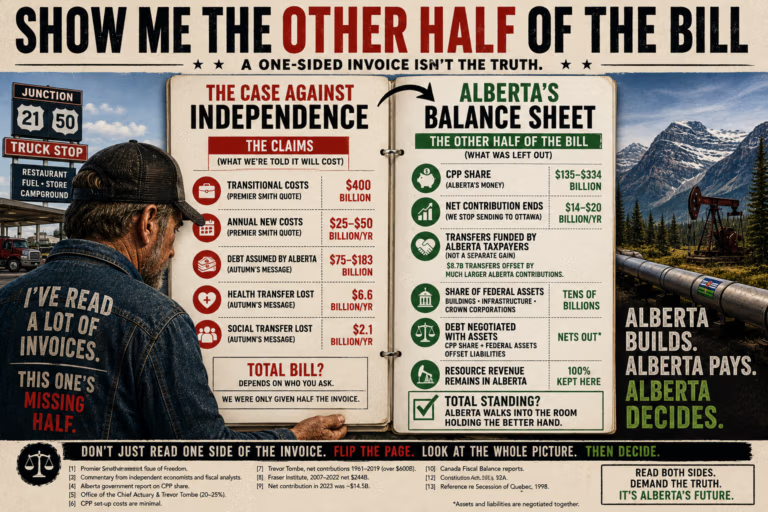
In 2022 alone, Alberta sent roughly $22 billion more to Ottawa than it received back in federal spending (Fraser Institute, “Measuring the Fiscal Imbalance 2022,” Table A2). Between 2007 and 2022, the cumulative net transfer was approximately $244.6 billion (ibid.). Extending that back to 1957 yields a total of about $600 billion nominal—which, adjusted for inflation to 2025 dollars, equals roughly $1.3 trillion(Calculation based on Bank of Canada CPI Series V41690973).
That’s 1.3 trillion dollars of Alberta’s wealth that has gone east and never come back. To put that in perspective, it’s more than the entire Canadian federal budget for 2025 (projected at $538 billion; Parliamentary Budget Officer, 2025). Alberta has already bought and paid for every federal asset within its borders many times over — and then some.
A System Designed for Dependency
From the beginning, Ottawa’s policy toward the West was extractive. In 1904, Clifford Sifton, then Minister of the Interior, stated openly:
“We all desire, every patriotic Canadian desires, that the great trade of the prairie shall go to enrich our own people in the East—to build up the factories and workshops of Eastern Canada.” (Clifford Sifton, Vol. II – A Lonely Eminence, University of Toronto Press, 1985, p. 95)
That quote was not rhetoric—it was policy. The National Policy of Sir John A. Macdonald (1879) created tariffs that protected Eastern manufacturing and used Western resources to finance it. Equalization was merely the post-war continuation of the same philosophy—masked by the language of compassion.
Equalization in Practice: A Reverse Robin Hood
When Quebec blocks pipelines but receives billions from Alberta’s oil revenues, that’s not cooperation; it’s confiscation. Between 2007 and 2022, Quebec received more than $100 billion in equalization payments(Government of Canada, Fiscal Arrangements Tables 2023). Meanwhile, Alberta faced mass layoffs in its energy sector due to federal regulation. Think about the absurdity: the people whose work funds the program are the ones being punished by it.
And every dollar Ottawa “returns” to Alberta comes with strings attached. Federal transfers for health care, infrastructure, or green initiatives always arrive with conditions—policy strings that let Ottawa dictate provincial priorities under the guise of “partnership.” It’s a fiscal version of Stockholm syndrome: the kidnapper feeds you and tells you to be grateful.
The Bureaucratic Tax on Value
Even if Alberta were to receive its own money back through federal programs, the administrative cost alone is a net loss. The Fraser Institute estimates that federal bureaucratic overhead on redistributive programs can reach 10 to 15 percent (Fraser Institute, Size and Cost of Government in Canada, 2021). That means up to $3 billion a year in pure waste before a single dollar touches a provincial budget. In effect, equalization is a nationalized money-laundering scheme—Alberta creates value, Ottawa scrapes off a bureaucratic cut, and the balance is used to buy votes in the East.
Visualizing the Drain
If we translate Alberta’s 2007–2022 net transfer ($244.6 billion) into ounces of gold, it equals roughly 119 million troy ounces, assuming annual average gold prices from $650 (2007) to $1 800 (2022) (London Bullion Market Association Historical Data). At today’s price of $2 400/oz (March 2025), that’s over $285 billion in stored value — a mountain of wealth transferred out of Alberta forever. Imagine if that had been held in a sovereign fund for Albertans. At a modest 4 percent annual return, it would generate $11 billion per year in revenue—enough to eliminate provincial income tax entirely.
The Political Economics of Control
The federal government’s addiction to equalization is political, not economic. It ensures the majority of seats in Ontario and Quebec remain decisive in every federal election. By keeping recipient provinces dependent on federal largesse, Ottawa buys loyalty. By keeping Alberta over-taxed and under-represented, it eliminates threats to central power. In this way, equalization has evolved from a redistribution program into a mechanism of political domination.
What an Independent Alberta Could Do
If Alberta collected its own taxes and kept the revenue it earns, the numbers are transformational. In 2023, Albertans paid roughly $75 billion in federal taxes (CRA Tax Summary Table 2023). Even after funding core services and a modest defense budget, an independent Alberta could operate with a surplus of $15–20 billion per year (Fraser Institute, The Fiscal Balance of Alberta, 2023). That surplus could be used to create a sovereign wealth fund similar to Norway’s or Alaska’s Permanent Fund, ensuring future generations benefit from today’s resources.
Norway’s sovereign fund began in 1990 with modest petroleum revenues and is now worth over $1.5 trillion USD (Norges Bank Investment Management, 2024). Had Alberta followed the same model since 1976, our fund today would exceed $500 billion CAD, even with conservative assumptions (Fraser Institute, Heritage Fund Missed Opportunities, 2019). Instead, Ottawa drained our surplus to finance federal expansion and buy votes east of Thunder Bay.
Moral and Constitutional Implications
This isn’t just an economic issue—it’s a moral one. Section 36 of the Constitution was never intended to punish prosperity, yet that’s exactly what it does in practice. When a government penalizes success to reward dependency, it corrupts the very ethic that built the nation. And because the Constitution places exclusive taxing power over income and corporations with Ottawa (s. 91 (3)), Alberta is constitutionally handcuffed to the same bureaucracy that bleeds it.
The Bottom Line
The economic truth is simple: Alberta doesn’t depend on Canada—Canada depends on Alberta. If we walk away from this arrangement tomorrow, Ottawa would collapse fiscally within a decade. That isn’t hyperbole; it’s arithmetic. The rest of the country could no longer fund its programs without the productivity of this province. Meanwhile, Alberta would thrive—able to set its own taxes, negotiate its own trade deals, and develop its own resources without Ottawa’s permission.
Every economic argument against independence is an argument for continued theft. The only thing that’s unsustainable is staying where we are.
Section III: The Constitutional Trap – Rights on Paper, Chains in Practice
Every empire eventually discovers that you can’t maintain control forever with force alone—you have to convince people they’re free while keeping them obedient. In Canada, the instrument of that illusion is our Constitution.
Peace, Order, and “Good Government”
The foundational idea of Canada is summed up in three words: peace, order, and good government. It sounds noble enough—until you compare it to the founding principle of the United States: life, liberty, and the pursuit of happiness.
One empowers the citizen; the other empowers the state.
Our system was never built to make Canadians sovereign—it was built to keep them manageable. The British North America Act of 1867 was designed to consolidate colonial governance under the Crown, not to create a free republic. It codified a vertical power structure: the Crown at the top, the Governor General as proxy, the Prime Minister as manager, and the citizens as subjects.
When Pierre Trudeau patriated the Constitution in 1982, many Canadians believed we’d finally become independent from Britain. But what actually happened was that we replaced one set of chains with another. The new Charter of Rights and Freedoms looked revolutionary, yet its most dangerous clause is hidden in plain sight: Section 1.
“The rights and freedoms set out in it are subject only to such reasonable limits prescribed by law as can be demonstrably justified in a free and democratic society.” (Canadian Charter of Rights and Freedoms, 1982)
That single sentence guts the entire Charter. It means your rights exist only until the government decides you don’t need them.
The Oakes Test: How to Suspend Freedom Legally
In 1986, the Supreme Court’s ruling in R v Oakesestablished a legal framework for “balancing” individual rights against government objectives. The so-called Oakes Test allows the government to override any Charter right if it can show that its infringement serves a “pressing and substantial objective,” and that its actions are “proportionate.”
In theory, that sounds cautious. In practice, it means every time the government violates your rights, the courts ask not whether your rights were violated, but whether it was reasonable to do so.
That’s not liberty—it’s permission.
The United States Bill of Rights, by contrast, explicitly prohibits government intrusion. The First Amendment doesn’t say “you have the right to free speech unless Washington decides otherwise.” It says, “Congress shall make no law…” That single phrase changed the relationship between citizen and state forever.
Canada has no such firewall. Our Charter is a list of privileges granted by the Crown, not inalienable rights possessed by the individual. And the Crown—represented by the Prime Minister and the courts—can suspend those privileges at will.
COVID-19: The Constitutional Stress Test
Nothing exposed this flaw more brutally than the COVID-19 pandemic. During that time, every level of government trampled Charter rights—freedom of assembly, mobility, worship, and expression—claiming it was for our safety. But the real revelation came later, when courts began reviewing those actions.
In Ingram v Alberta (2023 ABKB 360), Justice Barbara Romaine ruled that many of the Chief Medical Officer of Health’s pandemic orders had no legal foundation because authority was improperly delegated. That means people were fined, arrested, and prosecuted under illegal orders. Yet not one official has been held accountable.
I know this firsthand. When I opened the Whistle Stop Café in defiance of illegal restrictions, I was convicted of contempt of court. I stood in front of Justice Adam Germain, who admitted that my Charter rights were valid—but then set them aside under Section 1. The government never had to prove its actions were justified. My rights were “balanced” out of existence by bureaucratic decree.
If rights can be revoked whenever convenient, then they aren’t rights—they’re favors.
When the Courts Serve Power Instead of Checking It
The courts were supposed to be the firewall between citizens and government. But what we’ve seen instead is a judiciary that increasingly advocates for government rather than restrains it.
Canada’s three branches of government—legislative, executive, and judicial—are supposed to function independently. Yet the executive (which includes the RCMP and Crown prosecutors) enforces policy crafted by the legislative, and the judiciary often interprets those laws to preserve state authority rather than citizen freedom.
This is why Canadians find themselves punished for civil disobedience while politicians who violate the law receive cabinet appointments. When the courts become enforcers of ideology rather than arbiters of justice, tyranny becomes “lawful.”
The Notwithstanding Clause: Ottawa’s Threat to the Last Safety Valve
Recently, the federal government has floated the idea of removing the Notwithstanding Clause (Section 33)—the one constitutional mechanism that allows provinces to override certain Charter rulings. Prime Minister Trudeau stated publicly that he was “considering limiting its use,” claiming it undermines fundamental rights (CBC, Oct. 2023). In reality, it’s the only clause that gives provinces even a sliver of autonomy against federal overreach.
If Ottawa removes or neuters Section 33, the last legal defense for provincial sovereignty disappears. The Supreme Court would become the final, uncontested authority on every provincial law—effectively federalizing the entire country under judicial rule.
The Difference Between Freedom and Obedience
When I say the Canadian system doesn’t protect its people the way the American Bill of Rights does, I’m not indulging in patriot envy—I’m describing a structural reality. Americans are citizens; Canadians are subjects. In the United States, the people are sovereign, and government operates by their consent. In Canada, the government is sovereign, and citizens operate by its permission.
That’s why the same police officer who protects your right to protest in Montana may arrest you for it in Manitoba.
The irony is that Canada prides itself on being “kinder” and more “collective” than the U.S., but our collectivism has cost us our liberty. We traded the discomfort of risk for the comfort of regulation, and now we’re finding out that the regulator owns us.
The Alberta Lesson
During the pandemic, I saw hundreds of Albertans realize this truth in real time. Business owners, pastors, truckers—ordinary people—found themselves punished not for harming others, but for refusing to comply with unlawful dictates. They appealed to their rights, only to discover those rights were conditional. They appealed to their courts, only to find those courts defending the same government that wronged them.
That’s when the mask came off—not the literal one, but the political one.
It became clear that the problem isn’t limited to one law, one government, or one crisis. It’s systemic. The Constitution itself is the cage.
The Impossibility of Reform
Even if you wanted to fix it, you couldn’t. The formula for constitutional amendment under Section 38 of the Constitution Act requires seven provinces representing 50 percent of Canada’s population, plus majorities in both the House of Commons and the Senate. In practice, that means Ontario and Quebec hold a permanent veto. Alberta’s voice—no matter how unified—will never be loud enough to alter the system.
So when people say “work within the system,” I ask them this: How do you fix a system that’s designed to ignore you?
The Moral Imperative for a New Constitution
The solution isn’t to tear down law—it’s to write better law. An independent Alberta must establish a new constitution by the people, for the people—a document that doesn’t merely list our rights but restricts government power.
Our constitution should enshrine:
- The right to free speech without government limitation.
- The right to property as sacrosanct.
- The right to defend oneself and one’s family from tyranny or harm.
- The right to refuse digital identification or government-tracked currency.
- The right to bodily autonomy and informed consent.
- The right to earn a living and operate a business free from arbitrary closure or censorship.
And unlike the Canadian Charter, these rights should not be “subject to reasonable limits.” They should be absolute.
Because as history shows, “reasonable” always becomes “convenient,” and “convenient” always becomes “compulsory.”
Conclusion: The Trap Sprung Shut
Canada’s Constitution has become a velvet cage—comfortable enough that most people don’t notice the lock. But for those of us who have felt the weight of government boots on our necks, the illusion is over.
The courts, the Charter, and the institutions that were supposed to protect us have become instruments of obedience. Reform is impossible because the system is working exactly as designed—to preserve control at the center.
Alberta’s path forward isn’t rebellion; it’s renewal. The only way to restore true liberty in this province is to reclaim our authority to govern ourselves. Not under the benevolent permission of Ottawa, but under the enduring protection of a constitution that cannot be twisted into tyranny.
Section IV – Managed Decline: The Global Script and How It’s Playing Out in Canada
When I use the term managed decline, I’m not talking about the slow phasing out of a single industry, like oil and gas. I’m talking about something much bigger—an orchestrated strategy to control the collapse of Western prosperity while convincing the public it’s progress.
What Managed Decline Really Means
A lot of people assume government incompetence explains why things are falling apart. But after five years of watching policy after policy deliberately undermine our economy, energy sector, and food security, I don’t buy the “incompetence” argument anymore. The pattern is too consistent. Managed decline is not failure—it’s design.
It’s the smiling face of a system preparing for collapse. It’s when politicians talk about building back better before anything has even been destroyed. It’s when bureaucrats create the problem, blame it on you, then sell you the solution. And that’s not my interpretation—those are their own words.
In 2020, the World Economic Forum’s founder Klaus Schwab said:
“The pandemic represents a rare but narrow window of opportunity to reflect, reimagine, and reset our world.” (WEF, The Great Reset, 2020)
Think about that. While ordinary people were losing their jobs, homes, and freedoms, the global elite were preparing a “reset.” A new system. A “Fourth Industrial Revolution” built on centralized control, digital currency, and surveillance disguised as convenience.
In the same vein, the United Nations’ Agenda 2030—adopted by Canada in 2015—calls for “deep structural changes in production and consumption” and the “strengthening of global partnerships for governance” (UN, Agenda 2030, Goals 12 & 17). Those are diplomatic words for what’s really happening: the transfer of sovereignty from nations to supranational institutions.
Canada’s Role in the Global Plan
Canada isn’t resisting this agenda—it’s leading it. Our Prime Minister repeats the WEF and UN talking points almost verbatim. Whether it’s “net-zero by 2050,” “sustainable development,” or “inclusive digital transformation,” the script is the same because it is the same. It’s global policy handed down through international frameworks and adopted by domestic bureaucrats who were never elected to govern.
And that’s the part most people miss—none of this is happening through Parliament. It’s happening through framework agreementsand memorandums of understanding signed between Canadian ministries and organizations like the UN, IMF, and WEF. These agreements are then implemented quietly through provincial regulation, bypassing public debate altogether.
Take Bill C-8 (2022), for instance. On the surface, it was presented as an “economic recovery” bill. Hidden within it was the Underused Housing Tax Act—a federal intrusion into property rights dressed up as an anti-speculation measure. But when you peel it back, it’s perfectly aligned with the UN’s Sustainable Development Goal 11: “Sustainable Cities and Communities.” The long-term vision is clear—government-managed housing, government-approved energy, and government-controlled consumption.
It’s not about saving the planet; it’s about managing the population.
From Energy Policy to Economic Sabotage
Energy is the easiest target because it’s the foundation of prosperity. Every nation that has ever lifted its people out of poverty has done it through abundant, affordable energy. When you control energy, you control everything—production, transportation, food, even freedom of movement.
That’s why the same global institutions pushing “decarbonization” also promote “15-minute cities,” “digital identification,” and “carbon tracking.” It’s all the same system—surveillance under the banner of sustainability.
Let’s look at some data. Between 2015 and 2023, Canada lost an estimated $150 billion in energy investment due to federal policy barriers (CAPP, Canadian Energy Investment Data, 2023). That’s not an accident—that’s managed decline. The government chokes our most productive sector while subsidizing unreliable alternatives that can’t sustain modern life.
Meanwhile, the world’s largest emitters—China, India, and Russia—build hundreds of new coal and oil facilities every year. If climate change were truly an existential threat, those nations would be the focus of pressure and sanction. Instead, it’s the West that’s being throttled. Why? Because you can’t control strong, self-sufficient nations—you can only control those dependent on your system.
The Climate Narrative and Manufactured Fear
Now, let’s talk about climate policy itself. Contrary to what we’re told, there is no such thing as anthropogenic catastrophic climate change. Over 70 apocalyptic climate predictions made since the 1970s have failed to come true (Patrick Michaels & Paul Knappenberger, Climate Models vs. Reality, Cato Institute, 2020).
The data show that CO₂ tends to follow temperature increases, not precede them (Stott et al., Nature, 2001). Water vapor, not carbon dioxide, is the dominant greenhouse gas. And CO₂’s warming effect diminishes logarithmically as concentrations rise—it’s not an accelerant; it’s a saturation curve. These facts are even acknowledged in the IPCC’s own reports—if you read beyond the political summaries.
As Alex Epstein argues in Fossil Future (2022), “The more we use fossil fuels, the more life on Earth flourishes.” Increased CO₂ has contributed to the greening of the planet, not its destruction. Satellite data from NASA confirm that the Earth’s vegetative cover has increased by roughly 14 percent since 1982, largely due to higher atmospheric CO₂ levels (NASA MODIS Data, 2020).
So, what we’re experiencing isn’t environmental policy—it’s ideological warfare. The climate movement has become the perfect moral cover for global economic control. It’s the justification for every restriction, every tax, and every surrender of sovereignty.
The Language of Control
It’s worth noticing how the vocabulary itself is being weaponized. Words like sustainability, resilience, and equity sound harmless—even virtuous. But in the bureaucratic lexicon, they have precise meanings:
- Sustainability → reduced consumption, rationing, degrowth.
- Resilience → permanent compliance with crisis governance.
- Equity → outcome control through redistribution.
This is how managed decline is sold to the public: as moral progress. The same way they sold “two weeks to flatten the curve.” You can get people to accept almost anything if you tell them it’s virtuous.
The Economic Results of Decline
The results are everywhere if you’re willing to look. Canada’s GDP per capita, adjusted for purchasing power, has declined by 7.5 percent since 2019 (OECD Economic Outlook, 2024). Real wages are stagnant, inflation is eroding savings, and productivity growth has fallen to its lowest rate since the 1980s.
Our currency has depreciated roughly 45 percent against gold since 2015 (World Gold Council, 2024). That means it now takes nearly twice as many Canadian dollars to buy the same ounce of gold as it did a decade ago. The value of our money is being deliberately diluted.
Foreign investment is fleeing too. Between 2014 and 2023, direct investment outflows from Canada averaged $90 billion per year, while inflows fell below $60 billion (Statistics Canada, Table 36-10-0008-01). In simple terms, capital is leaving faster than it’s arriving. And when investment leaves, opportunity follows.
The Cultural Cost
The economic decay is mirrored by a cultural one. A nation can’t survive when its people no longer share a common purpose—or worse, when they’re told their prosperity is shameful. Canadians are being taught to despise the very industries that built this country: oil, gas, farming, mining, and manufacturing.
Managed decline requires managed minds. It depends on guilt. You can’t convince a population to accept poverty unless you first convince them they deserve it.
Where Alberta Fits In
Here’s where it comes full circle. Alberta is not the cause of Canada’s decline—it’s the last barrier to it. Our energy, our independence, and our entrepreneurial spirit are the final obstacles to complete centralization.
That’s why federal policy treats Alberta as both a cash cow and a scapegoat. Ottawa needs our money but despises our independence. Every carbon tax, every production cap, every regulatory choke point is designed to weaken Alberta enough that we can’t stand on our own.
But here’s the irony: the harder they push, the faster they prove our point. Every act of sabotage becomes another argument for sovereignty.
Conclusion: The End of the Illusion
Managed decline is not conspiracy—it’s confession. It’s written in white papers, spoken in speeches, and codified in policy. The only thing still missing is public recognition.
When politicians tell us “you’ll own nothing and be happy,” I hear something else: “You’ll own nothing, and we’ll be happy.”
The choice before Alberta is simple. We can ride this train all the way into the ditch of global technocracy, or we can pull the brake and chart our own course. Managed decline may be the federal plan—but it doesn’t have to be ours.
Section V – Population, Immigration, and the Erosion of National Identity
When people say “population growth is a strength”, I don’t disagree. A healthy, expanding population can be a tremendous advantage. But that only holds true when growth is organic, sustainable, and aligned with shared values. What we’re witnessing in Canada right now isn’t growth — it’s an unmanaged surge, driven by political expediency, not national vision.
The Numbers Don’t Lie
Let’s start with the data. In 1995, under Prime Minister Jean Chrétien, Canada admitted about 176,000 immigrants per year (Statistics Canada, Table 17-10-0005-01). During Stephen Harper’s tenure (2006–2015), that number rose gradually to roughly 250,000 per year — a pace consistent with housing, labor, and infrastructure capacities at the time.
But under Justin Trudeau’s government, immigration exploded. By 2022, Canada had welcomed over 800,000 new permanent and temporary residents — the largest annual increase in modern history (IRCC, Immigration Levels Plan 2023–2025). For 2024–2025, Ottawa has set targets approaching 500,000 permanent residents annually, not including temporary foreign workers or international students.
To put that in perspective, that’s roughly the population of Edmonton every single year.
Canada’s population grew by 3.2 percent in 2023, the fastest among all G7 countries (Statistics Canada, Quarterly Demographic Estimates, 2024). That might sound like success, but here’s the problem: GDP per capita declined by 1.5 percent during the same period (OECD, Economic Outlook 2024). The economy isn’t growing — it’s stretching thinner.
The Economic Consequences of Unchecked Growth
Mass immigration under these conditions doesn’t enrich a country; it dilutes it.
Housing is the clearest example. In 2015, the average home price in Canada was about $450,000. Today it’s over $720,000(Canadian Real Estate Association, 2024). In Toronto and Vancouver, the averages exceed $1.1 million. Wages have not kept pace. The government blames “corporate greed” and “market speculation,” but the simple arithmetic shows that demand is massively outstripping supply — and immigration policy is driving it.
According to the Canadian Mortgage and Housing Corporation (CMHC), we would need 3.5 million additional homes by 2030 just to restore affordability to 2004 levels (CMHC Housing Supply Report, 2023). Yet at current construction rates, we’ll fall short by more than 1.8 million units.
You can’t import a city every year and expect prices not to skyrocket.
And it’s not just housing. Hospitals are overwhelmed. Schools are overcrowded. Infrastructure built for 30 million people is being stretched to serve nearly 42 million. The “growth” narrative collapses under the weight of basic arithmetic.
The Cultural Consequences
This next part is harder to talk about, but honesty demands it.
A nation’s culture is its software — the invisible operating system that makes everything else work. It’s the set of shared values, traditions, and moral assumptions that allow strangers to cooperate. When immigration outpaces assimilation, the software breaks down.
Canada’s immigration system no longer prioritizes cultural compatibility; it prioritizes quotas. We’re bringing in people faster than we can integrate them, and many arrive from nations that do not share the principles of Western civilization — free speech, gender equality, property rights, or secular governance.
The result isn’t diversity; it’s fragmentation.
I’ve heard people argue that criticizing immigration policy is “xenophobic.” But this isn’t about race or origin — it’s about values. Western civilization, imperfect as it is, remains the most successful framework for human freedom and prosperity in history. If we import large populations from regions governed by authoritarianism, tribalism, or theocracy, and we fail to insist on assimilation, we risk importing those problems too.
It’s crude but true: people flee broken systems only to re-create them if they don’t adopt the values that built the system they fled to.
The Historical Warning
History gives us plenty of warnings. The Roman Empire, in its decline, opened its borders to massive waves of migration from territories it could no longer control. The newcomers didn’t destroy Rome out of malice — they simply didn’t share its culture or institutions. The result was fragmentation, not renewal.
Today, Western Europe is facing the same problem. France, Germany, and Sweden have all seen rising cultural conflict, social segregation, and declining civic trust — outcomes directly correlated with rapid demographic change. Sweden’s population has increased by 20 percent since 2000, but violent crime, particularly gun violence, has risen over 300 percent during the same period (Swedish National Council for Crime Prevention, Brå Annual Report, 2022). Correlation doesn’t equal causation, but it should at least demand conversation.
Yet in Canada, conversation is forbidden. Questioning immigration policy gets you branded a bigot. But pretending the issue doesn’t exist won’t stop the consequences from arriving.
Alberta’s Position and the Constitutional Problem
Now, here’s the kicker: under Section 95 of the Constitution Act, immigration is a shared jurisdiction between the federal and provincial governments. In practice, however, Ottawa has monopolized it. Only Quebec has exercised significant control through its own immigration ministry and bilateral agreements. Alberta, like most provinces, simply handed the reins to Ottawa decades ago.
Even if Alberta took back that jurisdiction, our control would still be limited. Once immigrants obtain Canadian citizenship, they can move freely across the country under Section 6 of the Charter — the mobility rights clause. So even if Alberta wanted to moderate population growth, we couldn’t stop federal immigration from flooding other provinces, granting citizenship, and then relocating those new citizens to Alberta.
That’s not cooperation — that’s subjugation.
The Social Fracture We’re Pretending Not to See
It’s not just economics or infrastructure; it’s social cohesion.
Surveys by Leger and Angus Reid show that more than 60 percent of Canadians now believe immigration levels are “too high” (Leger, National Immigration Attitudes Survey, 2024). Among younger Canadians, that number rises to nearly 70 percent. But rather than listen, Ottawa doubles down, accusing critics of xenophobia and pushing for even higher quotas.
When governments refuse to acknowledge reality, societies polarize. We’re already seeing the signs: urban-rural divides, rising resentment between newcomers and long-term citizens, and an eroding sense of national unity.
Population Growth as Political Strategy
Why does Ottawa keep doing it? Because immigration has become a political tool. New voters mean new electoral maps. In 2022, for instance, the Liberal Party’s strongest support came from ridings with the highest concentration of recent immigrants (Elections Canada, Post-Election Analysis, 2023). This isn’t about humanitarianism — it’s about demographic engineering.
Mass immigration under the guise of compassion is really a power strategy. The more transient and divided the electorate, the easier it is to control. A population that’s constantly moving, struggling, and dependent on government housing or benefits is far less likely to demand accountability.
The Alberta Path Forward
I believe Alberta needs to take back its constitutional jurisdiction over immigration immediately. We should create a Ministry of Alberta Immigration, modeled loosely after Quebec’s, with clear cultural and economic standards. Our immigration should prioritize people who share Alberta’s values: personal responsibility, work ethic, and a respect for freedom and property.
But even then, Alberta’s ability to protect its demographic stability remains limited as long as we’re part of Canada. As long as Ottawa can grant citizenship to anyone and open the borders, Alberta can’t preserve its culture, economy, or identity.
The only real solution is sovereignty.
Independence would allow Alberta to control who enters, under what conditions, and at what rate. We could design an immigration policy that strengthens, rather than destabilizes, our society — one that rewards merit and assimilation, not dependency.
Conclusion: A Nation’s Soul
A nation isn’t just a collection of people; it’s a collection of shared beliefs. If those beliefs are lost, the borders don’t matter.
Canada has reached the point where population growth is no longer a sign of vitality — it’s a symptom of policy failure. The country is importing people faster than it can provide homes, jobs, or hope. Ottawa calls that progress. I call it managed chaos.
Alberta has a choice. We can continue being part of a federation that’s diluting its culture and destroying its economic base, or we can chart our own path — one that welcomes newcomers who want to become Albertans, not just residents of a global experiment.
Because in the end, it’s not the number of people that makes a country strong; it’s the strength of the people who call it home.
Section VI – Alberta’s Path Forward: Control, Sovereignty, and Self-Determination
When people ask me, “What’s Alberta’s plan if we leave Canada?”, I usually smile and answer, “To do what every successful nation does — govern ourselves.” That’s not radical. It’s common sense. Every thriving country on earth collects its own taxes, manages its own resources, secures its own borders, and protects its own people. Alberta could do the same — and do it better.
Step One: Take Back the Powers We Already Have
Under the current Constitution, provinces already hold jurisdiction over most of what matters to everyday life: education, healthcare, natural resources, municipalities, and property rights (Constitution Act, 1867, ss. 92–95). The problem is that Ottawa has slowly colonized those areas through conditional funding and regulation. Every federal dollar comes with strings, and those strings wrap tighter every year.
Before independence, Alberta must first reclaim its constitutional jurisdictions:
- Tax collection. Alberta can establish its own revenue agency — similar to Québec’s — and collect both provincial and federal portions of income tax, remitting Ottawa’s share only temporarily. This is already allowed under the Tax Collection Agreements Act.
- Pensions. The Alberta Pension Plan proposal (2023) demonstrated that Alberta could operate its own system and immediately gain roughly $334 billion in assets from the Canada Pension Plan, based on Alberta’s historical contributions (Lifeworks Actuarial Report, 2023).
- Policing. Alberta pays over $700 million annually for RCMP services (Alberta Justice Budget 2024). Creating an Alberta Provincial Police Service would keep that money — and accountability — here.
- Immigration. As discussed earlier, Section 95 gives shared jurisdiction. Alberta could immediately form an Alberta Ministry of Immigration and negotiate its own bilateral agreements.
Each of these steps is legal today, inside Confederation. Doing them simultaneously would signal to Ottawa — and to Albertans — that we’re ready to govern ourselves.
Step Two: Build Parallel Institutions
Parallel institutions are the scaffolding of independence. We don’t have to declare sovereignty tomorrow; we can build it quietly, deliberately, and legally until it becomes inevitable. That means:
- An Alberta Revenue Agency capable of collecting all taxes.
- An Alberta Treasury with a sovereign wealth fund backed by hard assets — oil, gas, and precious metals.
- An Alberta Court of Appeal whose final authority rests in Alberta, not Ottawa.
- An Alberta Central Bank that rejects digital control and preserves private, hard-backed currency.
This approach follows the same path as Norway, Iceland, and the Baltic states before their separations — establish competence first, then independence becomes a formality.
Step Three: Secure Economic Independence
Alberta’s economy is already large enough to function as a sovereign nation. In 2024, our GDP was $400 billion CAD, with per-capita income roughly 35 percent above the national average (Statistics Canada, Provincial Economic Accounts 2024). We produce about 80 percent of Canada’s crude oil, 65 percent of its natural gas, and one-third of its agricultural exports. Those aren’t numbers — that’s leverage.
If Ottawa disappeared tomorrow, Alberta would still have:
- The world’s third-largest proven oil reserves (after Venezuela and Saudi Arabia).
- Massive untapped reserves of lithium, helium, potash, and rare earths.
- The second-youngest and most educated workforce in Canada.
The difference between dependency and prosperity is control of our own revenue stream. Right now, Alberta produces the wealth and Ottawa redistributes it. An independent Alberta could fund infrastructure, healthcare, and education without Ottawa’s bureaucratic overhead and still run a surplus.
Step Four: Defense and Security
Critics often ask, “Who will defend Alberta?” The answer is: Albertans will.
Alberta already hosts key military infrastructure — CFB Cold Lake, CFB Suffield, CFB Edmonton — with runways, training ranges, and logistics depots that could easily form the backbone of an Alberta Defense Force. These assets were built on Alberta soil, funded by Alberta taxpayers, and staffed largely by Albertans. We’ve already paid for them.
During negotiations for independence, Alberta should seek to purchase or assume ownership of these facilities, along with appropriate equipment, as part of the federal asset settlement — offset against Alberta’s historical net contribution to Confederation (estimated at $1.3 trillion in 2025 dollars, Fraser Institute 2023; Bank of Canada CPI Series).
Defense Partnerships
We don’t need to reinvent the wheel. The United States already operates the world’s most powerful and technologically advanced defense network. Alberta could negotiate a continental defense partnership under NORAD or a bilateral defense compact, much like Iceland and Denmark do.
Delegations from the Alberta Prosperity Project have already discussed the concept of U.S. military contracting for transitional defense coverage, and the response was positive — provided independence occurs through democratic and peaceful means.
This arrangement benefits both nations. The U.S. strengthens continental security between Alaska and the lower 48; Alberta gains guaranteed protection while building its own forces.
Step Five: Currency and Banking
Money is the bloodstream of sovereignty. Without monetary control, independence is an illusion.
Canada’s federal government is openly exploring Central Bank Digital Currency (CBDC) frameworks, which would give Ottawa — or any future government — the power to monitor, restrict, or disable private transactions. I believe that’s incompatible with freedom.
An independent Alberta should constitutionally prohibit mandatory digital ID or digital currency for employment, banking, or healthcare. Cash must remain legal tender for essentials.
There are three practical currency options:
- Adopt the U.S. Dollar (USD): Used by 27 sovereign nations. Provides immediate stability, low inflation, and easy cross-border trade. The downside: no independent monetary policy.
- Create the Alberta Dollar backed by gold or oil: A hard-asset standard would make Alberta the first jurisdiction in North America with fully redeemable currency. That kind of trust attracts capital.
- Hybrid system: Maintain USD reserves for international trade but circulate an Alberta Dollar domestically, redeemable for gold through licensed depositories like Silver Gold Bull Ltd. in Calgary.
Personally, I prefer a hard-money Alberta Dollar. Paper currencies fail; commodities endure. Gold, silver, or oil-backed currency would insulate Alberta from global fiat volatility. We could establish a privately audited depository, verified quarterly, to guarantee full convertibility. That transparency alone would make the Alberta Dollar one of the world’s most trusted currencies.
Step Six: Trade and Port Access
Critics love to say, “Alberta is landlocked.” True — but so are Switzerland, Austria, and Bolivia, and they all trade globally. Landlocked doesn’t mean isolated.
Under the United Nations Convention on Transit Trade of Land-Locked States (1965) and reaffirmed in Article 125 of the U.N. Convention on the Law of the Sea (1982), landlocked countries are guaranteed free access to international waters through neighboring states. Canada is a signatory. That means Alberta, as a sovereign nation, would have legal right to tidewater access through either British Columbia or the United States.
If British Columbia tried to block it, they’d cripple themselves. B.C. receives roughly 90 percent of its refined fuel from Alberta pipelines (National Energy Board Flow Report, 2019). Vancouver International Airport’s jet-fuel supply would dry up in four days. So while we’d prefer cooperation, Alberta holds the leverage.
We could also negotiate partial port ownership — for example, a long-term lease on a terminal at Prince Rupert or Kitimat, similar to how China’s COSCO Shipping operates in Rotterdam. Trade agreements with the U.S. could expand port use through Seattle or Tacoma if B.C. politics proved obstructive.
Step Seven: Judicial Independence
Courts are the architecture of sovereignty. Right now, Alberta’s Court of Appeal decisions can be overturned by the Supreme Court of Canada — a body increasingly driven by ideology rather than law. In an independent Alberta, judicial independence must be absolute.
We can model our system on the U.S. or Swiss framework:
- Judges appointed for fixed terms, not life.
- Mandatory constitutional review for any legislation affecting civil rights.
- Citizen recall provisions for gross judicial misconduct.
An independent judiciary that interprets law rather than ideology would become one of Alberta’s greatest exports — trust. Investors and citizens alike go where the rule of law is predictable.
Step Eight: Civic Renewal and Constitutional Foundation
Political independence without civic virtue is just another tyranny waiting to happen. Alberta’s constitution must be written by the people, not bureaucrats.
It should contain:
- Explicit limits on government debt and taxation.
- A Bill of Rights modeled after the U.S. Bill of Rights, not the Canadian Charter.
- Direct-democracy mechanisms — binding referenda and citizen-initiated legislation.
- Term limits for elected officials.
- A requirement that any treaty or international agreement must be ratified by referendum.
This would make Alberta not only sovereign, but a global model for constitutional liberty in the 21st century.
Step Nine: International Relations
Alberta’s diplomacy should begin with mutual respect and trade, not ideology. Our strongest partnerships will naturally remain with the United States, the United Kingdom, Australia, and other culturally aligned Western nations. But independence doesn’t mean isolation. We should also pursue trade relationships with India, Japan, South Korea, and even China — where it benefits us economically and doesn’t compromise our principles.
Our guiding principle should be simple: Alberta trades freely, but never surrenders its sovereignty for access.
Conclusion: The Alberta Doctrine
Alberta’s path forward isn’t fantasy. It’s the logical progression of a province that’s already proven it can stand on its own. We have the land, the resources, the talent, and the will. What we lack is the permission — and that’s precisely what independence gives us: the permission to thrive.
When I imagine Alberta’s future, I don’t see a rebellious outpost. I see a prosperous, self-reliant nation — friendly to its neighbors, firm in its values, and free from the shackles of managed decline.
Every step toward control of our own destiny makes independence not only possible but inevitable. And when that day comes, Alberta won’t just be a success story. It will be a blueprint for how a people reclaimed their freedom — peacefully, democratically, and unapologetically.
Section VII – Security, Defense, and the Myth of Dependence
One of the most common objections I hear about Alberta independence is: “You can’t go it alone — you’d have no military, no defense, and no stability.”
Let’s unpack that.
The Myth of Dependence
This idea — that Alberta needs Ottawa for safety — comes from the same place as every other myth about Confederation: ignorance of how it actually works. Ottawa doesn’t defend Alberta out of benevolence; it defends Alberta because it needs Alberta. The oil, gas, agriculture, and transportation corridors here are the logistical backbone of Canada’s economy. If Alberta fell, Canada would fall with it.
But defense isn’t charity — it’s logistics.
And the reality is that the physical infrastructure, training facilities, and manpower already exist here. We’re not starting from scratch. We’ve already built the foundation of our own defense network — we just don’t own it yet.
The Infrastructure That Already Exists
Right now, Alberta hosts:
- CFB Cold Lake — one of the most advanced air bases in North America, home to Canada’s CF-18 fighter fleet and NORAD training.
- CFB Suffield — a massive training area used jointly by Canada and the United Kingdom for armoured and chemical defense exercises.
- CFB Edmonton (Steele Barracks) — headquarters for the 3rd Canadian Division, a major logistics and engineering hub.
- Wainwright Garrison — primary mechanized infantry training base for Western Canada.
Together, these facilities occupy over 2,700 square kilometers of strategic land, equipped with airfields, hangars, firing ranges, and rail access. Most of this was built and maintained with Alberta taxpayer money — through the same transfer system Ottawa uses to siphon our wealth.
If Alberta were an independent nation, we’d simply assume ownership of these assets as part of the asset offset settlement during separation negotiations — a perfectly legitimate claim given Alberta’s net fiscal contribution of approximately $1.3 trillion (2025 dollars) to Confederation.
That alone gives us more infrastructure than many NATO member states started with.
Personnel and Training
As of 2024, roughly 20 percent of Canada’s Armed Forces personnel are stationed in or hail from Alberta (Department of National Defence, Force Distribution Summary 2024). That’s tens of thousands of Albertans already trained in logistics, command, engineering, aviation, and infantry operations.
When independence comes, these men and women won’t lose their skills — they’ll gain a choice: to re-enlist with the Alberta Defense Force or continue serving in the CAF elsewhere. History shows what happens in those moments. In 1993, when the Czech Republic and Slovakia split peacefully, nearly 70 percent of Slovak-born troops chose to serve their new country.
Patriotism follows home soil.
Defense Partnerships and Continental Security
The question then becomes: What about external threats?
Well, let’s look at geography and precedent. Alberta borders two stable democracies: British Columbia and Saskatchewan, and shares a southern border with the United States — our largest trading partner and closest ally. We don’t have hostile neighbors. The only external threat to North America would come from overseas — and that’s already handled through NORAD, the North American Aerospace Defense Command, headquartered in Colorado Springs.
An independent Alberta could remain within NORADthrough a defense-sharing agreement, just as Iceland does. Iceland has no standing army but maintains defense under a bilateral agreement with the United States, formalized in 1951. Its contribution? Strategic geography and cooperative sovereignty. Alberta offers both.
In fact, the Alberta Prosperity Project’sdelegations to Washington in 2025 discussed this very issue. Senior American officials confirmed that if Alberta’s independence were achieved democratically, the U.S. would support continental defense cooperation. President Trump’s national security advisors even noted that strengthening the interior of the continent — between Alaska and the lower 48 — would improve U.S. national security.
It’s simple: securing Alberta secures America.
Defense Funding and Structure
Could Alberta afford it? Absolutely.
Let’s run the math. Canada’s total defense budget for 2024 is $39 billion (Parliamentary Budget Officer, 2024). Proportionally, Alberta contributes about $8 billionthrough federal taxation. That’s more than enough to fund a small but highly modernized Alberta Defense Force (ADF) — leaner, more agile, and technologically advanced.
For reference:
- Norway, population 5.5 million, operates a $9.5B USD defense budget.
- Finland, population 5.6 million, spends about $7.1B USD.
- Singapore, population 5.8 million, allocates $12.3B USD.
All three maintain advanced air, cyber, and territorial defense systems — and all three export defense technology and training.
Alberta, with a similar population (4.8 million), could easily maintain a $6–8 billion defense budget, which represents only 2 percent of GDP — the NATO guideline.
What the Alberta Defense Force Would Look Like
The ADF wouldn’t be a copy of the Canadian military. It would be streamlined, decentralized, and built for the modern era:
- Air Command: Based in Cold Lake, maintaining advanced fighter capability (initially leased or purchased F/A-18 or F-35 aircraft) and integrated NORAD radar coverage.
- Land Command: Mechanized units stationed at Suffield and Wainwright; engineering corps focused on disaster response and infrastructure protection.
- Cyber Command: Alberta is already a hub for tech and data centers; this branch would focus on cybersecurity, counter-intelligence, and infrastructure resilience.
- Reserve & Militia Corps: Constitutionally protected citizen militia, similar to the Swiss model — trained, armed, and ready for homeland defense.
- Emergency Support Division: Dual-role for humanitarian response to floods, fires, and natural disasters.
This hybrid structure blends traditional defense with civil resilience — something the CAF struggles to achieve.
Strategic Doctrine: Peace Through Strength
Canada’s defense policy has become performative — underfunded, bureaucratic, and politically compromised. Ottawa commits troops to global virtue missions while ignoring continental security. Alberta would take the opposite approach: defend the homeland first, trade freely, and mind our own business.
That doesn’t mean isolationism. It means realism. As Ronald Reagan said, “Peace is not the absence of conflict; it is the ability to deal with conflict by peaceful means.” And the surest way to maintain peace is to be strong enough that no one wants to test it.
The Nuclear Question
When I’m asked whether Alberta should pursue nuclear weapons, my answer is this: deterrence matters, but technology evolves. It’s naïve to think everyone will give up their guns and nobody will shoot — but it’s also foolish to make war an industry.
I believe Alberta’s defense research should focus on advanced interception, energy shielding, and cyber resilience — technology that renders nuclear attack obsolete. Power through innovation, not proliferation. That’s how small nations punch above their weight.
Diplomacy as a Shield
Military deterrence is one part of security; diplomacy is the other. An independent Alberta would begin by reaffirming mutual non-aggression treaties with Canada, the U.S., and NATO allies. Neutrality, not hostility.
We would also have the moral advantage of being a clean slate. Unlike Ottawa, Alberta wouldn’t carry the baggage of decades of failed foreign interventions. We could be a nation known for transparency, resource ethics, and humanitarian support — a voice of reason in an increasingly unstable world.
The Real Threat: Internal, Not External
Let’s be honest: the greatest threat to Alberta’s freedom isn’t invasion. It’s infiltration — the gradual erosion of sovereignty from within.
That’s what we’ve been living under for decades. Ottawa doesn’t need to occupy Alberta militarily; it already occupies us economically and bureaucratically. Every carbon tax, gun ban, and federal regulation is an act of domestic colonization. Independence doesn’t make us less secure — it’s the only way to be secure.
Conclusion: Standing on Our Own Feet
Security doesn’t come from dependency. It comes from self-reliance and mutual respect. Alberta doesn’t need to fear standing alone — because we wouldn’t be alone. We’d be surrounded by allies, armed with resources, backed by wealth, and protected by the one thing no government can confiscate: resolve.
The myth that Alberta “can’t go it alone” is just that — a myth. We already go it alone every day: funding our own services, powering the nation, feeding the world, and enduring the costs of others’ policies. Independence wouldn’t change that — it would finally make it fair.
The world respects those who respect themselves. When Alberta takes that stand, we won’t need to beg for protection. We’ll command it through strength, peace, and principle.
Section VIII – Currency, Sovereignty, and the Battle for Economic Freedom
If there’s one thing I’ve learned over the past few years, it’s this: the people who control the money control the people.
That’s not conspiracy — that’s reality. It’s been true since the days of Rome, and it’s true now. Empires don’t fall when their armies are defeated. They fall when their currencies collapse. And Canada’s current trajectory — crushing debt, debased currency, and creeping digital control — is exactly that kind of collapse in slow motion.
The Illusion of Canadian Sovereignty
Let’s get one thing straight: Canada doesn’t have a sovereign currency. The Bank of Canada may print our money, but the value of that money depends entirely on foreign confidence — primarily the United States. Since we abandoned the gold standard in 1971, the Canadian dollar has been nothing more than a political promise printed on paper.
Worse, it’s a borrowed promise. Every Canadian dollar in circulation exists because someone, somewhere, owes that dollar to a bank — with interest. That’s not wealth creation; that’s debt creation. Between 2015 and 2024, Canada’s federal debt ballooned from $612 billion to over $1.3 trillion (Parliamentary Budget Office, Fiscal Sustainability Report 2024). That’s over $33,000 for every man, woman, and child in the country.
Meanwhile, the Bank of Canada printed nearly $400 billion in new money during the pandemic, driving inflation to 40-year highs. When government debt and inflation soar together, it’s not a temporary crisis — it’s systemic decay.
And when the money loses its value, so does the trust in everything that depends on it: contracts, pensions, savings, wages, and sovereignty itself.
The New Chains: Digital Currency and Centralized Control
The next phase of this decay is digital. The Bank of Canada is openly developing a Central Bank Digital Currency (CBDC) — a programmable, traceable form of money. They say it’s for “convenience and inclusion.” But here’s the truth: it’s about control.
A CBDC gives government the power to monitor every transaction, freeze accounts instantly, and even program how or where money can be spent. Imagine a future where your “digital dollar” expires after 30 days, or where your account is throttled because your “carbon footprint” is too high. That’s not speculation — it’s already happening.
- China’s digital yuan (e-CNY) restricts spending to approved vendors and tracks every purchase.
- Nigeria’s eNaira automatically deducts taxes from digital wallets.
- The European Central Bank has stated openly that “anonymity will not be possible” under the digital euro.
And now Canada is next. The Trudeau government’s Digital Charter Implementation Act (Bill C-27) and related Bill C-8 (Digital ID framework) are the legislative groundwork. These bills enable “identity-linked financial data systems,” meaning your ID, health records, and money all live under one digital roof — controlled by Ottawa.
Once that switch flips, freedom becomes conditional.
The Biblical Warning and Modern Parallels
Scripture warned us about this centuries ago. Revelation 13:17 describes a time when “no man might buy or sell, save he that had the mark.”
Now, I don’t expect everyone to share my faith. But whether you view it as prophecy or political foresight, the parallels are chilling. The infrastructure for total financial control is being built right now — in the name of safety and efficiency. The devil doesn’t come with horns; he comes with a “convenience” app.
And as other nations roll out digital IDs and cashless mandates — the U.K. now requiring digital ID for employment, the EU pushing for “mandatory digital wallets” by 2030 — it’s becoming clear that this isn’t just bad policy. It’s global coordination. The UN’s Agenda 2030 and Agenda 2050 lay out precisely this kind of integrated “sustainable governance,” linking climate policy, digital ID, and financial systems.
They call it sustainability. I call it centralized dependency.
The Alberta Alternative: Sound Money and Real Freedom
An independent Alberta can and must chart a different course. We can’t avoid the digital age, but we can refuse digital servitude. That means creating a currency system that is transparent, hard-backed, and constitutionally protected from government abuse.
Here’s how:
1. A Hard-Money Alberta Dollar
The Alberta Dollar should be backed by gold and precious metals, not by debt. Gold doesn’t care about politics. It doesn’t vanish when a government falls. It can’t be “deplatformed” or frozen. It’s value you can hold in your hand — and that’s why for 6,000 years, every major civilization has used it as real money.
Let’s do the math: As of 2025, gold trades around $2,400 USD per ounce (World Gold Council, May 2025 average). With Alberta’s GDP of $400 billion CAD, a reserve ratio of just 10 percent would require about $30 billion in gold reserves — roughly 385 metric tonnes.
That’s less than one-tenth of Canada’s annual oil export value. In other words, Alberta could back its currency with gold just by dedicating one month’s energy royalties per year for a decade. That’s not theory; that’s solvable economics.
And the beauty of hard money is its honesty: the government can’t print more without physically owning more. Inflation becomes mathematically impossible.
2. Private Custody and Independent Auditing
Those reserves shouldn’t sit in Ottawa or Washington. They should sit here — in Alberta vaults, physically held and independently audited. Companies like Silver Gold Bull, headquartered in Calgary, already operate high-security depositories that meet international standards. Their vaults are privately owned, fully insured, and could easily scale to sovereign capacity.
This model cuts out bureaucracy, reduces costs, and ensures that the government can’t “re-hypothecate” — or secretly loan out — the people’s assets.
3. Dual-Currency System for Trade
For international trade, Alberta can transact in U.S. dollars, as over 90% of our exports already flow south. For domestic use, we’d circulate the Alberta Dollar (ALD). Every ALD could be redeemable on demand for gold at authorized banks or depositories. That convertibility alone would make the Alberta Dollar one of the world’s most trusted currencies — even more so than the U.S. dollar, which hasn’t been redeemable for gold since Nixon closed the window in 1971.
4. A Ban on Forced Digital Currency and ID
In the Alberta constitution, we would enshrine explicit prohibitions:
- No citizen shall be compelled to use digital currency for essential goods or services.
- No employer or financial institution shall require a digital ID to work, transact, or bank.
- Cash — physical or precious-metal-backed — shall always remain legal tender.
Refusing to accept cash for essentials would be treated as a regulatory offense, not a crime — penalized by fine, not jail. The goal is deterrence, not tyranny.
This isn’t about nostalgia for paper money. It’s about the right to transact freely — the foundation of every other right.
The Reserve Standard: A Twelve-Month Cushion
Economists often talk about a “six-month import cover” — meaning a nation should hold enough foreign reserves to pay for six months of imports if trade stops. That might work for globalists and debtors, but Alberta should aim higher: a twelve-month reserve.
That means enough gold, silver, and hard assets to cover a full year of imports — fuel, machinery, medicine, food — in case of global disruption. With Alberta’s export surplus and resource wealth, that’s entirely achievable.
If individuals are told to have six months’ savings for emergencies, why shouldn’t a nation do at least twice that?
Protecting the People from the Bankers
Let’s be blunt: the same global banking cartel that crashed the 2008 economy, printed trillions during COVID, and now pushes digital ID doesn’t care about Alberta’s sovereignty. We can’t trust Washington’s promise to “hold our gold,” any more than Europe could after World War II. When France asked the U.S. to return its gold in 1971, Nixon shut the window. When Germany asked for its reserves back in 2013, it took seven years to repatriate them — and some bars weren’t the originals.
If Alberta wants to be truly sovereign, our assets must be physically in Alberta soil, not in a vault 4,000 kilometers away.
The Ethical Currency
A sound, transparent, asset-backed Alberta Dollar wouldn’t just protect us — it would attract the world. Capital loves stability. Investors, businesses, and even individuals across Canada and the U.S. would flock to Alberta’s financial system because it would be honest. No hidden inflation, no arbitrary rate hikes, no political games. Just money that means what it says.
We’d be the Switzerland of North America — but with oil, food, and freedom.
Conclusion: The Moral of Money
In the end, this isn’t just about economics. It’s about morality.
Money is a moral instrument — a measure of trust between people. When governments debase it, they’re not just inflating prices; they’re inflating dishonesty.
An independent Alberta can do better. We can build a system where money reflects real value, where savings mean something, and where freedom isn’t just a slogan printed on a polymer note but a reality embedded in every transaction.
Because sovereignty without control of money isn’t sovereignty at all. And the people who say Alberta can’t manage its own currency are the same ones who’ve managed Canada’s into chaos.
It’s time to take back not just our borders and laws — but our money, our trust, and our future.
Section IX – The Hope and the Warning: Why Alberta’s Independence May Save Canada Itself
I’ve said before that I didn’t set out to become an activist for Alberta independence. Frankly, I don’t have time for this. I run a business, I raise a family, I work the same long days everyone else does. But I look around and I barely recognize the country I grew up in.
The Canada I was taught to love — free, honest, hardworking, decent — has been replaced by something hollow and bureaucratic. It’s a Canada where citizens fear their own government, where truth is censored, and where those who stand on principle are treated like criminals. I know this firsthand.
But I didn’t lose faith in Canada because I wanted to. I lost faith because Canada lost its way. And the more I’ve learned, the more I’ve realized that Alberta’s independence isn’t just an economic argument — it’s a moral imperative.
Because if we don’t do something now, collapse isn’t just likely — it’s inevitable.
The Collapse of Nations Follows the Same Pattern
Every civilization that’s fallen in history has followed the same path:
- Economic corruption replaces production.
- Bureaucracy replaces freedom.
- Dependence replaces responsibility.
- Truth becomes dangerous to say.
And eventually, collapse becomes the only teacher left.
Look at the federal trajectory:
- Canada’s debt-to-GDP ratio is climbing toward 50%.
- The Bank of Canada’s real interest rate is negative, meaning savers are punished while borrowers are rewarded.
- Productivity has stagnated.
- The fertility rate has fallen below 1.4, while mass migration fills the demographic gap without addressing cultural cohesion.
In short, we’re importing population while exporting freedom.
Ottawa’s Path Is Unsustainable
The federal government’s promises — green energy, digital equality, global citizenship — all sound noble until you follow the money. Each new program is funded by more borrowing, more taxation, and more dependence on global institutions like the IMF, UN, and World Economic Forum.
That isn’t sovereignty. That’s subcontracted governance.
And as long as Alberta remains tethered to Ottawa’s model, we are complicit in our own decline.
Alberta: The Last Frontier of Common Sense
Alberta has always been different. We built our prosperity with calloused hands, not bureaucratic decrees. We weathered droughts, oil crashes, and political assaults, and every time, we got back up stronger.
Our identity isn’t defined by victimhood or federal charity. It’s defined by work, faith, and family. That’s what built the Whistle Stop Café. That’s what built every small business across this province. And that’s what built Alberta itself — ordinary people doing extraordinary things when the so-called experts said it couldn’t be done.
That’s the Alberta I know. That’s the Alberta that still exists under the surface of all this madness.
Independence: The Hope
People ask me if Alberta independence is realistic. My answer is always the same: it’s already happening.
Every conversation about self-governance, every new provincial policy asserting jurisdiction, every Albertan who says, “I’m done with Ottawa” — these are the birth pains of independence. We’re not waiting for permission. We’re rediscovering our power.
Independence isn’t the destruction of Canada. It’s the renewalof Canada — by example.
Because once Alberta leaves, the illusion of dependency will vanish. The other provinces will see that they, too, can take control of their resources and their destinies.
- Québec, with its massive hydroelectric capacity and natural gas reserves, could achieve full energy independence.
- Newfoundland and Labrador, sitting atop offshore oil wealth and global fisheries, could reclaim their prosperity from Ottawa’s regulation.
- Saskatchewan could become a global agricultural superpower.
- The Atlantic provinces could harness their maritime potential instead of begging for equalization scraps.
When Alberta becomes sovereign, it will awaken a sleeping nation. The act of one province standing up will remind the others that freedom isn’t granted — it’s taken.
The Warning: Time Is Running Out
But there’s a clock ticking. If we wait too long, there may not be anything left to save.
Ottawa’s path toward digital ID, central bank digital currency, and “net-zero” industrial suicide is moving faster than people realize. Every new regulation, every federal program tied to the UN’s Agenda 2030 or Agenda 2050, moves us closer to a future where the average citizen owns nothing, owes everything, and is grateful for the illusion of comfort.
If we allow that to happen — if we trade freedom for convenience — we’ll deserve what we get.
As Benjamin Franklin said, “Those who would give up essential liberty to purchase a little temporary safety deserve neither liberty nor safety.”
The Alberta Doctrine
Here’s the hard truth: no one is coming to save us. Not Ottawa. Not the courts. Not even the next election.
If Alberta wants freedom, prosperity, and dignity, we have to take them ourselves — peacefully, lawfully, but decisively.
We do that by standing on truth. By building parallel institutions. By writing our own constitution that limits government instead of limiting people. And by never again allowing bureaucrats or global technocrats to dictate how we live, work, or worship.
That’s what independence really means — not isolation, but restoration.
Faith, Freedom, and Future
Some people tell me I should tone down the faith talk — that quoting the Bible alienates people. But I won’t apologize for truth.
Scripture says in John 8:32, “And ye shall know the truth, and the truth shall make you free.” That applies to individuals — and to nations.
Freedom isn’t found in clever politics or better slogans. It’s found in truth — in moral courage to do what’s right even when it’s hard.
And right now, the truth is this: Alberta’s independence is not only necessary for Albertans, it may be the salvation of Canada itself. Because only by seeing one province reclaim its liberty will the rest realize what liberty looks like.
If Alberta stands, others will follow. If Alberta falls, the dream of freedom in this country dies with it.
So I’ll stand — even if I have to stand alone.
Call to Action
If this message resonates with you — if you believe in freedom, responsibility, and truth — then get involved. JOIN US! At the Alberta Legislature Grounds on October 25th! We will be RALLYING for Alberta Independence!
Join the Alberta Prosperity Project. Volunteer. Educate. Share this message.
Visit www.albertaprosperityproject.com to learn how you can help advance the cause of Alberta’s independence, and support the upcoming referendum question proposed by constitutional lawyer Jeff Rath:
“Do you agree that Alberta should become an independent nation and cease to be a province within Canada?”
And while you’re at it — engage in the system that exists right now. The United Conservative Party’s AGM this November is an opportunity to influence policy, to support resolutions that assert Alberta’s rights, and to show the political class that the people are awake.
History doesn’t wait for the hesitant. Every great movement begins with a few brave people who refuse to submit to lies.
I believe Alberta can still lead the way — not just to freedom for ourselves, but to renewal for an entire nation.
Because if we stand for truth, even when it’s hard, even when it costs us something — we might just find that Alberta’s independence isn’t the end of Canada. It’s the beginning of something better.
-Chris