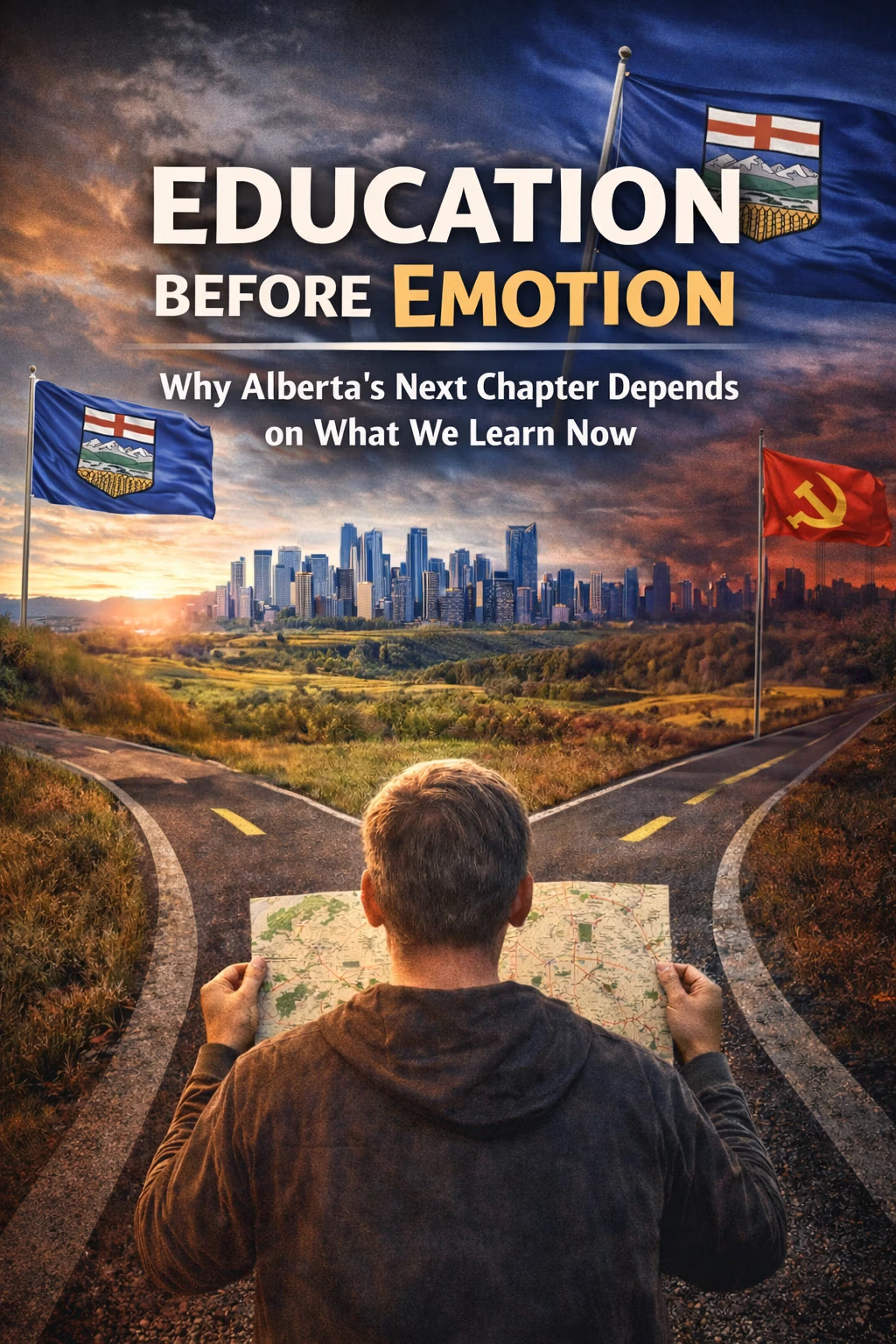
Education Before Emotion: Why Alberta’s Next Chapter Depends on What We Learn Now
Everything that unfolds in Alberta from this point forward, in relation to the Citizen Initiative Petition initiated by Mitch Sylvestre, will expose two unavoidable realities.
First, it will reveal the depth of our collective misunderstanding. Not just about one issue, but about civics, government structure, constitutional law, Indigenous rights, and even who we are as a political people. These gaps don’t usually matter in casual debate. They matter when decisions become real, binding, and irreversible. That moment has arrived.
Second, this process will expose who benefits from the status quo. It will identify those who instinctively defend existing institutions, symbols, and arrangements without questioning whether they still serve the public good. In many cases, allegiance to a flag or a label replaces allegiance to freedom itself. That raises a necessary question: is that loyalty rooted in genuine benefit, or in unfamiliarity with the consequences of the path Canada is currently on?
Either way, the process will make these divisions visible. And once visible, they cannot be unseen.
If we understand this reality, one conclusion becomes unavoidable: education is the single most important task ahead.
Decisions of this magnitude will affect not just us, but our children and the society they will inherit. That requires informed judgment, not reflexive emotion. Learning demands intellectual honesty and the willingness to temporarily set aside identity, nostalgia, and fear so facts can be examined clearly.
This is especially difficult because many of the most common arguments against Alberta independence are not analytical arguments at all. They are emotional assertions, often sincerely held, but rarely examined.
“I love this country.”
“Canada has given us so much.”
“What about all the things Canada gives us?”
These statements resonate because they appeal to memory, gratitude, and identity. But they are not arguments. Loving a country does not place it beyond scrutiny. Gratitude does not remove the obligation to evaluate outcomes. And asking what Canada “gives” Alberta without examining what Alberta contributes, what it surrenders, and how those exchanges are governed is not analysis. It is sentiment.
More troubling are the claims that surface once emotion hardens into hostility.
“Independence is treason.”
“They should all be jailed.”
These statements reveal a profound misunderstanding of both law and democracy.
In Canada, advocating for constitutional change, including secession, through lawful and democratic means is not treason. It is explicitly protected political expression. The Supreme Court of Canada addressed this directly in the Reference re Secession of Quebec (1998), affirming that a clear democratic expression of will creates an obligation to negotiate. Secession pursued through legal, peaceful, and democratic processes is not a crime. It is a political question, not a criminal one.
Calling it treason confuses disagreement with illegality.
The demand that people be jailed for holding or expressing pro-independence views is even more revealing. It is not a defense of democracy. It is a rejection of it. Democracies do not imprison citizens for proposing constitutional change. Authoritarian systems do.
Ironically, these accusations undermine the very country they claim to defend. A nation confident in its legitimacy does not fear debate. It does not silence dissent. It does not equate peaceful political advocacy with criminality. When people reach for punishment instead of persuasion, they are no longer arguing for unity. They are arguing for control.
This is where patriotism, when untethered from principle, becomes dangerous. It stops being about shared values and starts being about enforced conformity. It protects institutions from scrutiny rather than protecting citizens from abuse of power.
This is how people can declare themselves “forever Canadian” while remaining unaware of, or unwilling to confront, the legal, economic, and democratic trajectory Canada is currently on. Loyalty becomes a substitute for understanding.
Education cuts through that. Emotion, left unchecked, reinforces confusion.
This is where organizational discipline matters.
The Alberta Prosperity Project exists for one purpose: education. That is its mandate, and it must remain its only function. There is a separate and distinct organization, Stay Free Alberta, tasked with the operational and legal work required to advance the Citizen Initiative Petition and trigger a referendum. That work is essential and must be carried out lawfully and precisely.
Once that phase is complete, the educational effort must expand dramatically.
Under Alberta’s rules governing political campaigns, Alberta Prosperity Project must not advocate for outcomes or participate in campaigning. It does not tell people how to vote. It does not promote slogans or positions. It educates. Period. That constraint is not a weakness. It is a safeguard. It ensures that any eventual decision is grounded in understanding rather than fear, coercion, or emotional momentum.
A referendum driven by emotion is not democratic strength. It is democratic risk.
If Albertans are to make a decision of this magnitude, it must be done with clarity, knowledge, and intellectual independence. Education is not secondary to that goal. It is the foundation. Without it, the process becomes noise. With it, the decision whatever it may be is legitimate, informed, and owned by the people themselves.
That is the responsibility of this moment. And that is the work ahead.
-Christopher