
IT’S TIME WE WERE ASKED
Why Every Argument to Stay Is a Reason to Leave
A Let’s Talk Alberta publication
Written by Christopher Scott
The views presented in this booklet are the personal opinions of Christopher Scott, presented by Let’s Talk Alberta. Figures are drawn from public records — Statistics Canada, the Public Accounts of Canada, the Parliamentary Budget Officer, the Office of the Chief Actuary, named polls, and court rulings — and are cited in full at the back of this booklet and at letstalkalberta.com. Verify the live figures before you repeat them; numbers and rulings change, and we would rather you check us than trust us.
How to read this booklet
There are two ways to write a book like this. The first is to tell you what to think, bury the parts that don’t help, and hope you never go looking. That’s the version you’ve been handed for most of your life, from both sides of this question.
This is the other kind. When there is a real cost to independence, you’ll find it named on the page, in the same size type as everything else. When there is a real risk, I’ll tell you it’s real. What I ask in return is only this: that when someone shows you one column of a ledger — a big, frightening number with no breakdown — you ask to see the other column before you make up your mind.
Nobody should tell you what to think about this. Not Ottawa. Not me. My job in these pages is to put the facts on the table and trust you to decide. That’s the whole idea behind Let’s Talk Alberta, and it’s the reason I sat down to write.
Read both sides. Demand the truth. Then decide for yourself.
— C.S.
PART ONE
Why We’re Having This Conversation
1. Who I Am, and Why I’m Writing This
I run a truck stop in Mirror, Alberta. The Whistle Stop — café, gas, convenience store, a campground out back. I’ve spent about twenty years reading invoices for a living, and if there’s one thing two decades in business teaches you, it’s how to tell the difference between a real number and a number somebody wants you to be afraid of. A real invoice has two sides. It tells you what you owe and what you’re getting for it. When somebody hands you only the “what you owe” side and tells you to sign, you’ve stopped being a customer and started being a mark.
I didn’t come to this fight through politics. I came to it through a parking lot. During the lockdowns I watched governments — my government — decide which businesses were allowed to feed their families and which weren’t, and I watched the rules land on people out here who’d never hurt anybody, who just wanted to work. I learned, up close and personally, what it feels like to be governed by people who will never have to look you in the eye. That experience did something permanent to me. It made me start reading the fine print of the country I’d always assumed was on my side.
What I found is the subject of this booklet. It isn’t a grievance. Grievances are about feelings, and feelings fade. What I found is structural — it’s built into the paperwork of the country — and once you see it, you can’t unsee it. I started writing about it on my blog at whistlestoptruckstop.ca, one essay at a time, because I’m a café owner and that’s what a café owner has: a keyboard and a stubborn streak. Those essays became conversations. Those conversations became town halls. And the town halls became Let’s Talk Alberta.
I want to be honest with you about what I am and what I’m not. I’m not a lawyer, an economist, or a politician, and I’m not on anyone’s payroll — not Ottawa’s, not a party’s. I’m a guy who reads the invoice. Everything in this booklet, I’ve tried to source to public records, and I’ve tried to show my work so you can check it. Where the experts disagree, I’ll tell you they disagree. Where I’m giving you my opinion, I’ll call it my opinion.
Here’s the opinion, up front, so you know where I stand before you read another word: I believe Alberta should govern itself. Not because I’m angry at Canada — because I’ve read both columns of the invoice, and the math points home.
Now let me show you the math.
2. The Rarest Thing in the World
Across all of human history, the rarest thing a person could ever be handed is a real say in their own future — the chance to be asked a question about the kind of country they’ll live in, and to have their answer actually counted.
Think about how rare that is. For most people who have ever lived, the shape of their nation was decided by a king, an army, a conqueror, or an accident of birth. The right to self-determination — to be asked, and answered — has cost millions of people their lives. Whole generations fought and bled and died for the chance to walk into a room, mark a ballot, and have it mean something. Norwegians in 1905. Icelanders in 1944. The Baltic peoples who stood in front of tanks in 1991. They understood exactly what was on the table, because for them it had never been on the table before.
We are being handed that same right almost quietly. No barricades. No bloodshed. On October 19, 2026, for the first time in this province’s history, Albertans may be asked directly what future we want — and our answer will count. All it asks of us is our time: to show up, think it through, and talk honestly with our neighbours.
I don’t think most people have let that land yet. We’re so used to being told that voting on our own future is somehow radical, or dangerous, or embarrassing, that we’ve forgotten it’s the single most normal thing a free people can do. A referendum is not separation. A referendum is democracy in action. It is the thing every generation before us would have given anything to have.
Your voice matters. Your answer counts. That is a blessing generations bled for — and it would be a strange kind of ingratitude to be handed it peacefully and refuse to even pick it up.
That’s why the conversation matters more than the outcome. Whatever you decide, decide it yourself, with your eyes open. Don’t let anyone — including me — decide it for you.
3. Why Alberta Independence Is Necessary — and Inevitable
Let me make the whole argument in miniature, and then spend the rest of the booklet backing it up.
Necessary, because every serious problem Albertans face — an economy at the mercy of policies written against it, resources we own on paper but can’t move, money we send away and beg to have returned, a say in our own affairs that shrinks with every session of Parliament — traces back to the same root. We don’t control the decisions that decide our future. We’ve tried to fix that from inside the system since 1905. We’ve tried better deals, firewalls, formal demands, court challenges, and a Sovereignty Act. Every “better deal” has come out worse than the last, because you cannot negotiate a fair share from a table where the other side writes the rules, holds the pen, and appoints the referee. Reform from within requires leverage we do not have and, inside this structure, can never get.
Inevitable, because the pressure is structural and it is building, not easing. Alberta is a young, wealthy, resource-rich region tied to a federation whose economic centre of gravity, voting math, and policy instincts run in the opposite direction — and the gap is widening, not closing. A century ago the world had about fifty countries; today it has one hundred ninety-three. Most of them were born not through war but through referendums and negotiation, when a region finally decided that governing itself was more honest than being governed badly from a distance. That tide has been running one direction for a hundred years. The question was never really whether Albertans would ask to run their own affairs. The question is only when, and how well we understand the choice when we make it.
This booklet exists to make sure that when the question comes, we understand it.
I’m going to do it in a particular order, and the order matters. First I’ll show you what Canada actually is — not the version on the tourism posters, the version in the founding paperwork — because you can’t judge a relationship until you understand its terms. Then I’ll walk through what we stand to fix: the money, the economy, the resources, the treaties, health care, currency, pensions, security, and the rest — honestly, both columns. Then the numbers, in full. Then the myths, answered one at a time. And finally the path forward, and how you can be part of it.
One promise before we start: I will not tell you independence is free. It isn’t. There is a real cost and a real risk, and I’ll name both. What I’ll show you is that the other half of the bill — the half you’re never shown — is larger, and that the largest cost of all is the one nobody puts on any invoice: staying exactly as we are.
PART TWO
What Canada Actually Is
4. What Is Canada? Why It Was Created, and What “Canadian” Means
Ask most people what Canada is and they’ll describe a feeling — hockey, politeness, the flag, standing for the anthem. That’s Canadian identity, and it’s real, and nothing in this booklet asks you to give it up. But identity is not the same thing as the structure you actually live under, and it’s the structure we have to look at clearly, because the structure is what governs you.
Here is the structure. Canada was not founded the way the United States was founded — by a people declaring themselves into existence and writing their own rules from the ground up. Canada was drafted. In 1867, in London, the British Parliament passed the British North America Act, and that Act is the country’s operating document to this day. It was not put to a vote of the people who would live under it. There was no ratifying convention of ordinary citizens, no “we the people.” Authority in that document flows downward — from the Crown, through Parliament, to the provinces, to you — rather than upward from the citizens to the government they create.
That is a profoundly different design than most of us assume we live under, and it has consequences that reach right into your daily life. Read your land title sometime. You’ll find you hold your property “of the Crown.” The minerals under most of that land belong “to the Crown.” The preamble of the founding document binds the country to the Crown. This isn’t ceremonial trivia. It’s the architecture. In the American design, government is a tool the people built and can rebuild. In our design, the people are, in the old legal sense, subjects — and I’ll spend the next chapter on exactly what that word means, because it’s the hinge the whole booklet turns on.
Why was it built this way? Because it was built for a specific purpose at a specific time: to knit together a set of British colonies, keep them in the Empire, get a railway built, and manage a vast territory from a central capital. It was, in effect, a corporate charter for a semi-autonomous colony — a franchise. That’s not an insult; it’s a description. And a franchise can be renewed many times without ever becoming a partnership of equals. The fact that Canada has endured and been renewed for over a century tells you it’s durable. It does not tell you it’s fair to Alberta — those are different claims, and defenders of the status quo constantly slide from the first to the second and hope you don’t notice.
So what does it mean to be Canadian? It means whatever you feel it means — and you get to keep every bit of that. Borders change; people don’t. Your family’s history, your memories, your pride, the game on Saturday night: none of that lives in the British North America Act, and none of it disappears if Albertans decide to govern themselves. What changes is not who you are. What changes is who holds the pen.
5. Subject or Citizen?
This is the most important idea in the booklet, and it’s the one nobody in the official conversation wants to talk about, because once you understand it, everything else looks different.
There is an old and precise distinction in political thought between a subject and a citizen.
A subject lives under an authority imposed from above. Their rights are privileges — freedoms that haven’t been revoked yet, granted by a power that reserves the right to limit them. Their property is held at the pleasure of that authority. They are governed by institutions that existed before them and will exist regardless of their consent. A subject can have a comfortable life, even a free-feeling one. But the arrangement is not theirs. It was handed to them, and it can be adjusted without asking.
A citizen lives under an authority they themselves constituted. Their rights are recognized as inherent — not granted by government, but pre-existing, with the government merely acknowledging them. Their property is genuinely their own. Their government operates within limits the people wrote and can change. The citizen is the author of the arrangement, not merely a resident of it.
Now look at the paperwork of your own life again. Your rights in this country are protected by the Charter — but Section 1 of that very Charter says those rights are subject to “reasonable limits” that a government can impose and a court can uphold. Your land is held “of the Crown.” Your minerals belong “to the Crown.” The country’s founding text binds it to the Crown, not to you. By the old definition — the precise one — Albertans are still, structurally, subjects. Comfortable ones, in a wealthy country, in a peaceful era. But subjects.
Independence, stripped of all the noise, is the question of whether Albertans become citizens. It would mean — for the first time on this land — a constitution written by Albertans, for Albertans, in which rights are inherent rather than granted, property is genuinely owned, and the government lives inside limits the people themselves set down. That’s not a flag or a football team. That’s the deepest thing a people can own.
When someone tells you independence is about anger, or oil prices, or one bad pipeline decision, they are keeping you in the small conversation. The real conversation is this one: subject, or citizen? Everything else in this booklet is downstream of that single question.
6. Written Around Us, and To Us
People assume that if the system were truly unfair to Alberta, we could simply fix it from within — vote differently, negotiate harder, amend the rules. I want to show you, carefully, why that door is nailed shut, and why it was nailed shut by the very document people tell you to trust.
Start with arithmetic. Changing the constitution in any fundamental way requires the agreement of Parliament plus the legislatures of at least seven provinces representing at least fifty per cent of the population. Do the population math and you find that Ontario and Quebec together hold an effective veto over the things that matter most. Alberta cannot assemble the numbers to change the deal, no matter how right we are or how hard we push. The amending formula didn’t happen to leave us out; it’s structured to. Reform-from-within isn’t a hard road for Alberta. Inside this formula, it is a closed one.
Now add Section 1 of the Charter — the “reasonable limits” clause. Your rights are real, but they are qualified at the source by a government’s power to limit them and a court’s willingness to bless the limit. A right that can be “reasonably limited” by the same authority you’d need to appeal to is not a wall around the citizen; it’s a gate the state holds the key to.
Put those two together and you get the trap. The federation can pass laws that fall hardest on Alberta — the National Energy Program, the tanker ban, the emissions cap, a carbon tax — and Alberta has neither the constitutional numbers to stop them nor an unconditional shield to hide behind. The system doesn’t have to be malicious to grind against us. It only has to keep working exactly as designed. Decisions get made around us, by a majority that doesn’t share our interests, and to us, because we lack the leverage to say no.
And here is the part that should stop you cold: when Albertans have tried to use the one tool we clearly do have — the ballot — to even ask the question of changing our place in this structure, the machinery has moved to shut the question down. A federally appointed court has weighed in on whether Albertans can so much as vote on the terms of the arrangement. Sit with that. The argument being made against us is not merely that we should choose to stay. It’s that we may not be permitted to ask. When a structure will not let you leave, will not let you meaningfully reform, and then questions whether you’re even allowed to pose the question — that is not a partnership. That’s the thing the word “subject” was invented to describe.
7. Governed Since 1905, Never Asked
Alberta did not walk into Confederation as an equal. We were admitted to it. Our terms of entry were written in Ottawa in 1905 and never put to a vote of the people who would live under them. And here’s the detail most Albertans were never taught: when Alberta became a province, Ottawa kept our land and natural resources. The other provinces controlled their own resources from the day they joined. Alberta did not gain control of its own resources until 193013 — a full quarter-century of being a province that didn’t own what was under its feet. We started behind, by design, and we started without being asked.
That pattern — decisions about Alberta, made in Ottawa, without Alberta’s meaningful consent — did not end in 1930. It is the throughline of the last century:
The National Energy Program of 1980 held down the price Albertans could get for their own oil to subsidize consumers elsewhere, helped drive a brutal regional recession, and taught a generation exactly where they stood in Confederation.
Equalization takes tax dollars generated in Alberta and redistributes them to other provinces, year after year — a system Albertans voted to remove from the constitution in a 2021 referendum14, a vote Ottawa simply absorbed and ignored.
Bill C-48, the tanker ban, closed the northern British Columbia coast to the tankers that would carry Alberta oil to Asian markets — while leaving tanker traffic on the east coast, importing foreign oil, untouched.
Bill C-69 rewrote the federal review process for major projects so thoroughly that critics — and eventually the Supreme Court, which found core parts of it unconstitutional12 — recognized it as a gate that could stall an Alberta pipeline indefinitely.
The carbon tax and the emissions cap applied national climate policy in a way that fell hardest, and most specifically, on the one industry Alberta does better than anyone on earth.
Look at the list and notice what it is not. It is not a run of bad luck. It is not a few unfortunate policies that a better negotiator could have talked Ottawa out of. It is a consistent, century-long pattern in which the interests of the federation’s population centres and the interests of Alberta pointed in opposite directions, and the structure resolved the conflict against us every single time — because that is what the structure is built to do.
Since 1905, through all of it, Albertans have never once been asked, directly, what future we actually want. Not in 1905. Not in 1930. Not through the NEP, or equalization, or C-48, or C-69. On October 19, 2026, for the first time in one hundred twenty years, the answer could finally be ours. That alone — the simple, overdue dignity of being asked — is worth showing up for.
PART THREE
What We Stand to Fix
A note on this section. What follows is the “what if it works” part — a walk through the big questions people raise, one at a time: the money, the economy, the resources, the treaties, health care, currency, pensions, security, and more. I’ve tried to give each one both columns. Independence isn’t free, and I’ll keep saying so. But the point of this section is that on question after question, the honest ledger runs in Alberta’s favour — and the reason it does is almost always the same: control moves home.
8. The Money: Who Controls What Albertans Already Send
Start with the single most important fact in the whole debate, because everything else is a footnote to it: independence is not about finding new money. It’s about who controls the money Albertans already send.
Every year, far more tax revenue is raised in Alberta and sent to Ottawa than comes back in services and transfers. The net figure — what leaves and never returns — has run in the range of roughly $17 to $27 billion a year, averaging around $21 billion, and it peaked near $27 billion in a single year4. Over the long run the totals become staggering: since 1961, Albertans have paid on the order of $600 billion more into Confederation than came back — a figure that, adjusted into today’s dollars, climbs past a trillion4. And here’s the part that should end the argument about whether these numbers are “separatist propaganda”: the economist most often cited for them is a federalist who opposes separation. This isn’t our math. It’s the public record’s math.
So when someone asks “how could Alberta possibly afford to be independent?”, the honest answer is that Alberta is the one already carrying others. We are not the province that needs a bailout. We are the province writing the cheque. The question independence asks is simply: what if that money stayed, and was spent by a government that answers to the people who earned it?
That’s not a promise of a windfall. Running a country costs money, and the next chapters count that cost honestly. It’s a change in who decides. Right now, the largest single flow of money out of Albertans’ pockets is directed by a government most Albertans did not vote for and cannot hold to account. Independence puts that steering wheel in Alberta’s hands. You can disagree about what we would do with it. But you can’t seriously argue we can’t afford to hold it — we’re the ones filling the tank.
9. The Economy: From Extraction to Ownership
There’s a story we’ve been told for forty years: that Alberta’s economy is a rollercoaster, that the busts are just the price of the boom, that this is simply our lot as a resource province. Part of that is honest — commodity prices do swing. But a large part of the pain we’ve absorbed wasn’t the market. It was policy.
Consider what has been chased out. Over the last decade, on the order of $150 billion in energy investment5 left this province or was cancelled outright — pipelines vetoed after approval, projects strangled in review, capital that simply decided the rules here were too unpredictable to risk. That’s not the invisible hand of the market. That’s the visible hand of C-69, C-48, the emissions cap, and a decade of signals telling the world that the one thing Alberta does best is the one thing this federation would rather it stopped doing.
Now flip it. The single greatest gift a government can give an economy is certainty — stable rules, one clear jurisdiction, a predictable tax regime, and regulators who answer to the same voters the industry employs. An independent Alberta would offer exactly that: one jurisdiction instead of a federal-provincial tug-of-war, rules set by people who want the industry to succeed, lower and simpler taxes, and a government whose own budget depends on Albertans working. Capital doesn’t flee stability. It flees the thing we have now.
This is the shift at the heart of the economic case: from extraction to ownership. Today, Alberta functions like a resource colony — the wealth comes out of the ground here, but the decisions about how much, how fast, to whom, and on what terms are made somewhere else, and a large share of the proceeds are routed away before we see them. Ownership means the decisions and the proceeds both come home. Not new money conjured from nowhere — the same economy, finally run for the benefit of the people living in it.
10. Resources: Owning What’s Already Ours
Here is a fact that surprises even people who’ve lived here their whole lives: under Section 92A of Canada’s own constitution, Alberta already owns its natural resources. The oil, the gas, the minerals — provincial jurisdiction, provincial property. Independence doesn’t seize the resources. On resources, it mostly removes the middleman who keeps telling us what we’re allowed to do with what’s already ours.
What changes is the overhang. Today, even though the resource is ours, the federal government sets the terms that decide whether we can develop it, move it, or sell it — emissions caps, review processes, tanker bans, market-access decisions. We own the barrel but not the tap. Independence connects the two: the people who own the resource also set the rules for using it, and keep every dollar of the revenue rather than watching a share of it routed to Ottawa first.
And there’s an opportunity here that almost nobody talks about, because it doesn’t fit either side’s script. Alberta is sitting on tens of thousands of orphan and inactive wells — usually described only as a liability, a cleanup bill of tens of billions. That’s real, and I won’t wave it away; the honest number for actual well cleanup is likely in the range of $40 to $70 billion8, not the inflated $200-billion figure you sometimes hear (which quietly folds in oilsands mine reclamation that’s a separate thing entirely). But “liability” is only half the ledger. A meaningful share of those wells are viable again with today’s technology and today’s markets — and the same brine that comes up with the old oil can carry lithium. I’ve tested a sample from my own well near Clive; it came back around 300 parts per million lithium. Alberta companies have already produced battery-grade lithium from Alberta brine. Picture a Crown corporation whose entire job is to go through that inventory well by well, restart the ones that pay, extract the minerals the world now wants, and let the revenue fund the cleanup of the ones that don’t. That’s the difference between managing a resource as a subject and owning it as a nation: one sees only a bill; the other sees the business.
11. Getting to Market: Pipelines and the Landlocked Myth
The oldest club used to beat down the independence conversation is one word: landlocked. “Alberta has no coast, so Alberta is at everyone’s mercy.” It sounds decisive. It falls apart the moment you look at it.
First, the obvious: Alberta is already landlocked, and is already one of the largest exporters in Canada. Whatever “landlocked” is supposed to prevent, it plainly hasn’t. Switzerland and Austria are landlocked and sit among the wealthiest nations on earth. Being landlocked is a routine condition managed by dozens of prosperous countries through trade agreements and transit rights — there are international conventions built precisely for this. The constraint was never the geography. The constraint is policy, and who negotiates market access on our behalf.
And who negotiates it now? Ottawa — the same government that banned tankers off the northern B.C. coast with C-4812, that let approved pipelines die, that had to buy a pipeline because its own rules had made one impossible to build privately. Right now, Alberta’s access to the sea runs through a federal process that has repeatedly used that access as a lever against us. As a sovereign nation, Alberta would negotiate directly — with British Columbia, with First Nations along the route, with the United States, with buyers in Asia — as a principal, not as a supplicant sending an application to a federal Major Projects Office and hoping.
This is exactly why “this was never about a pipeline.” When a west-coast pipeline framework was announced late in 202519, it was held up as proof the system works. But a memorandum of understanding is, by definition, non-binding — a framework, not an approval. Two of the three named owners were governments, the same pattern as the pipeline Ottawa already had to nationalize. The lesson wasn’t “see, the system delivers.” The lesson was that even our strongest hand still has to be played through a federal process that can fold it at will. Independence isn’t about any single pipeline. It’s about who decides whether Alberta can build at all.
12. Trade and the World: Partners, Not Permission
The fear beneath “landlocked” is really a fear about trade: if we leave, won’t Canada — and the world — cut us off?
Look at what actually moves. Alberta sells oil, gas, beef, grain, and refined products that other people genuinely need. Canada needs Alberta’s energy and agriculture more than Alberta needs Ottawa’s deficits — and trade flows on mutual need, not on sentiment. The rest of Canada isn’t going to stop heating its homes or fuelling its trucks to spite an independent Alberta; British Columbia depends on Alberta pipelines for the large majority of its refined fuel. Interests don’t evaporate when a border moves. They get formalized into agreements.
And agreements are ordinary. Independent countries negotiate trade deals as a matter of routine; continental frameworks like USMCA and bilateral deals can be negotiated in months, not generations, when both sides want the trade — and both sides here want the trade. Alberta already runs trade offices abroad. There has been documented, high-level interest from the United States in Alberta as a stable energy partner. None of this is exotic. It’s what every trading nation on earth does every day.
Here’s the honest part of the ledger, because I promised you both columns. The real economic risk of independence is not being “cut off” — it’s trade friction during the transition: the added cost and uncertainty while new arrangements get papered. One credible estimate puts that friction on the order of $130 billion over a decade in reduced economic activity if things go badly4. I’m not going to pretend that’s nothing. But notice two things. First, it’s a negotiation outcome, not a fate — the better the plan and the calmer the transition, the smaller it gets. Second, set it beside the other column: the tens of billions a year we would stop sending away. The friction is a one-time cost of changing the arrangement. The transfers are a permanent cost of keeping it. You are comparing a bruise to a standing monthly withdrawal.
13. First Nations and Treaties — The Most Important Question
I’ve put this chapter at the heart of the booklet on purpose, because it is the most important question we face, and it deserves more than a talking point. No honest path to Alberta’s future is built around Indigenous nations. It can only be built with them.
Let me start with what’s true and hard. For more than a century, the federal government has held near-exclusive authority over the lives of First Nations people — and by the government’s own statistics, the results are a moral catastrophe. First Nations Albertans face a life expectancy roughly nine to twelve years shorter than other Canadians. Youth suicide runs many times the national rate. Children on reserve are several times more likely to live in poverty, in overcrowded housing, under boil-water advisories. Indigenous people are dramatically over-represented in the foster system and in the prisons20. This is what a century of exclusive federal stewardship has produced. Whatever else you believe, you cannot look at those numbers and call the status quo a success worth protecting.
Now the legal question, plainly. Treaties are held with the Crown, not with a particular government — and jurisdiction under the Crown has already changed hands many times: Hudson’s Bay Company, the British Crown, the Dominion, the provinces. The treaties survived every one of those transfers, including Alberta’s own creation in 1905. A border moving does not dissolve a treaty; the obligations transfer intact. An independent Alberta would inherit every Crown treaty obligation in full — and in a founding constitution written here, Treaties 6, 7, and 8 could be entrenched with protection equal to or greater than Section 35 of Canada’s constitution9. The duty to consult is real and must be honoured at every stage. It is a duty to consult — not a veto — and that distinction has been affirmed in Canada’s own courts11.
But the law is the floor, not the point. The point is self-determination — the same principle that drives Alberta’s own case drives the case for First Nations to finally govern their own affairs as partners rather than as wards of a distant department. First Nations are not one voice, any more than Albertans are; that’s the entire reason you hold a vote instead of assuming the answer. In a recent Mainstreet poll, a higher share of First Nations respondents were open to independence than the general population21. Some will want to hold the existing treaties exactly as they are; some will want to renegotiate for something better than Ottawa has delivered. Both doors should be open, and both should be walked through together, in the open, as equals.
Treaties were meant to free people — to secure survival, peace, and a shared future. Ottawa turned them into an instrument of control through the Indian Act and a century of administration. An independent Alberta has the chance to honour them the way they were meant to be honoured: directly, transparently, locally, as partners — not dependents. That is not a threat to First Nations. Handled with the seriousness it demands, it may be the best opportunity in a century.
14. Health Care Without Federal Strings
“Independence will destroy health care” is one of the most effective scares in the whole debate, and one of the emptiest. Here’s why.
Your health care is already an Alberta system. It is delivered by Alberta, staffed by Albertans, and mostly paid for out of Alberta’s own budget. The federal role is narrower than most people think: Ottawa attaches conditions to a stream of federal money through the Canada Health Act — conditions on a payment, backed by the threat of withholding that payment. Take away the federal payment and you take away the federal leverage, but the system — the hospitals, the doctors, the nurses, the whole apparatus — doesn’t belong to Ottawa and never did.
So what actually changes with independence? Two things, both in Alberta’s favour. First, the money that funds health care comes from a bigger pot — the same tens of billions a year we currently send away could partly stay home, and health care is exactly the kind of thing Albertans would choose to spend it on. Second, reform gets easier, not harder, because the decisions are made entirely here, by people accountable to Alberta patients, without a set of federal conditions written for a different province’s circumstances hanging over every choice.
I want to be careful and honest here: independence is not a magic wand for health care. Every developed country wrestles with wait times, staffing, and costs, and we would too. What independence removes is not the difficulty — it’s the outside constraint on solving the difficulty our own way, with our own money, answerable to our own people. That’s not a downgrade. For a system that’s already ours in everything but the fine print, it’s the fine print finally catching up to reality.
15. A Currency, and the Fund We Never Built
Two money questions come up constantly: what about the Canadian dollar, and could Alberta even manage its own finances? Take them in turn.
On currency, let me be straight about what independence would and wouldn’t mean. Let’s Talk Alberta does not propose clinging to the Canadian dollar. The Canadian dollar has lost close to half of its purchasing power over the past fifteen years16, and Albertans have no meaningful say over the monetary policy that governs it — those decisions are made for the whole country, usually with the country’s population centres in mind. An independent Alberta would have choices: adopt a stable, widely-trusted currency such as the U.S. dollar for a transition, and decide in time whether to launch its own, ideally backed by real reserves. A resource-rich country with low debt and hard assets behind its money can build one of the most trusted currencies in the world. The point isn’t a particular answer; it’s that, for the first time, the answer would be ours to choose.
On competence, look at the one thing that haunts every honest Albertan who studies this file: the fund we never built. Norway took its oil wealth and built a sovereign fund now worth more than three trillion Canadian dollars (over US$2 trillion)15 — a nation’s savings account, earning for every citizen. Alberta started the same idea, at nearly the same time, with the Heritage Fund — and then let the discipline lapse while the resource wealth flowed out through the transfers we’ve already discussed. Had Alberta kept and compounded its own resource revenue the way Norway did, we would today be sitting on a fund in the hundreds of billions. That isn’t an argument that independence prints money. It’s the opposite: it’s proof of what was lost by not controlling our own wealth — and a blueprint for what controlling it could finally build.
16. Pensions, Citizenship, and What You’re Told You’d Lose
This is the category the fear campaign loves most, because these are the things people can’t afford to gamble with: my pension, my citizenship, my passport. So let me be very clear and very calm.
Nothing you’ve earned gets vaporized. It gets negotiated. That’s the honest word, and the dishonest move is to pretend there’s no table.
Your CPP: a pension you paid into is money you earned, and CPP assets are divided between governments when a province leaves — not erased. Alberta is a young, high-earning, net over-contributor to the plan, which means our share is large; independent actuarial work has put Alberta’s entitlement somewhere in the range of $135 billion at the conservative end to over $330 billion6. Wherever inside that range the number lands at the table, the direction is the same: Alberta starts from strength, not deficit. And whatever a future Alberta pension looks like, recipients keep receiving — people collect their pensions regardless of which country they live in; that’s true of retirees all over the world today.
Your citizenship and passport: these are settled by agreement between states, exactly as they have been every single time a nation has become independent. You don’t wake up stateless. Arrangements for citizenship — often dual citizenship — get worked out between governments, and a new Alberta passport is a routine function every sovereign country performs. Nobody’s identity gets cancelled by a negotiation.
The pattern in this whole category is the same. Someone names a thing you rightly care about, attaches the word “lose,” and hopes the fear does the work before the facts arrive. But every one of these — pensions, citizenship, passports, benefits — is a known, solved problem with a century of precedent behind it. Nations separate; the paperwork gets done; grandmothers keep getting their pension cheques. The only way “you’ll lose it” is true is if you believe Alberta would be uniquely incompetent at the ordinary administrative tasks that far poorer new nations have managed. I don’t believe that about us. Neither should you.
17. Security: Police, Defence, and Standing With Allies
“We would lose the RCMP, the military, our whole security blanket.” Let’s walk through it, because here too the reality is more ordinary than the fear.
Policing first. Alberta already runs Sheriffs and has been building toward a provincial police service — and provincial police forces are nothing exotic; other provinces run their own. The RCMP provides contract policing that Alberta already largely pays for, on the order of hundreds of millions a year; that money and that function can be redirected into an Alberta service accountable to Albertans. This isn’t a leap into lawlessness. It’s a change of shoulder patch and a change of who the officers answer to.
Defence next. Yes, Alberta would need to provide for its own defence — and yes, that costs money; the honest figure sits in the range of what a serious small nation spends. But look at who does this successfully. Norway, Ireland, Finland, Estonia, Singapore — all sovereign, several smaller than Alberta, all maintaining effective, modern forces sized to their needs. A nation doesn’t need to match a superpower; it needs to defend its territory and stand inside its alliances. Alberta sits in the middle of a continent whose security is organized through NORAD and shared defence with the United States — allies, not isolation. An independent Alberta would size its forces to its actual needs and remain a partner in continental defence, the way every other nation on this continent already is.
The theme repeats one more time: the things we’re told only Ottawa can provide are, on inspection, things ordinary countries provide for themselves every day. Security is not a gift from the federation. It’s a normal function of a normal state — and Alberta is more than capable of being a normal state.
18. Immigration and Population: Who Decides How Fast We Grow
Here is a lever Albertans barely realize they’ve given away: we do not decide who comes to Alberta, or how fast. Immigration levels are set nationally, for national reasons, and the effects land locally — on housing, on hospitals, on schools, on wages, on the pace at which a community can absorb newcomers and still function. When those levels are set far too high or far too low for Alberta’s actual conditions, Albertans wear the consequences without ever having set the dial.
Independence would put that dial in Alberta’s hands. And let me be clear about the spirit of this, because it matters: this is not about pulling up the ladder. Alberta is built by people who came here to work — from across Canada and from around the world — and newcomers are woven into the story of this province at every level. Some of the most passionate voices in this movement came here precisely to escape places where governments stopped listening to citizens, and they recognize the warning signs. Controlling immigration isn’t about fewer people or more; it’s about matching the flow to what Alberta can actually house, employ, and welcome well — a decision made by the people who live with the result, instead of by a national formula that treats a booming resource province and a struggling manufacturing town as the same problem.
A nation chooses its own rate of growth. A subject province absorbs someone else’s.
19. Agriculture and Food Security: Feeding Ourselves
Alberta feeds people — our own, and millions beyond our borders. Beef, grain, canola, pulses: this province is one of the great agricultural producers on the continent, and that is not an accident of soil alone. It’s the work of families who’ve farmed the same land for generations. Yet the rules that govern a great deal of Alberta agriculture — supply management systems, marketing frameworks, trade concessions — are set nationally, and Alberta’s interests are routinely traded away in negotiations run out of Ottawa, where our farmers are a small voice at a big table.
Food security is national security; a people that can feed itself is a people that can never be starved into submission. An independent Alberta would treat its agricultural base as the strategic asset it is — setting its own farm and trade policy, negotiating its own access to markets that want what we grow, and protecting the family farm rather than using it as a bargaining chip in deals struck for other regions’ benefit. When trade agreements are negotiated by a government that depends on Alberta’s farmers, Alberta’s farmers stop being the concession and start being the priority.
This is the same story as energy, told in wheat and cattle. We produce far more than we consume, we sell to a world that needs us, and the only thing standing between our producers and the best deal available is a set of decisions currently made by people who will never have to run the combine.
20. Education and Institutions: Standards Set at Home
Education is already, on paper, a provincial responsibility — and yet the pull toward national standards, national funding conditions, and centrally-driven curriculum debates keeps reaching into Alberta classrooms. Parents across this province, of every background and political stripe, share a simple instinct: they want a say in what their children are taught, and they want the people setting that direction to be close enough to be held accountable.
Independence doesn’t invent Alberta’s control over education; it completes it — removing the federal conditions, the national pressure, and the outside influence that creep in around the edges of provincial jurisdiction, and leaving curriculum, standards, and the shape of our schools and universities fully in the hands of Albertans and Alberta parents. Institutions built here, funded here, and answerable here.
The broader principle reaches past the schoolhouse. A nation’s institutions — its schools, its universities, its courts, its professional bodies, its public broadcaster — carry its values into the future. Right now, many of the institutions that shape Alberta’s public life are designed, funded, and directed from outside the province, and they carry priorities that aren’t always ours. Owning our institutions means they finally reflect the people they serve. That’s not about imposing one view; it’s about the difference between institutions handed to you and institutions you build.
21. Democratic Legitimacy: The Votes That Were Ignored
There’s a quiet insult buried in Alberta’s history with Confederation, and it’s worth saying out loud: when Albertans have voted, Ottawa has felt free to ignore it.
In 2021, Albertans voted in a referendum to remove equalization from the constitution. It was a real vote, on a real question, and it passed14. Nothing changed. The result was acknowledged and set aside. Go back further and the pattern deepens — a province that pushed for Senate reform for decades so that regions like ours would have a real check on the majority, that elected senators-in-waiting to make the point, and watched the reform never come because the amending formula we met in Part Two made sure it never had to. Alberta has spent a century using every legitimate democratic tool inside the system, and the system has absorbed each one without changing its behaviour.
This is the part of the case that isn’t about money at all. It’s about consent. A government that can take your money over your objection, override your priorities, and then treat your votes as advisory is not governing with your consent — it’s governing despite it. The most basic promise of democracy is that when the people speak clearly, the outcome follows. For Alberta, inside this structure, that promise has a hole in it, and the hole is not an accident — it’s the design we examined in Part Two.
Independence is, at bottom, a demand that our votes finally count — not just for premiers and MLAs, but for the shape of the country we live in. On October 19, 2026, the question is whether that hole gets closed. It’s the one vote Ottawa would find much harder to simply absorb and ignore.
22. The Constitution We Would Write
Everything in this section — the money, the resources, the treaties, health care, currency, pensions, security, immigration, agriculture, education, the votes that were ignored — comes together in one act, and it’s the most important thing this booklet has to offer. Independence would let Albertans do the one thing we have never, in one hundred twenty years, been permitted to do: write our own founding document.
Think about what that means. A constitution is not a policy. It’s the rulebook that sits above the policies — the frame that decides what any future government may and may not do to you. Every constitution ever written encodes a choice about the relationship between the people and the power that governs them. Canada’s, drafted in London in 1867, encoded that Albertans are subjects: rights granted and limitable, property held “of the Crown,” authority flowing down. We didn’t write it, we weren’t asked about it, and we can’t amend it.
An Alberta constitution, written by Albertans, could encode the opposite. Rights recognized as inherent, not granted — yours by nature, with government merely acknowledging them, not “reasonably limiting” them. Property genuinely owned. Treaties 6, 7, and 8 entrenched at the founding, protected as strongly as anything in the document. A government fenced inside limits the people themselves set down — limits on spending, on taxation, on how far any future majority in Edmonton can reach into your life. For the first time on this land, a constitution that flows up, from Albertans, rather than down, from a Crown across an ocean.
That’s the prize. Not a better deal inside someone else’s rulebook — our own rulebook. And here’s why it can’t wait, why “reform from within, someday” isn’t a real alternative: you cannot write your own constitution while living under one that won’t let you. The document that governs us was designed to be unchangeable by us. The only way to become the authors of our own rules is to become a country that has the standing to write them. Independence isn’t the goal. It’s the door. The constitution is what’s on the other side — and it’s the difference, finally and permanently, between being a subject and being a citizen.
PART FOUR
The Numbers
I’ve spent twenty years reading invoices. This is the part where I show you both sides of this one. Every figure here traces to a public source — Statistics Canada, the Public Accounts, the Parliamentary Budget Officer, the Office of the Chief Actuary, the Fraser Institute, named actuarial reports. Where estimates differ, I give you the range instead of the number that flatters my case. Check all of it.
23. Alberta’s Fiscal Outlook: The Two-Column Ledger
Every argument that Alberta “can’t afford” independence is built on the same trick: it lists every cost of leaving and deletes every offset. It shows you one column of a two-column ledger. So let’s build the whole ledger, both columns, in plain sight.
Column one — what independence costs. Running a country isn’t free. An independent Alberta has to replace the federal services it currently receives — defence, the federal share of various programs, national administration. The most-cited fiscal plans put the annual cost of standing up and running those national functions in the range of $23 to $32 billion a year.7 That’s the bill on the table. I’m not hiding it; I’m starting with it.
Column two — what independence keeps and reclaims. Here’s everything the “$400 billion” crowd leaves blank:
- What we stop sending to Ottawa: the net transfer out of Alberta, roughly $17–27 billion a year (averaging about $21 billion, peaking near $27 billion). That flow simply stays home.
- Federal taxes raised in Alberta: on the order of $60–69 billion a year is collected federally from Albertans. Independence isn’t about new money — it’s about keeping the tax base we already generate.
- Our share of the CPP: somewhere between $135 billion and $334 billion6, divided at the table, because Alberta is younger, higher-earning, and has over-contributed for decades.
- 100% of our resource revenue: already ours under s.92A — every dollar, no share routed away first.
- A share of federal assets and Crown corporations: on the order of $137 billion2 (roughly Alberta’s proportional share of Canada’s federal assets), settled by negotiation — because under the 1998 Secession Reference, assets and liabilities are divided together10, not one without the other.
Now do the arithmetic the fear campaign refuses to do. Set the $23–32 billion annual cost against the $17–27 billion in transfers that stop plus a tax base of $60-plus billion that stays home, and in most years an independent Alberta doesn’t run a deficit — it runs a surplus. Independent estimates have put that annual surplus, after fully funding national services, in the range of $15–20 billion.5 That’s money that could seed a sovereign wealth fund, eliminate the provincial portion of income tax, pay down debt, or all three over time.
The honest risk, kept in view. I told you I wouldn’t hide the cost, so here it is one more time, in the numbers column where it belongs: the genuine risk is transition friction — trade disruption during the changeover — which one credible estimate puts near $20 billion a year, or ~$130 billion over a decade4 in a bad scenario. That’s real. It’s also temporary, it’s a negotiation outcome rather than a fixed fate, and it sits against permanent annual surpluses and permanent retained transfers on the other side of the page. A one-time bruise against a standing monthly withdrawal.
That’s the whole ledger. When someone shows you only column one, now you know what they’ve erased — and you know to ask for the other half.
24. Show Me the Other Half of the Bill
Let me put the single most famous number in this whole debate under the light, because it’s the clearest example of the one-column trick in action.
Premier Danielle Smith has said that leaving could cost “almost $400 billion” up front, plus $25–50 billion a year. It’s a staggering figure, and it did exactly what a staggering figure is meant to do: it frightened people out of even asking the question. But notice what happened, and what didn’t. The number was said at a podium. It was never costed — never published with a line-by-line breakdown you could check. The fear arrived instantly; the math was going to come “soon.” That’s backwards from how any honest invoice works. On a real invoice, the number is the math.
Now set it beside the only fully-costed independent estimate anyone has actually put on paper. That work puts the one-time startup cost near $98–107 billion — and then, crucially, it does the thing the $400-billion figure refuses to do: it fills in the other column. Once you subtract Alberta’s share of federal assets, our CPP entitlement, and the payments we stop making, the net one-time cost falls to roughly $53–91 billion7 — and in most years afterward, the independent Alberta runs a surplus. That’s not a $400-billion catastrophe. That’s a manageable transition cost for a wealthy region buying its own sovereignty, financed in significant part by assets that were partly ours to begin with.
So which number is real? The one with the arithmetic attached. A gigantic total with no breakdown does exactly one job — it scares people away from the table. The moment you ask to see the second column, the “$400 billion” doesn’t survive contact with a calculator.
I’ve been reading invoices for twenty years, and I know the difference between a bill and a threat. A bill shows its work. A threat shows you a number and hopes you don’t ask. When a government campaigns against its own people’s choice with a frightening total and no breakdown — ask to see the other half of the bill. Every time.
25. Alberta as a Nation: A Snapshot
Step back from the line items and look at the country we’re actually talking about, because scale matters and the fear campaign counts on you picturing Alberta as small and fragile. It isn’t.
An independent Alberta would have a population of roughly 5 million — larger than Ireland, larger than New Zealand, larger than Norway, larger than Finland, and many times larger than perfectly successful sovereign nations like Iceland, Malta, or Luxembourg1. Even in the fear campaign’s own worst-case polling — where they imagine large numbers of people leaving — Alberta still retains a population larger than several prosperous countries combined. We are not too small to be a country. We are bigger than most of them.
On wealth, Alberta has among the highest GDP-per-capita in North America, one of the lowest debt-to-GDP ratios in Canada, and the kind of resource wealth that has earned Norway — a fellow resource nation — a top-tier, triple-A credit rating.17 We would not be a poor nation hoping to make it. We would launch as one of the wealthiest new countries in the world, per person, on day one.
Hold the whole picture together: a population larger than Ireland or Norway, GDP per capita among the highest on the continent, resource wealth on the Norwegian model, low debt, a young and productive workforce, and — for the first time — full control of the tens of billions a year we currently send away. Compared to the circumstances in which Norway, Ireland, Estonia, Singapore, and dozens of others became successful independent nations, Alberta wouldn’t be starting from behind. On almost every measure that matters, Alberta would be starting from the front of the pack.
The question was never whether Alberta is capable of being a country. Look at the numbers and that question answers itself. The only real question is whether Albertans will decide to be one.
PART FIVE
Clearing the Air
26. Myth vs. Fact
Here are the strongest objections people raise — the “yes, but what about…?” questions — with honest answers. These aren’t meant to end the debate; they’re meant to keep it open, because the whole game of the fear campaign is to shut the conversation down before it starts. Read them, test them, argue with them. That’s the point.
Myth: “Alberta can’t legally separate.”
Fact: Canada’s own Supreme Court settled this in the 1998 Reference re Secession of Quebec10. A clear majority on a clear question creates a constitutional obligation on Ottawa and the other provinces to negotiate in good faith. That’s a legal pathway, not a wall.
Myth: “Alberta would be landlocked and helpless.”
Fact: Alberta is already landlocked and already a top exporter. Switzerland and Austria are landlocked and among the richest nations on earth. The constraint is policy, not geography — and as a nation Alberta would negotiate market access directly instead of through a federal process that has repeatedly used that access against us.
Myth: “We would lose the Canadian dollar.”
Fact: We’re not proposing to keep it. The dollar has lost close to half of its purchasing power in fifteen years16 and Albertans have no say over it. An independent Alberta could adopt a stable currency during transition and, in time, back its own.
Myth: “Our credit rating would collapse.”
Fact: Alberta has among the lowest debt-to-GDP ratios in Canada and vast resource wealth. Norway, a resource-backed nation, holds a top-tier triple-A credit rating, and an independent Alberta would launch with a balance sheet stronger than most nations’, new or old.17
Myth: “We would lose our CPP and OAS.”
Fact: Payments continue regardless of which country a recipient lives in, and CPP assets are divided between governments, not erased6. Alberta is a net over-contributor and starts from strength.
Myth: “Treaties block independence / First Nations have a veto.”
Fact: Treaties are with the Crown and survive jurisdictional change — they survived the HBC, Confederation, and 1905. An independent Alberta inherits every Crown obligation in full and can entrench Treaties 6, 7, and 8 in its founding constitution. The duty to consult is real and must be honoured — but it is a duty to consult, not a veto.
Myth: “We would lose the RCMP, passports, and consular help.”
Fact: Alberta already has Sheriffs and is building a provincial police service; passports, consular services, and trade offices are routine functions every country runs — and Alberta already has trade offices abroad.
Myth: “Trade with Canada will collapse.”
Fact: Canada needs Alberta’s energy, beef, and grain more than Alberta needs Ottawa’s deficits. Trade flows on mutual need; USMCA and bilateral deals can be negotiated in months.
Myth: “Investment will flee.”
Fact: Over $150 billion in energy investment already fled5 under federal policy. Independence offers the opposite — one jurisdiction, stable rules, lower taxes, and a government that wants the industry to succeed.
Myth: “Health care will collapse.”
Fact: Health care in Alberta is already delivered and mostly funded by Alberta. The Canada Health Act just attaches federal conditions to federal money. Reform gets easier without those strings, funded from a bigger pot.
Myth: “Alberta is too small for a military.”
Fact: Norway, Ireland, Finland, Estonia, and Singapore — several smaller than Alberta — all maintain effective forces. Alberta would size its defence to its needs and stay inside continental defence (NORAD). Allies, not isolation.
Myth: “Most Albertans don’t want this.”
Fact: Support has climbed sharply as people learn the facts — which is exactly why the conversation is worth having, and exactly why some would rather it didn’t happen.
Myth: “We would just get absorbed by the United States.”
Fact: There’s no U.S. appetite to admit another state — the Senate math alone kills it. Independence is the alternative to absorption, not the road to it. Iceland, Norway, and Ireland all stay sovereign next to far larger powers.
Myth: “Reform from within is safer.”
Fact: Alberta has tried since 1905 — the NEP, equalization, C-48, C-69, the carbon tax, Senate reform, a 2021 referendum Ottawa ignored. Every “better deal” came out worse. Real reform requires leverage the amending formula guarantees we can never assemble from inside.
Myth: “50%+1 isn’t enough to leave.”
Fact: 50%+1 is the standard for every other democratic decision Albertans make — premiers, MLAs, mayors, school boards. A majority is a majority.
Myth: “Quebec tried twice and failed, so Alberta would too.”
Fact: Quebec’s 1995 vote lost by a single point26 — and they were asking to leave a country that gives them special status and favourable transfers. Alberta is the mirror image: a net contributor of tens of billions with every incentive Quebec lacked.
Myth: “I feel Canadian — this is my identity.”
Fact: Independence doesn’t erase your history, your family, or your memories. Borders change; people don’t. What changes is who governs Alberta — and that should be Albertans.
Myth: “We’ll lose equalization and transfers.”
Fact: Alberta doesn’t receive equalization — we fund it14, contributing far more than we get back. Independence keeps those dollars home.
Myth: “It’s just angry white men.”
Fact: The movement includes First Nations supporters from Treaties 6, 7, and 8, francophone Albertans, newcomers who came here to escape governments that stopped listening, and women making up roughly half the volunteers — farmers, nurses, teachers, and small-business owners across the province. The smear exists to help you dismiss the question without answering it.
27. Who’s Trying to End the Conversation — and Why
Pay attention to how the case against independence is usually made, because the method gives the game away.
Watch for the giant, frightening total with no breakdown. “$400 billion.” “$50 billion a year.” The number rolls out at a podium; the itemized math is coming “soon,” and soon rarely arrives. That’s not analysis — it’s a tactic. A huge number with no breakdown does exactly one job: it scares people away from even asking the question. When the fear arrives today and the math arrives never, you’re not being informed. You’re being managed.
Watch, too, for the move to shut the question down rather than answer it. When a federally appointed court is asked to rule on whether Albertans may even vote on their own future, the goal isn’t to win the debate — it’s to prevent the debate. When a premier or a party campaigns against its own people’s choice with fear instead of figures, the honest response is a question: what are you afraid we’ll say?
And follow the incentives, calmly and factually. The most prominent voices telling Albertans to stay are very often people the existing system rewards — with appointments, with committee seats, with a place at the national table, with the quiet honours a capital hands to those who keep the arrangement intact. That doesn’t make them villains. It makes them interested parties. Their opposition isn’t mysterious; it’s rational within the system that rewards them. You’re simply entitled to weigh the advice against the interest behind it.
I’m not asking you to believe in a conspiracy. I’m asking you to notice a pattern, and patterns are just evidence you can see twice. The people confident enough in their case to make it — with the breakdown attached, at a table, answering the hard questions — are worth listening to. The people working to make sure the question never reaches you are telling you something too. When anyone campaigns to shut down your right to ask a question, ask what they’re afraid you’ll answer.
28. Peaceful Precedent: Nations Born Without a Shot Fired
If independence still sounds like a leap into the dark, it’s worth remembering how well-lit this path actually is. Self-determination isn’t the fringe. For the last century, it has been the mainstream of how the modern world was built.
A hundred years ago there were roughly fifty countries on earth. Today there are one hundred ninety-three. That means most of the nations in existence were born within living memory — and the striking thing is how they were born. Not, mostly, through war. Through referendums and negotiation. Through exactly the kind of peaceful, democratic process Alberta is contemplating.
Consider just the peaceful splits from a larger union — Alberta’s own situation. Norway left its union with Sweden in 1905, by referendum, peacefully — the same year Alberta became a province. Iceland separated from Denmark in 1944. Singapore became independent in 1965 and grew into one of the wealthiest nations on earth. Estonia, Latvia, Lithuania and a dozen others emerged from the USSR in 1991. Czechoslovakia divided into the Czech Republic and Slovakia in 1993 so amicably that history named it the “Velvet Divorce.” Montenegro separated from Serbia by referendum in 2006. And beyond the splits, dozens of nations — Ireland, Jamaica, Malta, Botswana, the Bahamas, and many more — negotiated their way to independence rather than fighting for it.
In case after case, the same warnings were issued that Albertans hear today: the economy will collapse, the people will flee, the new nation can’t survive on its own. And in case after case, the warnings didn’t come true. The Velvet Divorce didn’t bankrupt anyone. Norway became one of the best-governed, wealthiest countries on the planet. Estonia became a digital powerhouse. Singapore, tiny and landlocked from its neighbours’ goodwill, became a global hub. The predicted catastrophes were, almost every time, arguments made by people who preferred the old arrangement — not forecasts that history bore out.
Alberta wouldn’t be stepping off a cliff. It would be stepping onto a road that a hundred nations have walked before us, most of them into a better future than the one they left. This is not a leap in the dark. It’s one of the most well-travelled routes in modern history.
29. How Quebec Asserts Sovereignty within Canada
Whenever Albertans talk about controlling our own affairs, we’re told it can’t be done — that a province is just a province, that Ottawa holds the cards, that the Constitution won’t allow it. There’s a simple answer to all of that, and it has been sitting in eastern Canada for sixty years. It’s called Quebec.
Quebec has spent two generations quietly building a near-country inside Canada, and it did it with a philosophy Albertans should study closely: do it first, and ask permission never. Where Alberta files requests and waits, Quebec legislates, acts, and lets Ottawa object afterward. Look at what that posture has actually won.
The override, used as routine. When Ottawa patriated the Constitution in 1982 without Quebec’s consent, Quebec’s National Assembly didn’t send a strongly worded letter. It passed a law that inserted the Charter’s “notwithstanding clause” — Section 33, the constitutional override — into every single statute on its books, and pledged to attach it to every new one. The Supreme Court upheld the technique in 198823. Quebec has been the country’s heaviest user of that override ever since — and, crucially, it uses the clause pre-emptively, before any court can even rule: on its 2019 state-secularism law, and again on its 2022 language law. Alberta is told the Constitution is a cage. Quebec treats one clause of it as a key.
Legislating the culture it meant to keep. Through a series of language laws — Bill 22 in 1974, the famous Bill 101 in 1977, and Bill 96 in 2022 — Quebec made French the sole official language of the province: the language of work, commerce, signs, schooling, and government. And in 2022 it went further than any province had dared, using its own constitutional power to unilaterally amend the founding 1867 Constitution to declare that Quebecers form a nation and that French is the province’s only official language23. It didn’t ask the rest of Canada. It wrote the change and dared anyone to stop it.
A parallel state, built piece by piece. Set the politics aside and simply count what Quebec already runs for itself, inside Confederation:
- Its own public pension — the Quebec Pension Plan — separate from the national CPP since 1966.
- Its own tax collector: Quebec is the only province that collects its own personal income tax, and Quebecers have filed a separate provincial return since 1954.
- Its own immigration system: under a 1991 accord, Quebec selects its own economic immigrants against its own criteria.
- Its own provincial police force, the Sûreté du Québec.
- Its own food-inspection agency, MAPAQ, running its own regime alongside the federal one.
- Its own network of quasi-embassies abroad — roughly three dozen delegations in some twenty countries — under a standing doctrine that Quebec conducts its own international affairs in its own areas of jurisdiction.
- Its own state energy giant (Hydro-Québec), its own hundred-billion-dollar investment fund (the Caisse), its own statistics agency, its own civil-law legal code, and its own sales tax — while even collecting Ottawa’s GST on Ottawa’s behalf.
Read that list again and ask what’s actually left that a country does and Quebec doesn’t. This isn’t a province asking for a better deal. It’s a province that quietly took one.24
Even the Crown. In 2022 Quebec made the oath to the King optional for its elected members; three who refused to swear it were barred from the chamber until the law was changed, and they handed their credentials back at the door rather than pledge loyalty to a monarch. Quebec has provided no official residence for the King’s representative, the Lieutenant Governor, since the old one burned in 1966 — it simply never rebuilt it. In 2023 every member of the National Assembly present voted to abolish the office of Lieutenant Governor outright, calling it a “symbol of colonialism.” Decades earlier Quebec had already swapped the Union Jack for the fleur-de-lis flag (1948), renamed its legislature the “National Assembly,” and abolished its appointed upper house (1968). Piece by piece, symbol by symbol, it has shed the trappings of a subject and taken on those of a nation.25
And twice, it simply asked its people. Quebec put the ultimate question — sovereignty — to its own citizens in a referendum not once but twice, in 1980 and again in 1995, when the result came within about fifty-four thousand votes of Yes.26 Both were peaceful, democratic, and lawful. Ottawa did not send in the army; it argued, it negotiated, and the very framework Canada’s own Supreme Court later set down for how a province may leave — a clear question, a clear majority, a duty to negotiate in good faith — grew directly out of Quebec’s example. This is worth sitting with: the mainstream Quebec movement pursued its aim at the ballot box, not the barricade, and won a hearing the whole country now takes for granted. Everything Alberta is told is impossible, Quebec has already done — peacefully, and out in the open.
What it cost, and for how long. None of this came cheaply, and none of it came fast. The French fact in North America has been fighting for its survival and its self-government for more than two hundred and fifty years — and for much of that time, it paid in blood. When New France fell to Britain on the Plains of Abraham in 1759, several hundred French and Canadien soldiers died in the battles for Quebec, and both commanding generals were killed. A few years before that, the British had begun the expulsion of the Acadians — the Grand Dérangement — deporting some eleven thousand French settlers, more than eight of every ten, and roughly five thousand of them died of disease, drowning, and starvation in the ships and the exile. That was not a policy disagreement. That was the attempted erasure of a people.
Then came the clearest chapter of all. In 1837 and 1838 the Patriotes of Lower Canada — the French-Canadian majority — rose up demanding responsible government: the plain right to be governed by people they elected, instead of a colonial clique appointed from London. They were crushed. Roughly three hundred and twenty-five people were killed, almost all of them Patriotes, at places like Saint-Charles and Saint-Eustache, where the British burned the homes around the dead. Twelve Patriote leaders were hanged. Fifty-eight more were shipped to a penal colony in Australia.27 Men died, were executed, or were exiled to the far side of the earth — for asking to govern themselves. To the people whose great-great-grandparents they were, that is not ancient trivia. It is part of why the fleur-de-lis still flies over a legislature they insist on calling a National Assembly.
Hold that in your mind — hundreds dead across the centuries in the pursuit of self-government — and then look at what the modern movement did with that inheritance. It put down the rifle and picked up the ballot. The sovereignty question of the 1980s and 1990s was settled not at the barricade but at the polling station, twice, peacefully. (The lone violent exception, the FLQ terror cells of the 1960s, killed eight people and were disowned by the mainstream movement, which wanted votes, not bombs.) A people that had bled for the right to be asked finally got to ask itself — with a ballot. If that sounds familiar, it should: it is exactly the peaceful, democratic path now open to Alberta, without a single one of the graves it cost Quebec to reach it.
A religious and linguistic apartheid. And what were they fighting to climb out of? For most of the century before 1960, the French-speaking majority lived as second-class citizens in their own province — subordinate in their economy, their language, and their daily lives to an English business class and an all-powerful Church. I’ll use the blunt word for it: a religious and linguistic apartheid. It carries a South African weight, and the comparison isn’t perfect — there were no race laws written into Quebec’s statutes — but the substance underneath is real, documented, and ugly.
- They couldn’t get a loan. Ordinary French Canadians were effectively shut out of the English-run banks of the day — which is exactly why, in 1900, they had to build their own. Alphonse Desjardins founded the caisses populaires, cooperative banks, after learning of a Montreal man ordered to repay five thousand dollars in interest on a loan of a hundred and fifty. A whole people had to invent its own banking system just to borrow money at a fair rate.28
- They were the hired help in their own house. The federal government’s own Royal Commission on Bilingualism and Biculturalism found French-Canadian men earning about half of what British-origin men earned in Quebec — a ratio that, in 1960, was actually worse than the income gap between Black and white men in the United States at the same moment.28 French Canadians ranked twelfth of fourteen ethnic groups by income in their own province, and though they were some eighty per cent of the people, they owned less than half the businesses. As one of their own put it, they were “the waterboys of their own country.” “Speak white” was a real insult thrown at those who used their language in public.
- The Church took their children. In the scandal of the “Duplessis Orphans,” through the 1940s, ’50s, and ’60s, thousands of children — many born to unwed mothers and handed to Church-run institutions — were falsely certified as mentally ill, because those institutions collected fatter government subsidies for psychiatric patients than for orphans. Children were warehoused, mislabelled for life, and in documented cases abused. Quebec’s government formally apologized and paid compensation in 2001.28 It ran alongside a broader practice, across Catholic Quebec, of pressuring single mothers to surrender their babies for adoption.
- Half the people couldn’t even vote. Quebec women were the last in Canada to win the provincial franchise, in 194028 — opposed to the end by the same Church that ran the schools, the hospitals, and the orphanages.
That is the world the Quiet Revolution swept out when Quebecers resolved, in the 1960s, to become maîtres chez nous — masters in our own house. Everything else in this chapter — the pension, the taxes, the language laws, the override, the two referendums — is what a people builds when it decides, once and for all, never to be second-class again.
The lesson for Alberta. Quebec’s story teaches two things, and they point the same direction. First, a province absolutely can claw back enormous control of its own affairs inside Canada — the “you’re just a province, you can’t” argument is refuted by sixty years of a neighbouring province doing precisely that. Second, and sharper: notice the double standard. Quebec overrides the Charter pre-emptively, rewrites the founding Constitution unilaterally, runs its own pension, taxes, immigration, police, and foreign offices, and has voted twice on outright separation — and is treated throughout as a normal, respected partner in Confederation. Alberta asks merely to be allowed to hold a vote, and is told it may not even ask. If self-assertion is legitimate for one founding people inside this country, it is legitimate for another. Quebec never waited for permission. It’s fair to ask why we’re expected to.
PART SIX
The Path Forward
30. What a “Yes” Actually Means
Let me clear up the single biggest misunderstanding about October 19, because the fear campaign depends on you getting it wrong. A “yes” on this referendum is not the moment Alberta separates. It isn’t even a decision to separate. It is something far more modest, and far harder to be frightened of: it is permission to hold the real vote.
Here is what’s actually on the ballot. The question asks, in plain terms, whether Alberta should remain a province as things stand — or whether the Government of Alberta should begin the legal process, required under the Canadian constitution, to hold a binding provincial referendum on whether Alberta should separate. Read that twice, because the whole scare depends on you skipping over it. This first vote is not binding, and it settles nothing on its own. A yes does one thing and one thing only: it authorizes the government to start the lawful, constitutional process toward a proper, binding vote down the road. It’s a decision to let the question proceed — not a decision to leave.
Think about how reasonable that actually is. Nobody is being asked to leap off anything. You’re being asked a single question: should Albertans be allowed to have the real conversation — through the front door, by the rules — and settle it with a binding vote when the time comes? That’s it. Saying yes on October 19 doesn’t tear up a passport or move a border. It clears the first, careful, legal step so the bigger question can one day be put to Albertans properly, with the terms on the table, instead of being shut down before it’s ever asked.
And when that binding vote does eventually come, the law is already settled on how it has to be handled. Under the 1998 Reference re Secession of Quebec — a ruling of Canada’s own Supreme Court10 — a clear majority on a clear question creates a constitutional obligation on Ottawa and the other provinces to come to the table and negotiate in good faith. Everything people worry about — the division of assets and debt, CPP, citizenship, trade, treaty obligations, the border — gets worked out at that table, over time, by negotiators on both sides. Nobody wakes up stateless or penniless. The dishonest move is to pretend there’s no table. There is one, and the highest court in the country says Ottawa is obliged to sit at it.
So strip away the noise and look at what October 19 really asks of you. Not “leave tomorrow.” Not even “decide to leave.” Only this: should this question be allowed to proceed to a fair, binding vote? When you see it that plainly, the strange thing isn’t that some Albertans will say yes. The strange thing is how hard others are working to stop you from being allowed to take even that first, cautious step — which tells you something about how afraid they are of the answer.
31. October 19, 2026
For the first time in one hundred twenty years, a date is circled on the calendar when Albertans may be asked, directly, what future they want — and have the answer counted. October 19, 2026.
Everything in this booklet has been building to a single, simple act: showing up on that day and marking a ballot. Not a barricade. Not a battle. A ballot. The rarest and most powerful thing a free people can do, and the thing generations before us would have given everything to have.
Between now and then, the only question that matters is whether Albertans walk into that decision informed — having heard both columns of every ledger, tested every scary number, and thought it through with their neighbours — or whether we let the loudest voices and the biggest un-broken-down totals decide it for us. That’s the entire reason Let’s Talk Alberta exists, and the entire reason I wrote this. Not to hand you an answer. To make sure that when the question comes, you’re ready to give your own.
Mark the date. Then help make sure the people around you are ready for it too.
32. How to Take Part
This conversation only works if it’s had — out loud, in person, between neighbours. Here’s how to be part of it.
Attend a town hall. Let’s Talk Alberta hosts open, in-person town halls across the province — no spin, no being told what to think, just an honest conversation and a seat saved for you, no matter where you land on this question. Find the next one near you at letstalkalberta.com.
Host one in your community. If there isn’t a town hall near you yet, be the reason there is. We’ll help you set it up. Reach out at letstalkalberta@gmail.com.
Support the conversation. These events, and materials like this booklet, are funded by Albertans who believe the question deserves an honest hearing. You can help by e-transfer to letstalkalberta@gmail.com, or by mail to Let’s Talk Alberta, Box 105, Mirror, AB, T0B 3C0.
And share this. Give this booklet to someone who’s only ever heard one side. Not to convert them — to invite them. The whole point is that everyone gets to decide for themselves, with the facts in front of them. That only happens if the facts get passed hand to hand.
Real questions. Honest numbers. No spin. It’s time we were asked — and it’s time we were ready to answer.
Come talk about it — in person. letstalkalberta.com
BACK MATTER
Glossary: The Bills and Terms You’ll Hear
Amending formula (Section 38, Constitution Act 1982) — The rule for changing Canada’s constitution: Parliament plus at least seven provinces representing at least 50% of the population. In practice it hands Ontario and Quebec an effective veto over major change.
British North America Act, 1867 (now the Constitution Act, 1867) — Canada’s founding legal document, passed by the British Parliament in London. It was not ratified by a vote of the people who would live under it.
Bill C-48 (the “tanker ban,” 2019) — Federal law restricting oil tanker traffic off the northern British Columbia coast, closing a key route for Alberta oil to Asian markets.
Bill C-69 (the “Impact Assessment Act,” 2019) — Federal law overhauling the review process for major energy and infrastructure projects. The Supreme Court of Canada found core parts of it unconstitutional in 2023.
Canada Health Act — Federal law that attaches conditions to federal health transfer payments. It governs the funding conditions, not the delivery of care, which is provincial.
Clarity Act (2000) — Federal law setting out how Ottawa would respond to a provincial secession referendum. It applies only within Canadian domestic law and cannot bind foreign governments or international law.
Duty to consult — The Crown’s legal obligation, affirmed in cases like Haida Nation and Tsilhqot’in, to consult and where appropriate accommodate Indigenous peoples on decisions affecting their rights. It is a duty to consult — not a veto.
Equalization — A federal program that redistributes revenue among provinces. Alberta contributes to it and does not receive from it. Albertans voted to remove it from the constitution in 2021.
Heritage Fund (Alberta Heritage Savings Trust Fund) — Alberta’s sovereign savings fund, created in 1976, often contrasted with Norway’s far larger oil fund built over a similar period.
National Energy Program (NEP, 1980) — Federal energy policy that held down the price Albertans received for oil and is widely blamed for deepening a regional recession.
Natural Resources Transfer Acts (NRTA, 1930) — The laws that finally gave Alberta control of its own natural resources — 25 years after becoming a province in 1905.
Notwithstanding clause (Section 33, Charter) — The constitutional “override” that lets a legislature pass a law despite certain Charter rights, for renewable five-year terms. Quebec is its heaviest user and has invoked it pre-emptively (Bills 21 and 96).
Quiet Revolution (Révolution tranquille, 1960s) — Quebec’s rapid modernization and secularization in the 1960s, captured by the slogan “maîtres chez nous” (“masters in our own house”), which launched the modern sovereignty movement.
Reference re Secession of Quebec (1998) — The Supreme Court of Canada ruling establishing that a clear majority on a clear question creates a constitutional obligation on Ottawa and the provinces to negotiate secession in good faith, with assets and liabilities divided together.
Section 1 (Charter of Rights and Freedoms) — The clause stating that Charter rights are subject to “reasonable limits” that governments can impose and courts can uphold.
Section 35 (Constitution Act 1982) — The section recognizing and affirming existing Aboriginal and treaty rights.
Section 92A (Constitution Act 1867) — The section confirming provincial ownership and jurisdiction over natural resources.
Treaties 6, 7, and 8 — The Numbered Treaties covering the lands that are now Alberta, held with the Crown.
Citations & References
Everything in this booklet is meant to trace to a public source. The rule we use is simple: if a hostile economist couldn’t tear a line apart, it stays in. The list below is where the figures and claims come from. Numbers and rulings change — verify the live figures before repeating them, and find the full, updated citations at letstalkalberta.com.
- Statistics Canada — provincial economic accounts; federal revenue and expenditure by province; population estimates. (Population, GDP-per-capita, and debt-to-GDP comparisons.)
- Public Accounts of Canada — federal assets, revenues, and transfers. (≈$137B federal-asset share; ~$60–69B in federal taxes raised in Alberta.)
- Parliamentary Budget Officer (PBO) — federal program and subsidy costings.
- Trevor Tombe (University of Calgary) — Alberta’s net fiscal transfers (~$17–27B/yr; $600B+ net contribution since 1961) and transition / trade-friction estimates (~$20B/yr, ~$130B over a decade). Cited despite the author’s federalist position.
- Fraser Institute — Alberta’s net federal transfers (~$244B, 2007–2022); ~$150B in energy investment lost under federal policy; projected independent-Alberta surplus (~$15–20B/yr).
- Office of the Chief Actuary / LifeWorks (Mercer) actuarial analysis (2023) — Alberta’s share of the Canada Pension Plan ($135B–$334B).
- Alberta Prosperity Project — fiscal plan: annual cost of national services ($23–32B/yr) and net one-time transition cost (~$53–91B).
- Alberta Energy Regulator; Orphan Well Association v. Grant Thornton (the “Redwater” decision, SCC 2019) — orphan-well liability, remediation, and reactivation.
- Constitution Act, 1867 (ss. 91, 92, 92A); Constitution Act, 1982 (Charter s. 1; s. 35; s. 38 amending formula).
- Reference re Secession of Quebec, [1998] 2 SCR 217 — a clear question and clear majority create a duty to negotiate in good faith.
- Haida Nation v. British Columbia (2004); Tsilhqot’in Nation v. British Columbia (2014) — the duty to consult (not a veto).
- Bill C-48 (Oil Tanker Moratorium Act, 2019); Bill C-69 (Impact Assessment Act, 2019) and the 2023 Supreme Court reference finding core parts unconstitutional.
- Natural Resources Transfer Acts, 1930; Alberta Act, 1905 — Alberta’s terms of entry and its delayed control of its own resources.
- Elections Alberta — 2021 equalization referendum results; 2026 referendum administration.
- Norges Bank Investment Management — the value of Norway’s Government Pension Fund Global (more than US$2 trillion / over C$3 trillion, 2026).
- Bank of Canada / Statistics Canada (Consumer Price Index) — the decline in the Canadian dollar’s purchasing power.
- S&P Global, Moody’s, and Fitch sovereign credit ratings — triple-A ratings for Norway and Canada. (Botswana is investment-grade but rated well below both, and was downgraded by Moody’s in 2025.)
- OPEC World Oil Outlook; International Energy Agency — long-term oil and gas demand and decline scenarios.
- Trans Mountain Corporation; the November 2025 Canada–Alberta pipeline memorandum of understanding (a non-binding framework; government-owned pipeline ownership).
- Statistics Canada; Indigenous Services Canada; the National Inquiry into Missing and Murdered Indigenous Women and Girls — Indigenous outcome disparities (life expectancy, suicide, poverty, housing, incarceration).
- Mainstreet Research / Act for Alberta (2026) — independence support by group, including First Nations respondents.
- Angus Reid (2026) — mobility / “would you stay” polling.
- Quebec’s notwithstanding-clause and language laws — An Act respecting the Constitution Act, 1982 (S.Q. 1982, c. 21); Ford v. Quebec (AG), [1988] 2 SCR 712; Library of Parliament, “The Notwithstanding Clause of the Charter.” Charter of the French Language: Bills 22 (1974), 101 (1977), 96 (2022, incl. unilateral s.45 amendment); Bill 21 (2019). The Canadian Encyclopedia.
- Quebec’s parallel institutions — Quebec Pension Plan (1966); Revenu Québec (dual returns since 1954); Canada–Québec Accord relating to Immigration (1991); Sûreté du Québec; MAPAQ; the Gérin-Lajoie doctrine (1965) and the Quebec Government Offices abroad; Hydro-Québec; Caisse de dépôt et placement du Québec (1965); Civil Code of Québec (1994).
- Quebec and the Crown — Bill 4 (2022), the royal oath made optional; National Assembly motion to abolish the Office of the Lieutenant Governor (Dec 2023); Flag of Quebec (1948); the renaming of the National Assembly and abolition of the Legislative Council (1968).
- Quebec referendums (Élections Québec) — 1980 (59.56% No) and 1995 (50.58% No / 49.42% Yes; 93.5% turnout).
- The centuries of sacrifice (The Canadian Encyclopedia) — the Battle of the Plains of Abraham (1759); the Expulsion of the Acadians / Grand Dérangement (1755–64, ~11,500 deported, ~5,000 dead); the Lower Canada Rebellions of 1837–38 (~325 killed, 12 hanged, 58 transported to Australia); the FLQ / October Crisis (1963–70, 8 deaths).
- Pre-1960 subordination — Royal Commission on Bilingualism and Biculturalism (1961 income data: French-origin men ~52% of British-origin men; 12th of 14 ethnic groups by income); the caisses populaires founded by Alphonse Desjardins (Lévis, 1900); the Duplessis Orphans (Quebec apology and compensation, 1999–2001); Church-run maternity homes and forced adoptions; Quebec women’s provincial franchise (1940); Michèle Lalonde, “Speak White” (1968).
- Christopher Scott’s essays (whistlestoptruckstop.ca) — “Every Reason to Stay Is a Reason to Leave,” “This Was Never About a Pipeline,” “Show Me the Other Half of the Invoice!,” “Treaties Were Meant to Free People,” “Why First Nations Stand to Benefit the Most in an Independent Alberta,” and “Alberta Rising.”
About Let’s Talk Alberta
Let’s Talk Alberta is a citizen-led, grassroots civic-engagement initiative. We host open, in-person town halls across the province so neighbours can ask hard questions, weigh real facts, and decide the future of Alberta for themselves. No politicians. No parties. No federal payroll. Just Albertans, talking.
Our mission: Let’s Talk Alberta exists to ensure Albertans are informed, engaged, and empowered when considering the future of our province — hosting open conversations where questions can be asked, ideas challenged, and the facts explored, so Albertans can decide their future with confidence.
Citizen Led · Fact Based · Albertan
Find a town hall, host one, or learn more: letstalkalberta.com
Email / e-transfer: letstalkalberta@gmail.com
Mail: Let’s Talk Alberta · Box 105 · Mirror, AB · T0B 3C0
Facebook: facebook.com/letstalkalberta
The views presented in this booklet are the personal opinions of Christopher Scott, presented by Let’s Talk Alberta. Figures are drawn from public records and cited in full at letstalkalberta.com.
Let’s talk about it — in person.
Let’s Talk Alberta hosts open, in-person town halls across the province — no spin, no being told what to think, just an honest conversation and a seat saved for you. Find a town hall, host one, or support the conversation at letstalkalberta.com or by e-transfer to letstalkalberta@gmail.com.
Citizen Led · Fact Based · Albertan




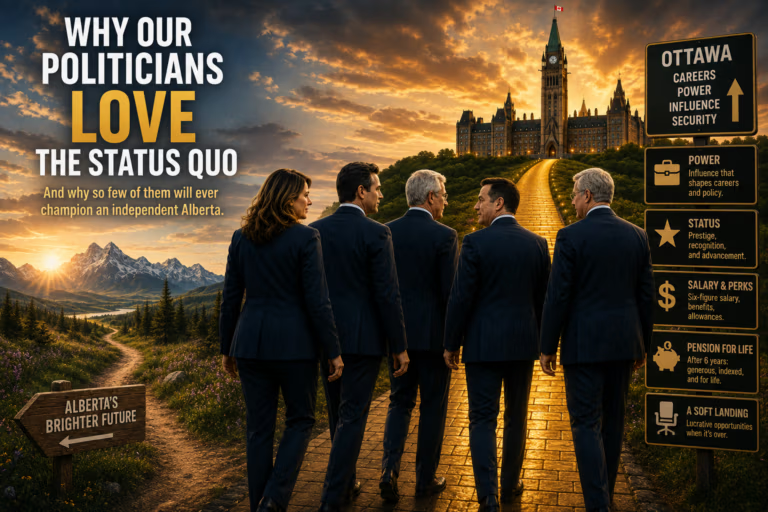
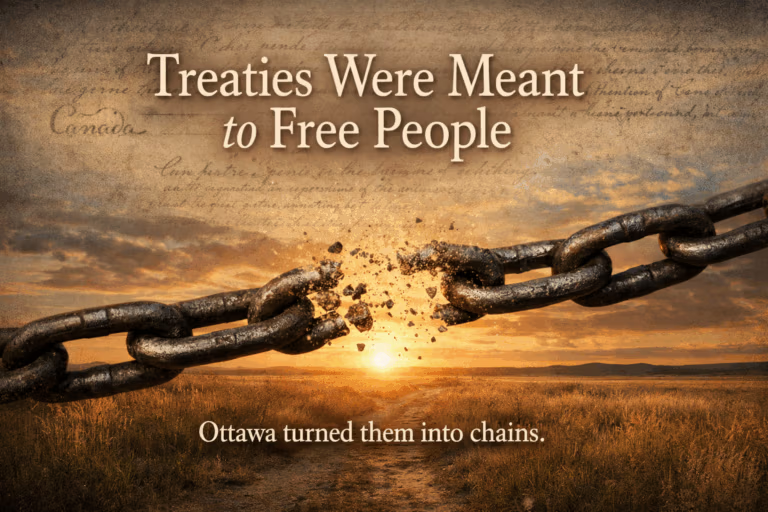
Hey Chris! I read this from beginning to end. First, thanks for putting in the work. Whether someone agrees with your conclusions or not, you’ve clearly invested a tremendous amount of time thinking about this, sourcing material, and trying to present a coherent case. Credit where it’s due.
One statement, in particular, stood out to me because I completely agree with it! “Nobody should tell you what to think about this… My job in these pages is to put the facts on the table and trust you to decide.”
I think that’s exactly the standard this conversation deserves. Where I began to struggle, though, is that I don’t think the book consistently follows that principle. The title itself is “Why Every Argument to Stay Is a Reason to Leave.” That tells the reader and me that the conclusion already exists before the evidence is examined.
Throughout the book, uncertainty, objections, and even many of the acknowledged risks ultimately become reasons supporting independence. That’s not wrong; as you know, I dislike that kind of framing, because every author reaches conclusions, but it does mean we’re no longer just presenting facts. We’re interpreting them.
That distinction matters because facts and conclusions aren’t the same thing. For example, two people can agree entirely on the facts surrounding Alberta’s fiscal position and still disagree on whether independence is the best solution. Likewise, two people can agree that the Constitution makes reform difficult while reaching different conclusions about whether reform is impossible, and I think it’s important to separate those two steps.
One example is the book states that Alberta has tried reform since 1905 and that meaningful reform within Confederation is something Alberta “can never get.” That’s a much stronger claim than saying reform has historically been unsuccessful, because one is an observation about history, while the other is a prediction about the future. History certainly informs predictions, but it doesn’t prove them.
Ironically, later in the book you point to Quebec as an example of a province that has gradually secured extraordinary autonomy within Confederation! Its own pension plan, tax collection, immigration agreement, police force, investment institutions and international offices. To me, that demonstrates something important: it doesn’t prove Alberta can achieve everything it wants, but it does show that constitutional evolution and asymmetric federalism are possible. That seems difficult to reconcile with the earlier conclusion that meaningful reform is structurally impossible.
I found myself asking the same question in the legal discussion. The book correctly explains that the Supreme Court of Canada held that a clear majority on a clear question would create a constitutional obligation to negotiate, and I agree in full here. Having said that, the Court also made something equally important clear: negotiation is not agreement. It did not predetermine how assets, debt, treaties, citizenship, borders, Indigenous rights, trade agreements or pensions would ultimately be resolved. Those outcomes would all depend on negotiations among multiple parties. Why it matters to me is that throughout the book, many future outcomes are presented with a level of confidence that the legal framework itself doesn’t provide.
The section I probably agreed with most was your discussion of incentives. I think you’ve made a persuasive argument that institutions shape behaviour. That resonates with me because I’ve lived it, during my years in Global Logistics. I genuinely believed I was acting in the company’s best interests, yet looking back, I can also see how that environment shaped what I measured, what I rewarded, what I worried about, and even what I accepted as normal. I wasn’t acting in bad faith per se; rather, I was adapting to the incentive structure around me, and I didn’t fully recognize it until I stepped outside it.
That’s why your book left me with a different question. If Canada’s institutions shape the incentives of today’s politicians, why wouldn’t an independent Alberta’s institutions eventually shape the incentives of Alberta’s politicians too? If environments shape behaviour, as I think you’ve convincingly argued, then independence doesn’t eliminate that dynamic. It changes the environment, and to me, that’s one of the most important unanswered questions in the entire discussion. Not whether Alberta would govern itself, but what constitutional safeguards would ensure Alberta’s future institutions continue serving Albertans rather than gradually developing the same kinds of incentive structures you’ve identified inside Confederation.
Finally, I want to come back to the principle you began with. You wrote that no one should tell Albertans what to think. I agree completely. That’s why I think the strongest case for independence doesn’t need certainty where uncertainty exists, or inevitability where reasonable people can disagree. It simply needs to survive the strongest possible scrutiny, and if Alberta independence is the better constitutional model, then rigorous stress testing won’t weaken it. It will strengthen it.
Sources
Supreme Court of Canada. Reference re Secession of Quebec, [1998] 2 S.C.R. 217.
Constitution Act, 1867 and Constitution Act, 1982 (amending formula, Charter, division of powers).
Government of Canada – Department of Justice: Constitutional documents.
Government of Quebec: Quebec Pension Plan, Canada–Quebec Accord on Immigration, Revenu Québec.
Statistics Canada (fiscal and demographic data).
Parliamentary Budget Officer (fiscal reports).