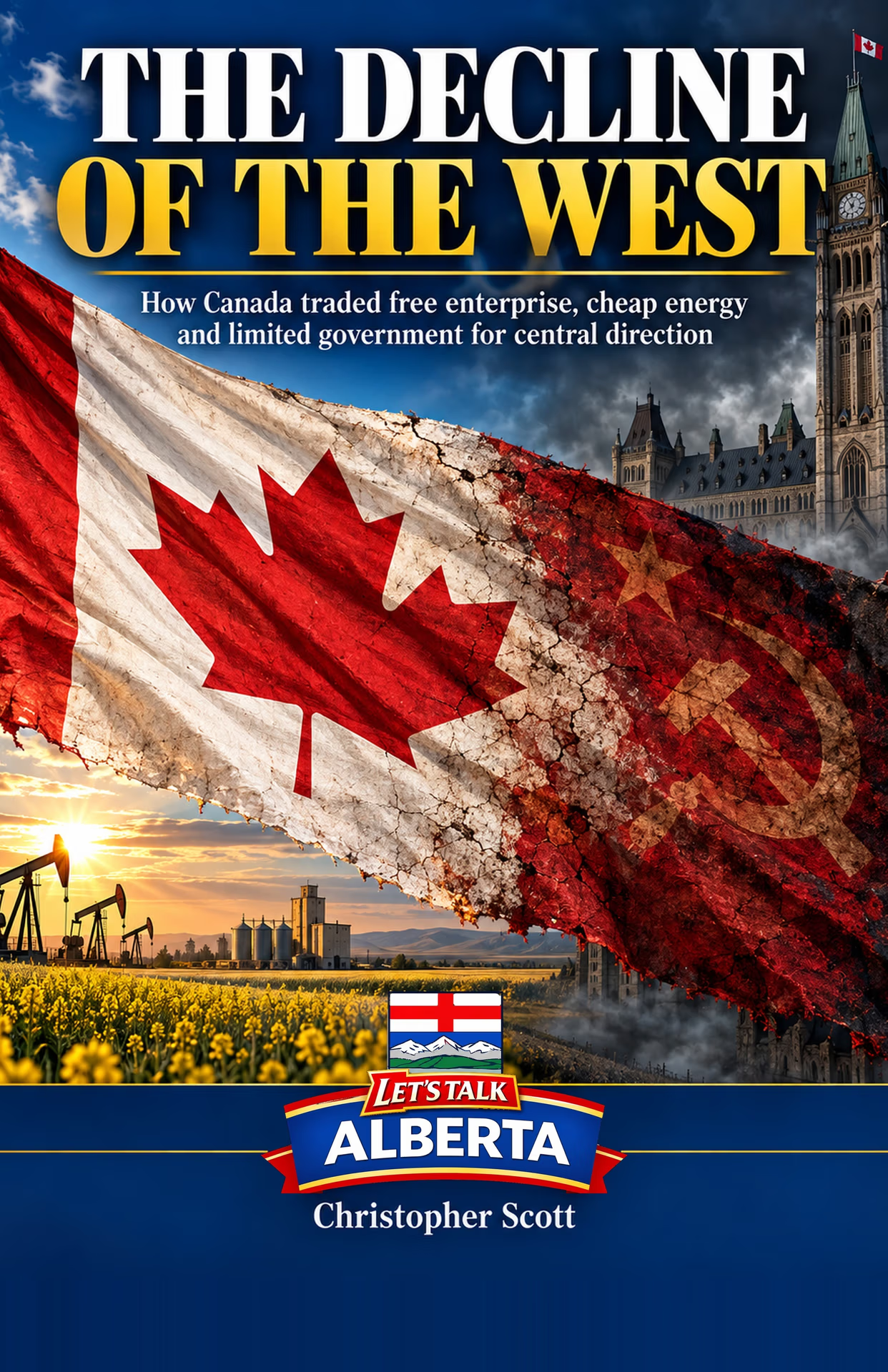
The Decline of the West
How Canada traded free enterprise, cheap energy and limited government for central direction
I have written a booklet on how the West became the freest and most prosperous civilization in history, and how Canada has been trading that away. This is the short version. The full version has ten chapters, the tables and timelines, and 78 numbered references. If you want to check anything here, start there.
Every claim below comes from a document you can look up: a party manifesto, a statute, a court ruling, a government report or official statistics. Where I interpret, I say so.
What built the West
For most of history, nearly everyone was poor. Then three things changed that.
You own what you build. John Locke argued in 1689 that people have a natural right to life, liberty and property, and that government exists to protect those rights, not to grant them. Secure property gave ordinary people a reason to work, save and take risks.
Prices coordinate what no planner can. Adam Smith showed that people pursuing their own interest through free trade produce an order no one designs. Friedrich Hayek explained why: the knowledge needed to run an economy is spread across millions of people, and prices pull it together. No planner can gather that much information.
Cheap, abundant energy. A single barrel of oil does the work of two to three years of manual labour. Coal, oil and gas powered the factories, tractors, refrigeration and hospitals that ended mass poverty.
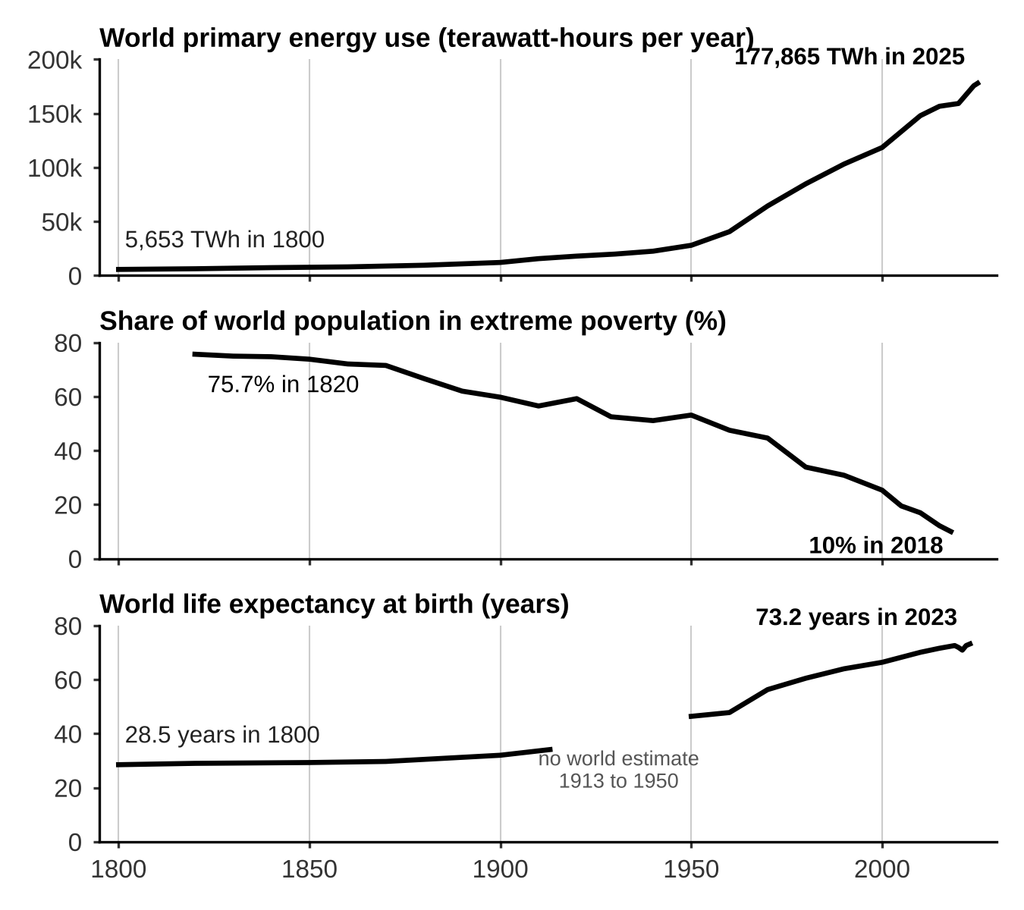
The results are on the record. In 1820 roughly three in four people on earth lived in extreme poverty. By 2018 it was one in ten. Over the same period, world energy use grew more than thirty-fold and life expectancy more than doubled (Our World in Data). Correlation does not prove cause. But the mechanism is simple: a society that can do more work per person can produce more per person.
The old promise
In 1848 Marx and Engels summed up their theory in one sentence: “Abolition of private property” (Communist Manifesto). The promise was that a strong state would take control for a time and then “die out.” It never did. Where the system was tried, the comparisons are hard to argue with. East and West Germany were one people. So were North and South Korea. The same people, under different systems, got very different results.
Canada’s left said what it wanted
Canada never had a revolution. It had a democratic socialist party that told voters what it wanted, in writing. The CCF’s Regina Manifesto of 1933 closed with this pledge:
“No C.C.F. Government will rest content until it has eradicated capitalism and put into operation the full programme of socialized planning which will lead to the establishment in Canada of the Cooperative Commonwealth.” (Regina Manifesto)
The NDP kept “social ownership” in its constitution until 2013. That year it rewrote the preamble to call for an economy “in which governments have the power to address the limitations of the market” (Maclean’s). The state no longer needed to own the economy. It needed the power to direct it. That is the shift I track in the booklet: from ownership to control.
From ownership to control
Outright nationalization mostly failed at the ballot box. Control succeeded instead. Leave the deed in private hands, and move the decisions to government: what you may build, how you must build it, what you may emit and whether you may expand. You carry the risk. Ottawa makes the calls.
Not every rule is a step toward socialism. A free society needs rules. The test is simple: does the rule set the boundaries of the game, or does it play the game for you? Contracts, fraud law and a clear price on pollution set boundaries. Technology mandates, production caps and open-ended approvals play the game for you. Since 2015, Canada has moved steadily toward the second kind.
- Bill C-69. The Impact Assessment Act gave Ottawa broad discretion over which major projects could proceed. In 2023 the Supreme Court ruled that “Parliament has plainly overstepped its constitutional competence” (2023 SCC 23).
- Trans Mountain. After regulatory and legal delays drove away the private owner, Ottawa bought the pipeline for $4.5 billion in 2018. The expansion’s cost estimate rose from $5.4 billion to about $34 billion. The taxpayer took on the risk.
- Clean Electricity Regulations. These effectively phase unabated gas power off the grid after 2035 (Canada Gazette).
- The Emergencies Act. In 2022 Ottawa froze bank accounts without court orders. Two federal courts later found the measures unlawful. Ottawa has asked the Supreme Court for leave to appeal.
The international agenda was a choice
Many Canadians sense their rules are written somewhere else. They are partly right. But very little of it is binding. Ottawa chose to adopt it.
The most striking UN statement on property came from Vancouver in 1976: “Public control of land use is therefore indispensable” (Habitat I). It was a recommendation, not a law. The UN’s 2030 Agenda calls its own targets “aspirational.” Ottawa answered in 2021 with a national strategy that says “All governments (federal, provincial, territorial, municipal and Indigenous) have roles to play” (Moving Forward Together). A voluntary framework became a direction for every level of government, without a vote in Parliament. Ottawa also wrote its Paris target into law in the 2021 Net-Zero Emissions Accountability Act.
In 2020 WEF founder Klaus Schwab called for “a ‘Great Reset’ of capitalism” (WEF). The WEF has no legal power. But the language travels. In Value(s), Mark Carney wrote that the pandemic’s “‘great reset’ of company and national strategies offers renewed opportunity to tackle climate change.” It is one phrase in a long book. It shows the idea moving from Davos into the thinking of the man who now leads Canada’s government.
Money travels too. Alberta’s Allan inquiry found $1.28 billion in foreign funding of Canadian environmental initiatives from 2003 to 2019, with $54.1 million in grants designated for “anti-Alberta resource development activity.” It also found that no one broke the law (Allan inquiry). The problem is not illegality. Canadians cannot easily see who funds the campaigns that shape their laws.
The results
- Productivity. In 1984 Canada produced 88% of US output per hour. By 2022 it was 71%. The Bank of Canada’s senior deputy governor called it “an emergency” (Bank of Canada).
- Investment. In 2024, Canadian workers received 41 cents of machinery and equipment investment for every dollar received by US workers (C.D. Howe).
- Energy. Oil and gas capital spending fell from $80.7 billion in 2014 to $34.9 billion in 2016, and never recovered to its earlier level.
- Living standards. Real GDP per person has fallen about 1.4% since mid-2022, even as the overall economy grew (C.D. Howe).
Two fairness checks. World oil prices collapsed in late 2014, and that explains much of the first drop in energy investment. And rapid population growth is the biggest single reason for the recent fall in GDP per person. Regulation is not the only cause. But investment fell hardest in the sector that faced the most new federal rules, and the industry’s own stated reason for holding back is regulatory uncertainty.
Whose values?
Mark Carney’s book deserves a fair reading. He does not call for abolishing markets. He writes that prices are “far superior guides to resource allocation than central planning.” His argument is about who sets the goals:
“We need political processes to define our goals and objectives – to set our values. Markets can then be marshalled to help discover and drive solutions in a form of mission-oriented capitalism.”
Government sets the goals. The market becomes the tool that carries them out. He goes further, suggesting governments could hand climate policy settings to unelected “Carbon Councils.”
One caution. A quote circulating online, claiming Carney wrote that the West is “morally rotten” and needs “rigid controls of personal freedoms,” is fake. The Canadian Press searched the book and found none of those words (Canadian Press). Don’t use it.
Here is the flaw. Values are subjective. A free market is a running count of millions of people’s values, decided by each person every day. A “political process” counts the values of whoever controls it. So the question for every Canadian is this: who picks the values, and who elected them?
If values can’t be left to whoever holds power, they need a standard above power. I hold that standard to be the biblical one. People are placed on the earth “to dress it and to keep it” (Genesis 2:15). We are caretakers and beneficiaries of the earth, not a problem to be reduced. “Thou shalt not steal” puts property beyond the reach of any majority or ruler. Carney himself credits medieval Church thinkers and their doctrine of stewardship. Then he replaces that fixed standard with values set by political processes. That is the turn I am asking Canadians to examine.
What can weaken the argument
Most socialist ownership proposals never became law. International frameworks are mostly voluntary. Commodity prices and rapid population growth explain a large share of the economic decline. Foreign funding of environmental groups broke no laws. Carney defends markets over central planning. And since 2025 Ottawa has reversed several policies, including the consumer carbon charge and the proposed emissions cap.
Those reversals came because Albertans pushed. They show that public pressure works. They do not show that the direction has changed. The net-zero target is still in federal law, and the industrial carbon price is set to rise.
What you can do
- Read the documents. Every major source is public. Judge for yourself.
- Ask the ladder question. Does a new policy set the rules of the game, or play the game for us?
- Ask the values question. When someone says policy should reflect “our values,” ask whose, and who chose them.
- Demand transparency. Who funds the campaigns, who benefits from the subsidies, who sits on the councils.
- Take part. Decisions drift away from citizens who stop showing up.
Canada is not a socialist country. What the record shows is a quieter shift: decisions over energy, land, capital and even citizens’ bank accounts moving from owners, legislatures and courts to ministers, regulators and international targets. The language changed from ownership to planning to values. The direction did not.
Read the full version of The Decline of the West, with every chapter, table and reference. Printed copies are available through Let’s Talk Alberta at letstalkalberta.com.
Christopher Scott. The views here are my own, presented by Let’s Talk Alberta. Disagree with something? Tell me in the comments.