
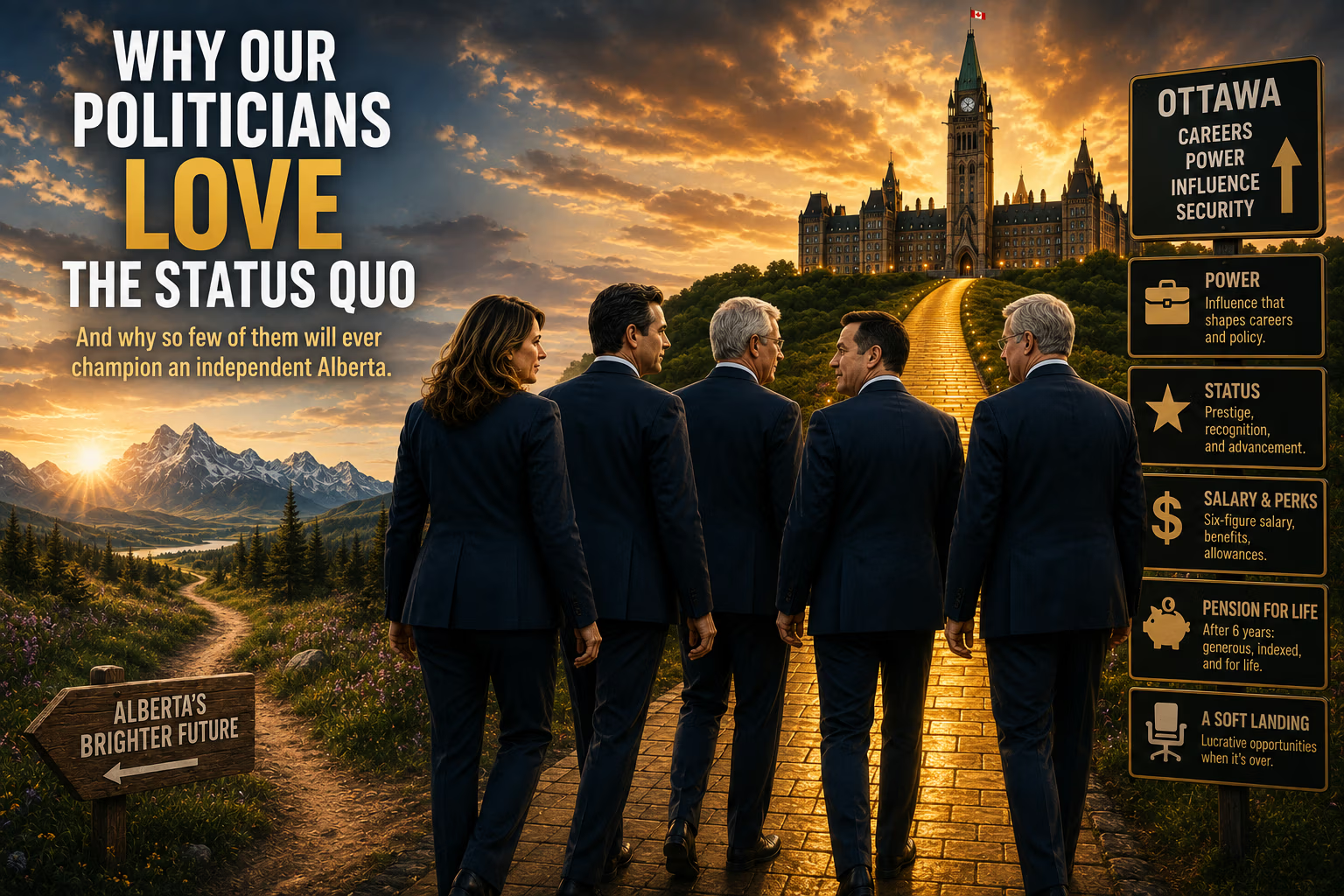
Why Our Politicians Love the Status Quo
And why none of them will ever champion an independent Alberta.
This is one in a series of plain-language pieces on Alberta’s future, published by Let’s Talk Alberta and written by Christopher Scott. A note before you start: everything here presented as a fact — a date, a job, a dollar figure, a vote — is drawn from the public record and sourced at the end. Where I give you my opinion about what those facts add up to, I say so plainly. Read it, check it, then decide for yourself.
1. The question, in plain words
Here is the question this article exists to answer. It’s the one I get at almost every town hall, usually from someone leaning back with their arms crossed, and it’s a good question:
“If independence is such a good idea — if the money really works, if the other provinces have already proven a region can govern itself inside this country and out of it — then why isn’t a single one of our big-name leaders fighting for it? Why is the loudest ‘Alberta first’ crowd in Ottawa telling us to calm down? If it were real, wouldn’t somebody powerful be leading the charge?”
It’s a fair challenge, and it deserves a straight answer instead of a dodge. Most people, when they can’t find a champion for an idea, conclude the idea must be weak. That’s a reasonable instinct in daily life. If nobody will sell you a product, maybe the product’s no good.
But that instinct quietly assumes something that isn’t true: it assumes the people in a position to lead have the same interests you do. It assumes that if independence were good for Alberta, it would be good for them, and so they’d want it too.
This article is about what happens when that assumption breaks. Because on this question — more than almost any other — what’s good for Alberta and what’s good for the people currently running Alberta’s politics are not the same thing. And once you see how the careers actually work, the silence of the powerful stops being evidence against independence. It becomes something you’d predict.
I’ll say the honest part now, so you know I’m not selling you a villain story: most of the people in this article genuinely believe Alberta is better off inside Canada. I’m not claiming they’re lying. I’m claiming something harder to shake — that they believe it from inside a set of rewards that would make almost anyone believe it. That’s not corruption. That’s human nature meeting a system built to channel it. Let me show you the system.
2. What we have now: a political class, and the ladder it climbs
Start with the thing nobody says plainly. In our system, “going into politics” is, for the ambitious, a career — and like any career, it has a ladder, and the ladder points in one direction: toward Ottawa, toward the national parties, toward the boards and firms and institutions that sit downstream of federal power.
Think about where an ambitious Alberta conservative actually goes to build a life. Not, historically, into building a separate Alberta. The prizes — a cabinet seat, a national party leadership, a diplomatic posting, a seat on a big corporate board when it’s over, a rich federal pension — all hang off the federal system as it currently exists. The path to every one of them runs through Confederation, not out of it.
That matters because of a simple idea economists call public choice, and you already understand it even if you’ve never heard the term. Public choice just means this: politicians and officials respond to incentives like everyone else. They are not a separate species of selfless saint who wants only the public good. They want what people want — security, status, a good living, a soft landing when it’s over — and they tend, consciously or not, to convince themselves that what’s good for their career is what’s good for the country. A cattle rancher doesn’t need a theory to know that you should be careful trusting a man’s opinion of the fence when he’s the one selling the fence. Public choice is just that piece of ranch common sense, written down.
Now apply it here. The Canadian federal system is, for a certain kind of Alberta political talent, the single largest employer, promoter, and pension provider they will ever have. Ask that plain rancher’s question: how much should you trust the fence opinion of someone whose whole career, and whose retirement, is paid for by the fence staying exactly where it is?
That’s not an accusation against any one person. It’s a description of the ladder. And in the rest of this article I’m going to show you the ladder with real names and real numbers on it — because the abstract version is easy to wave away, and the specific version is not.
3. How it actually works: the plumbing of a political career
Before the names, let me show you the machinery, because the argument only lands once you see how the money and status actually move. There are four rungs on the ladder, and they all lead the same way.
Rung one: the salary and the seat. A backbench Member of Parliament earned a base salary well into the six figures, before you add a minister’s top-up, a committee chair’s top-up, or a leader’s. For most Albertans that is a very good living, and it exists only inside the federal Parliament in Ottawa.
Rung two: the pension. This is the one people underestimate, so I’m going to be specific, and I’m going to be fair about the details. A federal MP becomes eligible for a pension after six years in office. The payments are generous, indexed to inflation, and they last for life. When actuaries — independent ones, not activists — were asked in 2024 to value the pension of one sitting MP we’ll meet shortly, their estimates ran from roughly $230,000 a year starting at 65, worth on the order of $1.75 million over a normal retirement, up to a lifetime value of $3.4 million under an early-retirement scenario. Those numbers are estimates, and I’ve labelled them as estimates. But even the low end tells you something: a federal political career doesn’t just pay you while you serve. It pays you, richly, for the rest of your life — and that stream of money exists only as long as the federal Parliament does.
Rung three: the appointment. Beyond elected office sits a whole tier of federally connected posts — diplomatic appointments, agency chairs, senate seats, advisory roles. LTA’s first booklet made this point about the loudest “stay” voices generally: many of them are people the existing system rewards, “with appointments, with committee seats, with a place at the national table, with the quiet honours that a capital hands to those who keep the arrangement intact.” That’s rung three. It’s real, and it’s entirely legal, and that’s exactly why it works on people.
Rung four: the landing. When the political career ends, where do senior figures land? On corporate boards, in law firms, in global consulting practices, in bank-funded think tanks — institutions whose business runs through the national and continental economy as it’s currently wired. A former first minister is valuable to those institutions because of the federal-and-corporate network he spent decades inside. Break up that network — redraw the country — and some of that value walks out the door with it.
Put the four rungs together and you have a career, cradle to grave, that is financed by the continuation of the current arrangement. I want to be careful here: none of that is a crime, and none of it, by itself, proves any individual is acting in bad faith. Plenty of people earn honest livings inside systems they’d also vote to keep. But you would have to be made of stone not to notice which way all four rungs lean. Every one of them rewards keeping the country exactly as it is. Not one of them rewards building a new one.
Hold that machinery in your mind. Now let’s watch a real generation of Alberta conservatives climb it.
4. The opportunity: what changes when the deciders answer to you
Before the case study, let me name the opportunity, because this article isn’t only a complaint — it’s a booklet about a door.
Right now, the people with the platform, the funding, and the name recognition to lead a serious conversation about Alberta’s future are, almost to a person, people whose careers are financed by the status quo. That’s the trap: the only folks big enough to be heard are the folks least free to say it.
An independent Alberta changes who holds the microphone. It creates, for the first time, a full slate of offices — a head of state’s table, a foreign service, a central bank, a sovereign wealth fund, national institutions — whose ladder runs through Alberta rather than through Ottawa. It builds a career path for ambitious Albertans that rewards building this place up instead of managing it on someone else’s behalf. The point isn’t that today’s leaders are uniquely corrupt. The point is that today’s ladder only points one way, and independence builds a second ladder that points home.
And here’s the part that should reassure you rather than worry you: you don’t need the current leaders’ permission to do it. That’s the whole design of what’s coming on October 19, and I’ll come back to it at the end. The tool that routes around a captured political class is a direct vote of the people. It exists precisely because the ladder is what it is.
Now — the case study.
5. The anchor case: the movement that set out to fight Ottawa, and grew up to become it
If you want to understand why Alberta’s biggest conservative names won’t lead you out of Confederation, you have to understand where they came from. Because the striking thing isn’t that these men were always creatures of the establishment. It’s the opposite. They started as insurgents — the “fight Ottawa,” tear-up-the-status-quo generation — and I want to trace, name by name, how the insurgency became the institution.
The starting line: “Vote for Day,” 2000
At the turn of the millennium, the western protest movement that began as the Reform Party had rebranded itself the Canadian Alliance, and in 2000 it held a leadership race. The winner, on a second ballot in July 2000 with about 63% of the vote, was Stockwell Day, then Alberta’s provincial treasurer. He beat the movement’s founder, Preston Manning. This was the young, angry, Western-rooted wing of Canadian conservatism at its high-water mark.
Look at who was in that campaign’s orbit, because you’ll recognize the names two decades later:
- A 20-year-old Pierre Poilievre, then a University of Calgary student, helped run an online effort literally called the “Organization to Draft Stockwell Day,” recruiting Day into the race. Two years later he left university without finishing his degree to work as an advisor to Day. As a teenager he’d sold party memberships for another up-and-comer named Jason Kenney.
- Jason Kenney himself, already a sitting Member of Parliament (first elected in 1997), served as a national co-chairman of Day’s leadership campaign.
- Ezra Levant, a self-described “Stockaholic,” became Day’s communications director in early 2001.
- Watching from the National Citizens Coalition, where he was president, sat Stephen Harper — who would enter the very next Alliance leadership race and win it in March 2002, taking the crown from Day. To clear a seat in Parliament for Harper, Levant gave up a Calgary nomination he’d already won.
I want you to sit with that photograph for a second. In and around one insurgent Alberta campaign in 2000 you can find a future Prime Minister (Harper), a future Prime-Minister-in-waiting and current Conservative leader (Poilievre), a future Premier of Alberta (Kenney), and the future founder of the country’s largest right-wing media outlet (Levant). This was the “burn down the old arrangement” generation. If anyone was ever going to lead Alberta out, it was these people, at that age, with that fire.
And the circle is even smaller than those four names suggest. Consider Jenni Byrne — today the most senior adviser and campaign manager to Pierre Poilievre. She’s no newcomer: she joined the Reform Party at sixteen and went on to run Stephen Harper’s national election campaigns in 2011 and 2015. She and Poilievre were also, by his own biographers’ accounts, a couple during his early years on Parliament Hill, in exactly this era. The point isn’t the romance — people’s private lives are their own. The point is how small and self-contained this world is. The same handful of people, bound by decades of shared campaigns and shared history, have cycled through the top of Alberta-rooted conservatism, federal and provincial, for a quarter-century. When you wonder why they all seem to arrive at the same conclusion about Alberta’s future, remember they are not strangers reaching it independently. They’re a tight network that grew up together on one ladder.
Now watch where the ladder took them.
Where the fire went: the establishment they became
Stephen Harper climbed all the way — Prime Minister of Canada from 2006 to 2015. And when it was over, where did the man who once ran the National Citizens Coalition land? On the board of directors of Alimentation Couche-Tard, one of the largest corporations in the country (appointed March 2024). On the board of Colliers International, a global real-estate firm (since 2016). At the head of his own global consulting firm, Harper & Associates. As chairman of the International Democrat Union, a worldwide alliance of establishment conservative parties. The insurgent became, in the most literal sense, a director of the establishment.
Jason Kenney went from Alliance MP to federal cabinet minister to Premier of Alberta, and after resigning as premier in 2022 he landed exactly where the ladder deposits senior figures: as a senior policy adviser at the law firm Bennett Jones, a senior advisor at the global firm Teneo, a director of Coril Holdings, and a senior fellow at the C.D. Howe Institute, a corporate-funded think tank. Every one of those chairs is downstream of the national economy and the federal system working as they do now.
Pierre Poilievre never left. He has been a fixture of federal Parliament since 2004 and leader of the Conservative Party of Canada since 2022. (Even his 2025 stumble is telling: he lost his own Ottawa-area seat in the April 2025 election, and the way he got back into Parliament was to have an Alberta MP step aside so he could win a by-election in Battle River–Crowfoot that August. Alberta was, quite literally, the safe seat he used to return to federal power.) He qualified for his federal pension at 31. He has spent his entire adult life on the Ottawa ladder, and — per those independent actuaries — stands to draw a federal pension estimated in the hundreds of thousands of dollars a year.
Stockwell Day, after federal cabinet, took the classic landing: a seat on the board of Telus and a strategic adviser role at the law-and-lobbying firm McMillan (both of which he resigned in June 2020 after public controversy over remarks on racism). The pattern held for him too.
The spine of the whole thing: the pension irony
Here’s the single fact that, to me, tells the entire story, and I’ve checked it carefully so I can tell it to you straight.
In 1993, a 25-year-old named Jason Kenney ran the Canadian Taxpayers Federation, and he made his name — his whole early career — on one crusade: destroying the “gold-plated” pensions of Alberta MLAs. He was relentless and he was effective. That year, Premier Ralph Klein cancelled the Alberta MLA pension plan outright, applying it retroactively to 1989. It was a genuine populist win against a self-dealing political class, and the young Jason Kenney was its face.
(In fairness, and because I promised you both columns: those provincial benefits didn’t stay gone forever — the legislature quietly restored equivalent perks through “transition allowances” in 1998 and 2001. The political class has a way of finding its money again. Hold that thought too.)
Now follow the man. Four years after killing Alberta MLA pensions, Kenney went to Ottawa — where the pensions are richer, and where nobody named Jason Kenney was going to campaign against them. And the movement he helped build, the one that put a 16-year-old Poilievre to work selling memberships, produced a generation of federal politicians drawing exactly the kind of gold-plated, lifetime, taxpayer-funded pensions that the young Kenney had told Albertans were an outrage.
I’m going to give you my opinion now, and I’ll call it my opinion: that is the shape of the whole thing in one story. A movement that rose by attacking a comfortable political class, climbing a ladder that turned its members into a comfortable political class — one whose comfort is paid for, salary and pension and board seat and consulting contract, by the country staying exactly as it is. I don’t think most of them schemed it. I think they climbed a ladder that only went one way, and became the men at the top of it. But the result is the same either way: do not expect the people at the top of the Ottawa ladder to hand you a saw and point at its base.
6. More examples: the pattern beyond the founders
One story is an anecdote. A pattern is something you can see more than once. So here are two more, from closer to home.
Danielle Smith: the opposition she built, and the opposition she folded
No one illustrates the tension between Alberta’s independence energy and Alberta’s career politics better than the current Premier — and I’m going to lay out her record in order, as fact, and then tell you plainly where the fact ends and my opinion begins. On this one, my opinion is not gentle.
The facts. Danielle Smith became leader of the Wildrose Party in 2009 and built it into the strongest official opposition Alberta had seen in decades — the “Alberta-first” vehicle, the home of exactly the sentiment this whole conversation runs on. Then, on December 17, 2014, she led nine Wildrose MLAs across the floor to join the governing Progressive Conservatives she’d been elected to oppose. It was widely called a betrayal and the collapse of the opposition; grassroots members were furious; she later apologized for not letting them debate it. Months later, the PC party she’d joined rejected her, and she lost her nomination in March 2015. Her career looked finished.
It wasn’t. She returned through talk radio and, in October 2022, became leader of the United Conservative Party and Premier of Alberta. As premier she has built the machinery of a sovereignty conversation: the Alberta Sovereignty Within a United Canada Act in December 2022, and then, in May 2025, Bill 54, which cut the number of signatures needed to trigger a citizen referendum roughly in half — from about 20% of voters to about 10%, making a separation vote far easier to launch. She chairs an “Alberta Next” panel exploring responses to Ottawa. It was under these easier rules that a citizens’ campaign gathered the signatures that put a separation question on the ballot for October 19, 2026.
Watch the company she keeps, because it tells you how tight this world is. The man at the very top of her office — Rob Anderson, who has run it as executive director and then chief of staff — is one of the eight MLAs who crossed the floor with her in 2014. He is also a co-author of the 2021 “Free Alberta Strategy,” the document that produced her Sovereignty Act — and by his own account, she “sanded down the edges” of his plan before it became law. And the chief of staff who came before him, Marshall Smith, arrived straight out of the Kenney government, where he’d been a senior ministerial staffer. Look at the pattern: floor-crossers, strategy authors, Kenney-era staffers — the same small circle keeps filling the most powerful unelected chairs in the building, government after government. The insurgent blueprint reached law softened, handled the whole way by people who have orbited one another for the better part of fifteen years.
And here is the other half of the record, stated just as plainly: Smith herself says she is not a separatist. Her position is “a sovereign Alberta within a united Canada.” She has said her government will not put a separation question on the ballot itself, though it will respect a citizen petition that qualifies. She frames her goal as a better deal inside the country.
I’ll add a personal note here, because I owe you honesty about my own vantage point. In 2022, just before her return to politics, I sat beside Danielle Smith at a freedom-minded dinner at the Red Barn in Olds. We didn’t talk much, and I’ve wished since that I had — because I’d have liked to ask her the very question this article is built around. I didn’t. So I’ll ask it on the page instead.
Now my opinion, and I’ll label it clearly, because it is opinion and not proven fact: I do not believe Danielle Smith stumbled into any of this. She is one of the sharpest political minds this province has produced. When she led nine MLAs across the floor in 2014, she did not need a consultant to tell her what it would do — it decapitated the strongest Alberta-first opposition in a generation, and a mind that sharp could not not have known that would be the result. You can read the 2014 crossing charitably, as a miscalculation. I don’t. My honest opinion is that it looked then, and looks now, like a movement being quietly folded back into the machine it was built to challenge.
I see the same shape today. She holds the pen, the majority, and the playbook — and what does she actually do with the sovereignty question? She builds the mechanism for a vote while refusing to lead it. She lowers the threshold, then steps back. She talks about taking control of Alberta’s affairs while, on her own watch, Alberta still does not collect its own taxes, still sits inside the CPP, and still contracts the RCMP — the concrete autonomy measures her own side wrote down twenty-five years ago and never built. My opinion, and only my opinion: her actions tell the tale of keeping Alberta exactly where it is — in quiet submission to the dominion. She oils the machinery of the sovereignty conversation with one hand while draining the fuel tank with the other — enough motion to hold a restless base, never enough to actually arrive anywhere. I can’t prove intent. I can’t see inside her mind, and I won’t repeat the unproven private claims some separatists make about her. But I’ll tell you what I believe the record shows: Alberta is no more sovereign today than it was in 2000, and the people with the most power to change that are the ones who keep finding reasons not to. Watch what she does when the answer actually gets close, and judge for yourself.
The playbook they wrote — and never ran
Here’s the fact that turns this from a story about one premier into a pattern about a whole movement, and it’s entirely on the public record.
In January 2001, six prominent Alberta conservatives published an open letter to Premier Ralph Klein that became famous as the “firewall letter.” One of its authors was a man named Stephen Harper — then head of the National Citizens Coalition, not yet Prime Minister. Another was Ted Morton. Their argument was that Alberta should stop waiting on Ottawa and build the hard institutions of self-reliance: collect its own income tax instead of routing it through the federal government, create an Alberta Pension Plan and pull out of the CPP, stand up a provincial police force to replace the RCMP, and take back provincial control of health policy.
That was 2001. Sit with what has happened in the quarter-century since. Alberta has been governed by conservatives — PC, then UCP — for almost the entire stretch. The man who co-wrote the letter went on to be Prime Minister of Canada for nearly a decade. His allies have held the premier’s office. And how many of those firewall institutions exist today? Not one. Alberta still does not collect its own income tax. Alberta is still in the CPP. Alberta still contracts the RCMP. As late as December 2025, a government panel was reduced to recommending referendums on the pension and the police — twenty-four years after the blueprint was handed to them, still proposing to study step one.
It isn’t as if there’s no model to copy. Look east. Quebec collects its own income tax through Revenu Québec instead of routing it through the federal agency; it built the Caisse de dépôt to manage its pension capital at home; it has its own cooperative banking giant in Desjardins and its own pension plan separate from the CPP. Quebec decided, decades ago, to keep its tax collection, its retirement savings, and its financial institutions inside the province — and simply did it. Alberta has spent those same decades talking about it. Some of these steps are genuinely big; others are low-hanging fruit a determined finance minister could begin with little more than a signature. The striking thing isn’t that the hard ones are undone. It’s that even the easy ones are.
My opinion, plainly: you cannot spend twenty-five years telling Albertans that you are the ones who will stand up to Ottawa, hold power for most of that time, be handed the exact blueprint by your own founders — and then build none of it — and still expect to be believed when you say the current arrangement is simply the best Alberta can do. Either the autonomy was never really the goal, or it was always worth more as a campaign theme than as a thing you actually finish. Both readings should make you want to take this decision out of their hands and into your own.
Thomas Lukaszuk: from the $20,000 phone bill to the front of the “stay” campaign
The second example is quieter, and I include it because it shows the machinery from a different angle. Thomas Lukaszuk was a Progressive Conservative MLA and, in 2012–13, Alberta’s Deputy Premier. He is best remembered by a lot of Albertans for one thing: a roughly $20,000 cellphone bill run up on the public dime during an overseas trip in October 2012. In fairness — both columns, always — Lukaszuk said the charges came from handling government business remotely, and Alberta’s Auditor General later reviewed them and cleared them as work-related. I’m not going to call it a scandal he was guilty of; I’ll call it what it is, a documented episode that made him, for a while, a symbol of a political class comfortable with other people’s money.
What matters for this article is where he is now. Today Lukaszuk runs a financial company and has become one of the most prominent public campaigners against an Alberta separation referendum, leading a citizens’ initiative called “Forever Canadian” — a rival petition asking Albertans to affirm that Alberta should remain in Canada, which gathered well over 400,000 signatures in late 2025. His stated reasons are sincere and worth stating fairly: he argues that even talking about separation scares away investment, that Canada is stronger united, that differences should be negotiated through existing institutions.
Those are real arguments, and Booklet 1 answers several of them. But notice the shape of the thing one more time. A figure who rose inside the old PC establishment, who became a symbol of its comfort with public money, now stands at the front of the campaign to shut the independence question down before it can be asked. I’m not saying he’s insincere. I’m saying: notice who shows up to end the conversation, and notice the ladder they climbed to get the platform to do it.
7. The honest other column
I told you at the start I’d give you both sides of the ledger on this, the same as every LTA booklet, so here is the strongest case against everything I’ve just argued. Read it seriously, because I mean it.
Sincere belief is not corruption. The biggest and fairest objection is this: showing that someone benefits from an arrangement does not prove they support it because they benefit. Millions of Albertans earn a good living inside Canada and would also, sincerely, vote to stay — and there’s nothing hypocritical about that. Harper, Kenney, Poilievre, Lukaszuk: every one of them can point to a real, argued belief that Alberta is stronger in Confederation. The fact that their careers also prospered there doesn’t automatically make the belief dishonest. To assume it does is exactly the kind of motive-reading I’ve warned you against elsewhere.
Incentives are not evidence of a plot. I want to be crystal clear, because it matters: nothing in this article shows a conspiracy. I found no secret network, no coordinated arrangement, no shared scheme among these people. What connects them is a common political lineage and a common ladder, not a smoke-filled room. Anyone who tells you these figures are secretly working together is going past the evidence, and I won’t.
The record cuts both ways — so here are both columns. Lukaszuk’s phone charges were reviewed and cleared. Kenney’s pension crusade was a genuine win for taxpayers — or was it, given that the legislature quietly restored equivalent perks a few years later? Poilievre returned to Parliament through a fair by-election — though notice the after-story. Damien Kurek, the MP who stepped aside to make room for him, was acclaimed as the riding’s candidate for the next election without so much as a nomination contest — a guaranteed path back to the seat — and moved into a lobbying firm, where he registered to work for a coal company. Nobody has proven a bargain, and I won’t allege one. But that is what the incentive ladder looks like from the outside: step aside for the leader, and the soft landings appear. Smith says, on the record, that she wants Alberta to stay in Canada and take control of its own affairs — but then never advances that past a talking point. If I only showed you the incriminating half of each story, I’d be doing exactly what Booklet 1 accuses the fear campaign of doing: handing you one column of the ledger and hoping you never ask for the other. So there’s the other column. Now weigh it.
But I’ll ask you to notice one more thing, and to be harder on it than politeness usually allows. For all the talk of honest debate, the big names on the “stay” side rarely agree to actually have the conversation — not a real one, with both ledgers open and someone in the room free to push back. They hold rallies, not debates. They fill rooms with people who already agree with them, who fund them, who will never ask to see the other column. And when an ordinary Albertan does ask — when you want nothing more radical than to see the math before you decide your own future — too often the answer isn’t a number. It’s a sneer. You get called a traitor. You get told that if you don’t like it, you can leave. Sit with how upside-down that is: wanting to make the best possible decision for Alberta’s future gets you branded disloyal by the very people who won’t show you their work. A confident case doesn’t need to shame you out of asking. Only a weak one does.
So here’s where I land, honestly. I can’t prove a single one of these people is acting in bad faith, and I’m not going to pretend I can. What I can show you — because it’s all on the public record — is that the people best positioned to lead Alberta to independence are, almost without exception, people whose salaries, pensions, appointments, board seats, and consulting careers are financed by the arrangement staying exactly as it is. You don’t need a conspiracy for that to matter. You just need to understand incentives. And once you do, the absence of a powerful champion stops being an argument against independence. It’s the most predictable thing in the world.
As LTA’s first booklet put it: “I’m not asking you to believe in a conspiracy. I’m asking you to notice a pattern, and patterns are just evidence you can see twice.” That’s all I’m asking here.
8. Myths on this topic, answered
Myth: “If independence were viable, one of our big leaders would be championing it.” This article is the long answer. The short one: our big leaders climbed a ladder whose every rung — salary, pension, appointment, corporate landing — is paid for by the current arrangement. Expecting them to lead you out is like expecting the fence salesman to help you tear down the fence. The absence of a champion among the incumbents isn’t evidence the idea is weak. It’s evidence the incumbents are exactly who you’d expect them to be.
Myth: “These are principled federalists, so questioning their motives is a smear.” Their principles may be entirely real — I’ve said so plainly. But “he sincerely believes it” and “his career depends on it” can both be true at once, and you’re allowed to weigh the second when you listen to the first. Noticing an interest isn’t a smear. It’s basic due diligence, the kind you’d do on anyone selling you anything.
Myth: “You’re just calling everyone corrupt.” No. I’ve gone out of my way not to. There’s no plot here, and I’ve said several of these people did genuinely good things. The argument isn’t that they’re crooks. It’s that they’re human beings responding to a ladder that only points one way — which is a far more stubborn problem than a few bad apples, because you can’t vote it out. You can only route around it.
Myth: “Politicians would tell us the truth about whether independence pays.” Some might. But ask yourself who you’re trusting: the person whose lifetime pension and next board seat depend on the answer being “no.” On this one question, the people with the biggest megaphones have the biggest conflict. That’s precisely why the decision was never meant to be theirs. It was meant to be yours.
Myth: “Danielle Smith is basically leading us to independence anyway.” Read section 6 again. She has built the machinery for a vote while stating she personally opposes separation and won’t lead the campaign for it. Whether that’s principle or positioning, the practical result is the same: the person holding the pen is not the person who will jump. If you want this settled, don’t wait for a premier to do it for you.
9. Common questions
“So should I distrust everything these people say?” No — distrust is as lazy as blind faith. Weigh it. When someone with a career-long stake in the status quo tells you the status quo is best, don’t reject it and don’t swallow it. Ask for the breakdown, check it against the other booklets in this series, and notice the interest sitting behind the advice. Then decide.
“Aren’t there self-interested people on the independence side too?” Of course. Anyone building a movement has motives, ego and ambition included, and you should weigh those the same way. The difference is structural: today, the money, the pensions, and the prestige overwhelmingly sit on the stay side of the ledger, because that’s where the established ladder leads. That imbalance is the point. I’m not asking you to trust the other team’s salesmen either. I’m asking you to notice which side the big rewards are actually on.
“If our leaders won’t lead this, who will?” You will — through a direct vote. That’s not a slogan; it’s the literal mechanism, and it’s why citizen-initiated referendums exist. When the professional political class has a conflict of interest on a question, a democracy’s answer is to take the question out of their hands and put it directly to the people. That’s what October 19 is.
“Doesn’t this argument prove too much — couldn’t you say it about any politician on any issue?” Fair challenge. You could raise incentives about almost anything, and if I were using it to dodge every inconvenient expert I’d deserve the eye-roll. But this issue is unusually clean: it’s the rare question where nearly all of the professional rewards line up on one side. Most issues split the establishment’s interests. This one mostly doesn’t. That’s what makes the pattern worth pointing at here specifically.
10. What a “Yes” on October 19 actually means for this
Here’s how all of this connects to the vote in front of you, and why it should make you more confident rather than less.
If the case for Alberta governing itself depended on a hero — some flawless leader riding in to carry us out — then the shortage of heroes would be a real problem. But it doesn’t. The entire design of what’s coming on October 19 is a way of deciding a question without needing the permission of the people who have a conflict of interest in the answer.
A citizen-initiated referendum is the tool a free people use precisely when their professional political class won’t act — or can’t, because their own careers are in the way. It doesn’t ask a premier to be brave. It doesn’t wait for a party leader to risk his pension. It puts the question directly to the people who don’t have a board seat waiting, whose retirement doesn’t depend on the outcome, whose only stake is the province their kids will grow up in. That’s you.
And remember what a Yes actually is: not a leap, not “leave tomorrow.” It’s permission to hold the real, binding vote down the road, through the front door, by the rules. It’s the citizens clearing the first careful step that the incumbents, for all the reasons in this article, will not clear for them.
So when someone points at the silence of Alberta’s big names and asks how independence can be serious if no one powerful is leading it, you now have the honest answer. The powerful aren’t leading it because the ladder they climbed is paid for by the arrangement you’d be changing. That was always going to be true. It’s the reason the founders of the referendum tool put the decision in your hands and not theirs. Don’t wait for a champion who is structurally unable to arrive. Be the majority that didn’t need one.
11. Real questions. Honest numbers. No spin.
This article named names, so let me be as accountable as I’ve asked others to be. Every fact in here is sourced below. Every opinion is labelled as mine. If I’ve gotten something wrong, I want to know — write to me, and if the record says I’m off, I’ll correct it in the next printing. That’s the deal, and it’s the same deal I’m asking Alberta’s leaders to accept: put the facts on the table, and let people decide.
Come talk about it — in person. Let’s Talk Alberta hosts open town halls across the province. No spin, no being told what to think — just an honest conversation and a seat saved for you. Find the next one at letstalkalberta.com.
Host one in your community. If there isn’t a town hall near you yet, be the reason there is. Reach out at letstalkalberta@gmail.com.
Support the conversation. These booklets are funded by Albertans who believe the question deserves an honest hearing. You can help by e-transfer to letstalkalberta@gmail.com, or by mail to Let’s Talk Alberta, Box 105, Mirror, AB, T0B 3C0.
And share this. Give it to someone who’s only ever been told that the silence of the powerful settles the matter. It doesn’t. It’s time we were asked — and it’s time we were ready to answer.
Come talk about it — in person. letstalkalberta.com
Glossary: the terms and names you’ll hear
Public choice — The study of how politicians and officials respond to their own incentives (careers, re-election, pensions, status) rather than acting as selfless servants of the public good. The plain-language version: be careful trusting someone’s opinion of the fence when their livelihood depends on the fence.
Canadian Alliance — The party (2000–2003) that grew out of the Reform Party and later merged with the Progressive Conservatives to form today’s Conservative Party of Canada. Stockwell Day won its leadership in 2000; Stephen Harper took it in 2002.
MP pension — The federal parliamentary pension: available after six years of service, indexed to inflation, paid for life. Independent actuaries have estimated individual entitlements in the hundreds of thousands of dollars per year. Funded by taxpayers.
Canadian Taxpayers Federation (CTF) — The advocacy group Jason Kenney led (as president from 1993) during his 1990s campaign against “gold-plated” Alberta MLA pensions.
Alberta MLA pension plan — Cancelled by Premier Ralph Klein in 1993 (retroactive to 1989) after the CTF’s campaign; equivalent benefits were later partly restored through “transition allowances” in 1998 and 2001.
Alberta Sovereignty Within a United Canada Act (2022) — Provincial law letting Alberta’s legislature direct provincial bodies not to enforce federal laws it deems harmful. Legal experts are divided on its force; it has been formally invoked once.
Free Alberta Strategy (2021) — A policy document co-authored by Rob Anderson, Barry Cooper, and Derek From, widely regarded as the intellectual origin of the Alberta Sovereignty Act. Anderson is now Executive Director of the Premier’s Office under Danielle Smith.
Firewall letter / “Alberta Agenda” (2001) — An open letter to Premier Ralph Klein, signed by Stephen Harper (before he became PM), Ted Morton, Tom Flanagan, Rainer Knopff, Andrew Crooks, and Ken Boessenkool. It urged Alberta to collect its own income tax, create an Alberta Pension Plan (leaving the CPP), replace the RCMP with a provincial police force, and reassert control over health policy. As of 2026, none of those institutional measures had been built.
Revenu Québec / Caisse de dépôt (CDPQ) / Desjardins — The institutions through which Quebec keeps tax collection, pension capital, and financial-sector ownership inside the province: Revenu Québec collects Quebec’s own income tax (Quebec is the only province that does), the Caisse de dépôt manages its public pension and deposit funds, and Desjardins is its large home-grown cooperative bank. Cited as the model Alberta has discussed but not matched.
Bill 54 / citizen-initiated referendum threshold (2025) — Alberta legislation that lowered the signatures needed to trigger a citizen referendum from roughly 20% to about 10% of voters, making a separation referendum substantially easier to launch.
“Forever Canadian” — The 2025 citizens’ petition led by former deputy premier Thomas Lukaszuk asking Albertans to affirm that Alberta should remain in Canada.
Sources
Every factual claim above is drawn from the public record. Key references:
- Stockwell Day wins the 2000 Canadian Alliance leadership; Stephen Harper wins it in 2002 — Wikipedia.
- Pierre Poilievre’s “Draft Stockwell Day” effort, career, and pension estimates (~$230K+/yr) — Wikipedia; CBC News, Sept 18 2024.
- Jenni Byrne — Poilievre’s senior adviser/campaign manager and long-time Conservative operative — The Logic; Wikipedia.
- Jason Kenney’s Canadian Taxpayers Federation campaign against MLA pensions (1993); later roles at Bennett Jones, Teneo, Coril Holdings, and the C.D. Howe Institute — The Canadian Encyclopedia.
- Stephen Harper on the boards of Alimentation Couche-Tard (2024) and Colliers International (2016); chair of Harper & Associates and the International Democrat Union — Couche-Tard; IDU.
- Stockwell Day’s Telus board and McMillan adviser roles, resigned June 2020 — Business in Vancouver.
- Danielle Smith leads nine Wildrose MLAs across the floor (Dec 17 2014); loses her nomination (2015); becomes Premier (Oct 2022) — CBC News; Wikipedia.
- Rob Anderson — floor-crosser, now the top of the Premier’s office, co-author of the Free Alberta Strategy behind the Sovereignty Act — The Globe and Mail.
- Bill 54 lowers the citizen-referendum threshold (law May 2025); the “Alberta Next” panel; the separation question set for Oct 19 2026 — Bennett Jones; Policy Options.
- The 2001 “firewall letter” (Harper, Morton et al.) and its still-unbuilt measures; Alberta still doesn’t collect its own income tax — Wikipedia (Alberta Agenda); Alberta.ca.
- Thomas Lukaszuk’s 2012 phone-bill episode; his “Forever Canadian” petition — Wikipedia.
- Damien Kurek steps aside for Poilievre (2025), is acclaimed for the next election, and joins a lobbying firm — Wikipedia.
The views presented are the personal opinions of Christopher Scott, presented by Let’s Talk Alberta. Figures are drawn from public records and cited in full at letstalkalberta.com.




Well researched and written. Thank you. Btw you don’t mention if those gold plated pensions extend to spouses if they die first.
Really enjoyed reading this. I still do not like what is happening, but appreciate how you have put the whole thing into perspective. Thank you
Hey Chris. I think your argument about incentives is one of the strongest things you’ve written. It also made me reflect on my own life.
When I worked in Global Logistics, I sincerely believed I was making decisions in the best interests of the company. Looking back, I can also see how the environment shaped what I paid attention to, what success looked like, what risks I prioritized, and even what I accepted as normal. None of that required bad intentions. It happened gradually because incentives became part of the lens through which I saw the world.
That makes me wonder, though, if politicians are uniquely vulnerable to this, or if all of us are?
If Canada’s institutions shape the incentives of politicians today, wouldn’t an independent Alberta eventually shape the incentives of its politicians, civil servants, judges, advocates, and even people like you and me?
I don’t think any of us are immune. We evolve as we move through different environments. We usually recognize the incentives that shaped who we used to be far more easily than the incentives shaping who we’re becoming.
If that’s true, then perhaps the central question isn’t whether we can escape incentive structures. It’s how we design institutions that continue to challenge them, even after they’ve become familiar.
Hi Andy, thanks for the comment! The premise I build my case on is that there’s always a “greener pasture” in federal politics for provincial MLA’s. In an independent Alberta WE could decide, if we wish, to pay our MLA’s based on performance. We COULD decide that they deserve pensions, (but reasonable ones,) and we COULD decide to treat them like employees with reward based on merit. Again, this is not a for sure thing as I can’t tell you whether or not people would agree with me and enact laws towards these things. The last part is that we have an OPPORTUNITY to enshrine things in our constitution- using hindsight and thousands of years of history as a guide- that give us the best chance to solve the issues we currently face AND protect the rights, freedoms and prosperity of those who come after us.
Chris, I appreciate this reply because I think you’ve clarified something important. I think your position has shifted from “sovereignty will produce better outcomes” to “sovereignty creates the opportunity to build better institutions.”, and that’s a distinction I can understand.
So I guess my remaining question is this! What would convince Albertans that those institutional safeguards will actually be built rather than simply remain possibilities? Because I completely agree that we could design better incentives. I’ve tried myself in many areas of my professional and personal life. But we could also choose not to.
So for me, the success of sovereignty seems to depend less on sovereignty itself and more on the constitutional and institutional model that follows it. That’s the part I’m most interested in seeing developed.
And perhaps this brings us full circle to your original article. If environments shape incentives, as I think they do, then that principle has to apply to all of us. Politicians, judges, civil servants… and the people writing the constitution, leading the movement, and persuading Albertans today.
The challenge isn’t simply creating a new system. It’s creating one that continues to challenge the incentives of the people inside it, including ourselves. Otherwise, we risk doing exactly what your article warns about: believing we’re seeing the system clearly, while slowly becoming shaped by it ourselves.
Those who pay little attention to politics should read this! Who benefits from the status quo? Read Section 2 of the Conflict of Interest Act and how our politicians benefit. The Act states that a “private interest” does not include an interest in a decision or matter that:
1) Is of general application; FYI – 99% of government decisions are of general application
2) Affects the public office holder as one of a “broad class of persons”; * important
Consequently, “of general application” functions as an exclusionary criterion: if a government decision applies to the general public or a broad segment of it (e.g., a climate change policy), a public office holder’s interest in that matter is not considered a “private interest” under the Act, and thus does not trigger a conflict of interest.
Until the legal loopholes are eliminated, and why would our politicians vote to change the very Act that allows them to enrich themselves, nothing is going to change!
Good to see you here, Maureen.
Thank your for drawing all the dots together. Some of these things I knew but only in so far as they were isolated facts, they were without cohesion because they were drawn from different sources as though they weren’t connected.
Again, thank you.